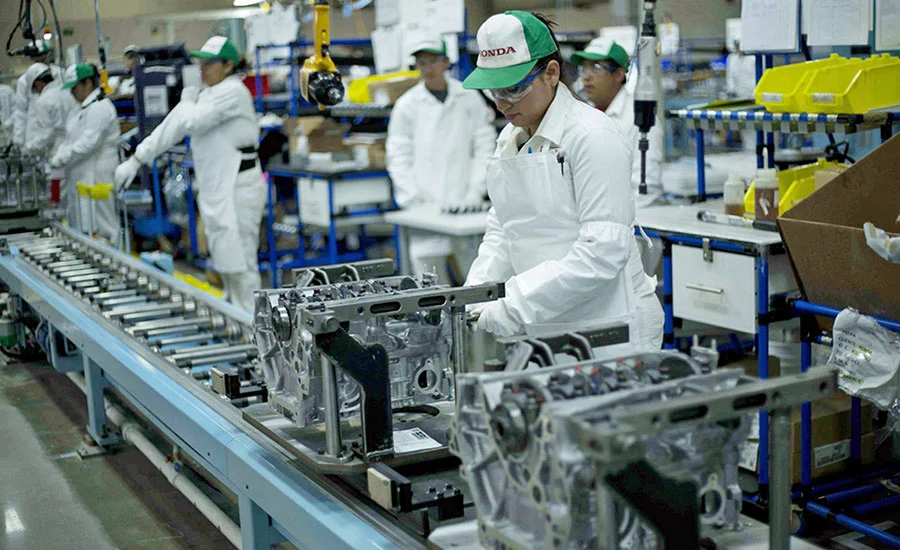
TOKYO – Honda Motor Co. is actively evaluating the feasibility of establishing an eighth automotive assembly plant within the United States, a move signaling a significant strategic realignment towards bolstering its manufacturing footprint in its most crucial market. This consideration comes as the Japanese automaker grapples with near-full production capacity in North America and pivots its sales strategy to emphasize hybrid vehicles over a more aggressive electric vehicle (EV) rollout in the immediate future.
The potential expansion was revealed by Honda President and CEO Toshihiro Mibe during an interview with the prominent Japanese newspaper Yomiuri Shimbun. Mibe underscored North America’s indispensable role in Honda’s global operations, stating that additional manufacturing capacity in the region is essential to meet anticipated demand and fortify the company’s market position. This introspection into its production capabilities arrives at a pivotal moment for Honda, as it navigates evolving consumer preferences, complex trade policies, and the broader industry’s transition towards sustainable mobility.
Strategic Imperative: Strengthening North American Presence
North America stands as the bedrock of Honda’s global sales, consistently accounting for over 40 percent of the company’s worldwide unit shipments. This dominant share underscores the strategic importance of the region, not just as a sales market but also as a production hub. Mibe explicitly stated his ambition to "significantly increase sales volume" in North America, a goal that is directly contingent on expanding production capabilities beyond current limits. The executive’s remarks highlight a proactive approach to prevent capacity from becoming a bottleneck to growth.
Honda’s existing manufacturing infrastructure in North America is substantial, comprising 10 automotive assembly plants: seven in the United States, one in Canada, and two in Mexico. Beyond these, the company also operates three additional U.S. facilities dedicated to assembling ATVs, power equipment, and even jets, showcasing a diverse industrial presence. However, despite this extensive network, the U.S. automotive plants collectively produced 928,679 units in 2025, operating at what Mibe described as "almost full capacity." This operational intensity leaves little room for flexibility, making the company vulnerable to market fluctuations or unexpected demand surges. "Without a buffer, we cannot make a comeback," Mibe reportedly explained, emphasizing the need for strategic excess capacity to absorb shocks and enable responsive market adjustments.
The Pivot to Hybrids: A Realistic Approach to Electrification
A key element of Honda’s revised strategy, which directly informs its manufacturing considerations, is a recalibration of its approach to vehicle electrification in the U.S. market. In a notable announcement earlier this year, Honda confirmed it had halted the development of new electric vehicles specifically for the U.S., opting instead to prioritize and strengthen sales of hybrid vehicles. This decision, as articulated by Mibe, reflects a pragmatic assessment of the current state of the U.S. EV market. "The era of EVs in the U.S. will not come in five years," he conceded, suggesting that the pace of EV adoption, infrastructure development, and consumer readiness is slower than initially projected. He further asserted that the decision to pause EV development was "correct when considering the whole picture," implying a holistic view of market dynamics, profitability, and resource allocation.
This strategic pivot positions hybrid vehicles as a crucial bridge technology for Honda. The market for hybrids has shown robust growth, driven by consumers seeking improved fuel efficiency without the range anxiety or charging infrastructure concerns associated with pure EVs. Honda’s long-standing expertise in hybrid technology, exemplified by models like the CR-V Hybrid and Accord Hybrid, provides a strong foundation for this renewed focus. Increasing hybrid vehicle production would directly support this strategy, allowing Honda to capitalize on current market demand while continuing to invest in future EV technologies at a more measured pace. A new U.S. plant could be instrumental in scaling up hybrid powertrain and vehicle assembly, aligning production with the revised product roadmap.
Economic and Policy Considerations: Tariffs and Profitability
Mibe also highlighted the complex interplay between production strategy, profitability, and U.S. tariff policies. He explained that Honda’s overarching strategy is to "produce where there is demand," a principle that logically favors expanding production within the high-demand North American market. However, he also pointed out the "difficulty of making profits due to U.S. tariff policies." This statement alludes to the various trade barriers and import duties that can increase the cost of components or finished vehicles imported into the U.S., impacting the company’s bottom line.
U.S. trade policies, including those related to Section 232 (steel and aluminum tariffs), Section 301 (tariffs on goods from certain countries, particularly China), and the stipulations within agreements like the United States-Mexico-Canada Agreement (USMCA), significantly influence automotive manufacturing decisions. The USMCA, for instance, mandates specific rules of origin for vehicles to qualify for duty-free trade within the bloc, often encouraging greater North American content. Building more vehicles locally helps mitigate tariff risks, streamlines supply chains, and can qualify vehicles for consumer incentives under acts like the Inflation Reduction Act (IRA), which promotes domestic manufacturing of EVs and their components, though Honda’s current focus is on hybrids. While the IRA primarily targets EVs, the general sentiment towards supporting domestic production extends to the broader automotive sector, making a U.S. plant a strategic asset for navigating trade complexities.
This emphasis on local production is further underscored by Honda’s recent financial performance. Earlier this year, the company reported its first annual loss since becoming a publicly traded entity in Japan in 1957. This loss was attributed to significant restructuring charges and write-downs, primarily after a reassessment and retrenchment of its EV strategy. The financial setback reinforces the urgency for Honda to optimize its operations, reduce costs associated with trade barriers, and align production with profitable market segments. A new U.S. plant, while a substantial investment, could ultimately contribute to long-term profitability by localizing production and reducing exposure to import duties and currency fluctuations.
A Legacy of U.S. Manufacturing: Honda’s Pioneering Role
Honda has a long and storied history of manufacturing in the United States, a legacy that began with its groundbreaking decision to establish a motorcycle plant in Marysville, Ohio, in 1979. This was followed in 1982 by the opening of its first U.S. automobile assembly plant, also in Marysville, making Honda the first Japanese automaker to produce cars in America. This pioneering move set a precedent for other international automakers and fundamentally reshaped the U.S. automotive manufacturing landscape.
Over the decades, Honda has steadily expanded its U.S. footprint, establishing additional assembly plants in Ohio (East Liberty), Alabama (Lincoln), and Indiana (Greensburg), alongside engine and transmission facilities. These operations have not only contributed significantly to local economies through job creation and investment but have also integrated Honda deeply into the American industrial fabric. The company’s cumulative investment in U.S. manufacturing facilities totals billions of dollars, supporting tens of thousands of direct and indirect jobs across its supply chain.
This deep historical commitment to U.S. production provides a strong foundation for the consideration of an eighth plant. It signals a continuity of strategy to build vehicles where they are sold, fostering closer ties with American consumers and mitigating risks associated with international logistics and trade policies. The potential new plant would extend this legacy, further cementing Honda’s role as a major contributor to U.S. manufacturing.
Broader Industry Trends and Competitive Landscape
Honda’s strategic deliberations occur within a dynamic global automotive industry characterized by rapid technological change, evolving regulatory landscapes, and intense competition. While many competitors, particularly domestic automakers like General Motors and Ford, as well as foreign rivals like Hyundai-Kia and Volkswagen, are heavily investing in and rapidly scaling up EV production, Honda’s more cautious EV approach and renewed focus on hybrids distinguish its immediate strategy.
Toyota, another Japanese automotive giant, has historically championed a multi-pathway approach to electrification, emphasizing hybrids as a key component of its strategy alongside EVs and hydrogen fuel cell vehicles. Honda’s recent shift aligns more closely with Toyota’s long-held perspective, suggesting a shared understanding among some Asian automakers regarding the practicalities and challenges of a full-scale, rapid EV transition. This approach acknowledges the current limitations of EV infrastructure, higher upfront costs for consumers, and the continuing strong demand for efficient gasoline and hybrid models.
The decision to expand U.S. manufacturing capacity also reflects a broader industry trend towards regionalization of supply chains and production. Geopolitical tensions, the lessons learned from the COVID-19 pandemic-induced supply chain disruptions, and governmental incentives for domestic production have all contributed to automakers increasingly seeking to localize manufacturing closer to their end markets. A new Honda plant in the U.S. would not only serve the North American market but also strengthen regional supply chains, making them more resilient and efficient.
Potential Economic Impact and Analyst Perspectives
The establishment of a new automotive assembly plant represents a monumental investment, typically running into the billions of dollars. Such a project would generate substantial economic benefits, including thousands of direct manufacturing jobs, along with numerous indirect jobs in the supply chain, logistics, and supporting services. Local economies in the chosen state and county would experience a significant boost through increased tax revenues, infrastructure development, and an influx of new residents and businesses. States with robust automotive manufacturing ecosystems, such as Ohio, Indiana, Alabama, Tennessee, South Carolina, and Michigan, would likely be prime candidates, offering skilled labor pools and established supplier networks.
Industry analysts are likely to view Honda’s consideration of an eighth U.S. plant as a pragmatic and strategically sound move. It demonstrates a commitment to its most profitable market, a realistic assessment of market demand for different powertrain technologies, and a proactive approach to mitigating supply chain risks and trade policy challenges. While some might question the slower pace of EV development, the focus on hybrids is seen as a financially prudent bridge strategy that caters to current consumer preferences and ensures profitability.
This expansion would also underscore Honda’s long-term commitment to the North American market, signaling confidence in its economic stability and consumer base. It would enable Honda to better compete with rivals by reducing lead times, customizing products for local tastes, and potentially lowering overall production costs by avoiding tariffs. Furthermore, the added capacity would provide the necessary flexibility to respond to future shifts in demand, whether for hybrid, gasoline, or eventually, a more robust electric vehicle lineup.
Conclusion: A Strategic Investment in the Future
Honda Motor Co.’s exploration of an eighth U.S. automotive assembly plant is more than just a potential expansion; it is a clear articulation of its strategic vision for the North American market. Driven by near-full capacity utilization, a pragmatic shift towards bolstering hybrid sales, and a desire to navigate complex trade policies, this potential investment represents a calculated move to reinforce Honda’s competitive position. By producing closer to its largest customer base, Honda aims to enhance profitability, improve supply chain resilience, and lay a robust foundation for sustainable growth in an evolving automotive landscape, ensuring it remains a dominant force in one of the world’s most critical automotive markets for decades to come.