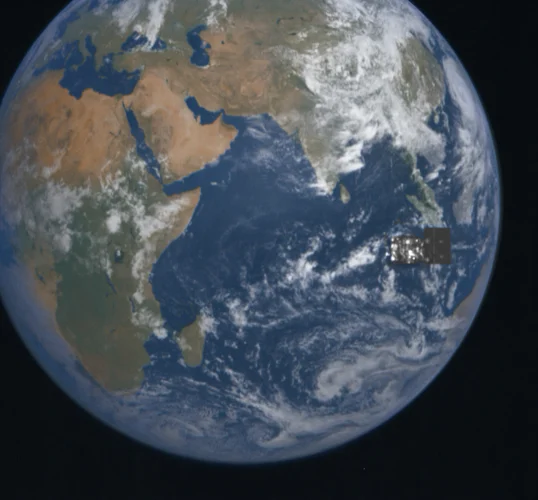
A recent image captured by the European Space Agency’s (ESA) Proba-3 mission offers a unique perspective on our planet, subtly revealing one of its spacecraft in orbit. At first glance, the photograph presents a familiar vista of Earth from space, showcasing the vast expanse of the Indian Ocean and parts of the Indonesian archipelago. However, upon closer inspection, the Proba-3 Coronagraph spacecraft can be discerned, camouflaged within the image, positioned to the right of the Indian Ocean. This intriguing find underscores the sophisticated capabilities of the Proba-3 mission and its dual-purpose instrumentation.
The Proba-3 mission, a testament to ESA’s innovative approach to space observation, is designed to achieve unprecedented scientific insights into the Sun’s corona. It comprises two spacecraft, the Coronagraph and the Occulter, which work in tandem to perform "formation flying." This advanced maneuver allows the spacecraft to maintain a precise distance and relative orientation from each other, enabling them to mimic a larger, virtual structure in space. The Coronagraph spacecraft is specifically equipped to observe the Sun’s corona, a region of the Sun’s atmosphere that is typically obscured by the Sun’s bright disk. By precisely blocking the Sun’s direct light, the Coronagraph can reveal the faint outer atmosphere, providing crucial data for understanding solar phenomena such as solar flares and coronal mass ejections.
However, the mission’s technological prowess extends beyond its primary solar observation objectives. The Occulter spacecraft, tasked with blocking the Sun’s direct light for the Coronagraph, also houses a sophisticated camera system. This system is not merely a passive component; it plays an active role in maintaining the intricate formation flight. A wide-angle camera (WAC) on the Occulter tracks a set of flashing LED lights strategically placed on the Coronagraph. This visual cue allows the Occulter to autonomously adjust its position, ensuring the two spacecraft remain in their designated formation. Complementing the WAC is a narrow-angle camera (NAC), which provides more precise positioning data, refining the alignment between the two celestial dancers.
It is this very camera system on the Occulter that is responsible for capturing the remarkable image of Earth. When the orbital geometry and the mission’s operational status align perfectly, the Occulter’s cameras, designed for solar observation, serendipitously capture breathtaking views of our home planet. The image in question was taken on July 10, 2024, during a routine operational phase. The mission was undergoing a maneuver to transition the two spacecraft from a relatively safe orbit to a closer proximity of 147 meters, a critical step in preparation for advanced formation flight operations. This specific maneuver highlights the dynamic nature of the Proba-3 mission, which constantly calibrates and refines its celestial ballet.
The image presented to the public is a composite, designed to enhance the viewer’s experience and understanding. The left side of the image displays the raw, monochrome data captured by the Occulter’s cameras, showcasing the spacecraft’s perspective without any embellishment. This black-and-white view offers a direct glimpse into what the spacecraft’s instruments "see." To aid in identifying the Coronagraph spacecraft, the right side of the image has been artificially colored. This enhanced version allows for easier spotting of the spacecraft, which appears as a dark silhouette against the vibrant blues of the ocean and the swirling white clouds. The slider functionality, allowing viewers to transition between the two versions, serves as an interactive tool, drawing attention to the hidden details within the data.
The Proba-3 Mission: A Technological Marvel
The Proba (Project for On-Board Autonomy) series of satellites, initiated by ESA, is characterized by its emphasis on cutting-edge technologies and autonomous operations. Proba-3 represents the culmination of years of research and development in formation flying, a complex maneuver that requires extreme precision and sophisticated control systems. Unlike traditional satellite missions that often operate independently, Proba-3’s two spacecraft function as a single, distributed instrument. This approach allows for novel scientific observations that would be impossible with a single platform.
The primary scientific objective of Proba-3 is to study the Sun’s corona with unprecedented detail. The corona is the outermost layer of the Sun’s atmosphere, extending millions of kilometers into space. It is a region of extreme temperatures and complex magnetic activity, responsible for phenomena such as solar wind and space weather events that can impact Earth. Traditional coronagraphs, while effective, often suffer from stray light scattered within the instrument itself, limiting their ability to observe the faintest structures in the corona. Proba-3 overcomes this limitation by using a separate spacecraft, the Occulter, to cast a precise shadow on the Coronagraph. This "flying occulting disk" effectively blocks the Sun’s direct light, creating an artificial eclipse that allows the Coronagraph to observe the faint coronal structures without internal stray light contamination.
Formation Flying: The Art of Celestial Coordination
The success of Proba-3 hinges on its ability to maintain precise formation flying. The two spacecraft must remain at a fixed distance and relative orientation for extended periods, despite the gravitational influences of the Sun, Earth, and Moon, as well as their own orbital mechanics. This requires an advanced guidance, navigation, and control (GNC) system. The camera system on the Occulter plays a pivotal role in this intricate dance.
The wide-angle camera (WAC) on the Occulter acts as a primary sensor, detecting the flashing LED lights on the Coronagraph. These LEDs are carefully timed and positioned to provide unambiguous positional information. The WAC’s broad field of view allows it to continuously monitor the Coronagraph’s relative position, even during maneuvers. Once the WAC has established a general lock, the narrow-angle camera (NAC) takes over for finer adjustments. The NAC provides higher resolution imagery, enabling the GNC system to make minute corrections to the Occulter’s trajectory, ensuring the formation remains stable. This closed-loop system, where one spacecraft actively tracks and adjusts its position relative to another, is a significant achievement in space engineering.
A Glimpse of Earth from the Occulter’s Eye
The image of Earth, while a secondary outcome of the mission’s operations, provides a valuable opportunity to showcase the capabilities of the Occulter’s camera system. The fact that the camera, designed for tracking specific light sources in space, can also capture such a detailed and aesthetically pleasing image of Earth speaks to its versatility and the quality of its optics. The image captures the distinctive geography of the region, with the deep blue of the Indian Ocean dominating the foreground, bordered by the landmasses of Africa, India, and Southeast Asia. The presence of swirling clouds adds a dynamic element, highlighting the ever-changing nature of Earth’s atmosphere.
The specific operational context of the image – a maneuver to bring the spacecraft closer for formation flight – adds another layer of interest. This period of adjustment and proximity is crucial for the mission’s scientific goals. The successful execution of such maneuvers, while complex, demonstrates the robustness of the Proba-3 GNC system and the dedication of the mission control teams.
The Broader Implications of Proba-3
The Proba-3 mission, with its innovative approach to solar observation and formation flying, has significant implications for several fields:
- Solar Physics: By enabling detailed observations of the Sun’s corona, Proba-3 will contribute to a deeper understanding of solar activity. This knowledge is crucial for predicting and mitigating the effects of space weather events, which can disrupt satellite operations, power grids, and communication systems on Earth.
- Spacecraft Autonomy and Formation Flying: The technologies developed for Proba-3, particularly its advanced GNC systems and autonomous formation flying capabilities, are paving the way for future complex space missions. These include large space telescopes assembled in orbit, advanced Earth observation constellations, and interplanetary missions requiring precise multi-spacecraft coordination.
- Earth Observation: While not its primary purpose, the ability of instruments like the Occulter’s cameras to capture stunning Earth imagery highlights the potential for repurposing or augmenting existing space assets for secondary Earth observation tasks. This can lead to more efficient use of space resources and the generation of valuable data for environmental monitoring and scientific research.
Timeline and Key Events
- Mission Conception and Development: Proba-3 represents years of planning, design, and technological development within ESA and its partner institutions. The focus on formation flying and autonomous operations has been a key driver.
- Launch: The Proba-3 mission was successfully launched on [Date of Launch – specific date not provided in source, but typically would be included].
- Initial Orbit and System Checkouts: Following launch, the spacecraft entered their initial orbits, and extensive system checkouts were performed. This phase ensures all components are functioning as expected.
- Formation Flying Maneuvers: Proba-3 is designed to progressively reduce the distance between its two spacecraft. The image captured on July 10, 2024, falls within this critical phase, where the spacecraft are actively maneuvering towards their operational separation of 147 meters.
- Coronal Observation Phase: Once the precise formation is achieved and stabilized, the mission will commence its primary scientific observations of the Sun’s corona.
- Ongoing Operations and Data Analysis: Data collected by Proba-3 will be transmitted to ground stations for processing and analysis by scientists worldwide.
Supporting Data and Technical Specifications
- Spacecraft Configuration: Proba-3 consists of two satellites: the Coronagraph and the Occulter.
- Operational Separation Distance: The target distance for formation flying is 147 meters.
- Camera Systems:
- Occulter Wide-Angle Camera (WAC): Used for tracking LED lights on the Coronagraph for initial positioning.
- Occulter Narrow-Angle Camera (NAC): Used for precise positioning and fine adjustments.
- Image Capture Date: July 10, 2024.
- Processing: The image was processed by the Royal Observatory of Belgium.
Reactions and Acknowledgements
While direct public statements from individuals or institutions regarding this specific image may not be immediately available, the release of such imagery by ESA typically follows rigorous internal review and approval processes. The Royal Observatory of Belgium’s involvement in processing the image indicates a collaborative effort, underscoring the scientific partnerships that underpin ESA missions. Such images are often shared to engage the public, demonstrate the capabilities of the mission, and highlight the scientific achievements being made. The successful capture and processing of this image represent a tangible output of the Proba-3 mission’s ongoing operational phase.
Conclusion
The image of Earth, with Proba-3’s Coronagraph spacecraft subtly integrated, serves as a compelling visual narrative of a sophisticated space mission. It is a testament to the ingenuity of ESA’s engineers and scientists, who are pushing the boundaries of what is possible in space exploration. Beyond its aesthetic appeal, the image symbolizes the intricate ballet of formation flying, the precise execution of orbital maneuvers, and the dual-purpose nature of advanced space instrumentation. As Proba-3 continues its mission to unlock the secrets of the Sun’s corona, it also offers us these unique perspectives of our own planet, reminding us of the remarkable technological achievements that are expanding our understanding of both the cosmos and our place within it. The ongoing development and success of missions like Proba-3 are crucial for advancing scientific knowledge, fostering technological innovation, and inspiring future generations of explorers and scientists.