In 1985, a seemingly modest advertisement in Scientific American by the Innovative Design Fund sparked an idea that, while initially unfulfilled, has now been resurrected and significantly advanced by researchers at the Massachusetts Institute of Technology (MIT). The advertisement offered up to $10,000 to support innovative prototypes in clothing, home decor, and textiles. William Freeman PhD ’92, then an electrical engineer at Polaroid and now a distinguished professor at MIT, was captivated by the call for novel designs. He submitted a groundbreaking concept: a three-sided zipper. Unlike conventional zippers used to close seams, Freeman envisioned a mechanism that could act as a dynamic switch, seamlessly transitioning objects like chairs, tents, and purses between soft, pliable states and rigid, stable forms. This innovation promised enhanced portability and simplified assembly for a wide range of products.
Freeman’s original blueprint bore a striking resemblance to a traditional zipper, with the key divergence being its triangular configuration. Each of the three sides was equipped with a belt designed to interlock narrow, wooden "teeth." A sliding component, engineered to encircle the entire device, could be moved to secure the three strips, effectively straightening them into a triangular tube. While this ingenious proposal was ultimately rejected by the Innovative Design Fund, Freeman, undeterred, proceeded to patent his prototype. The meticulously crafted device was then carefully stored in his garage, a testament to his foresight and belief in its future utility.
Nearly four decades later, a team of researchers at the MIT Computer Science and Artificial Intelligence Laboratory (CSAIL) embarked on a mission to revive Freeman’s visionary concept. Their objective was to develop objects with "tunable stiffness," a capability that had eluded previous attempts due to limitations in reversibility and manual assembly. The CSAIL team’s ambitious endeavor culminated in the creation of an automated design tool and an adaptable fastener they dubbed the "Y-zipper." This sophisticated software program empowers users to customize three-sided zippers, which are then meticulously fabricated using 3D printing technology with advanced plastics. These versatile Y-zippers are poised to revolutionize the assembly of diverse items, from camping equipment and medical gear to robotics and intricate art installations, by offering unprecedented convenience and adaptability.
A Novel Approach to Dynamic Assembly
Jiaji Li, an MIT postdoc and CSAIL researcher and lead author of an open-access paper detailing the project, explained the fundamental difference between traditional zippers and Freeman’s innovation. "A regular zipper is great for closing up flat objects, like a jacket, but Freeman ideated something more dynamic," Li stated. "Using current fabrication technology, his mechanism can transform more complex items." The CSAIL team’s breakthrough lies in their developed process, which enables the creation of objects capable of rapid transitions between flexible and rigid states, with a high degree of confidence in their real-world functionality.
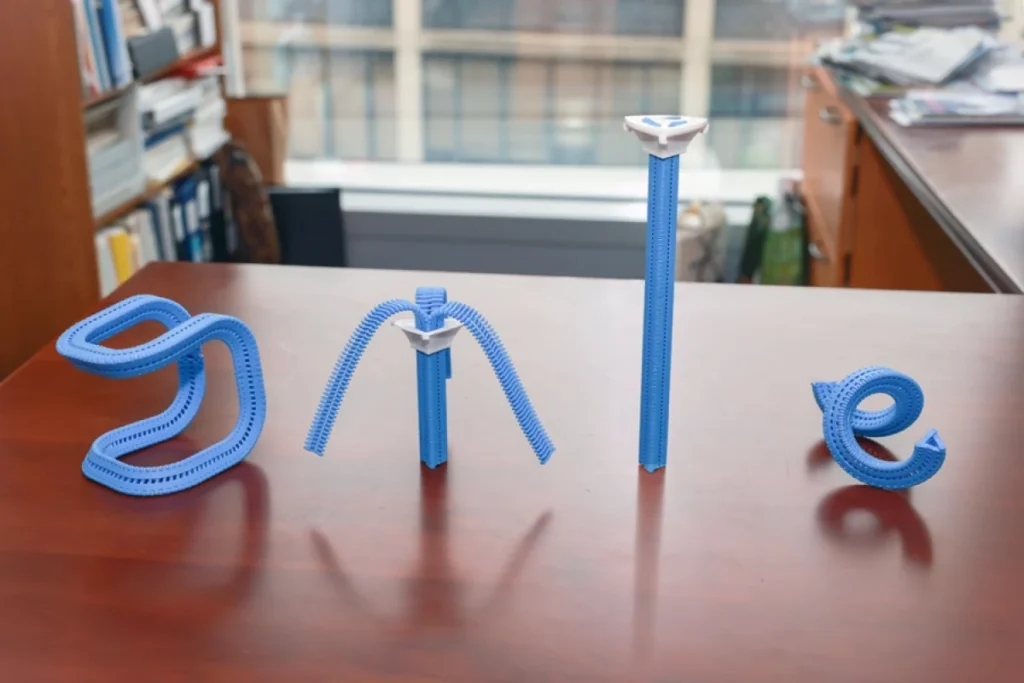
The Y-zipper’s appeal lies not only in its mechanical ingenuity but also in its user-centric design and remarkable versatility. Through CSAIL’s intuitive software, users gain the ability to customize the visual appearance of the fasteners when zipped. This customization extends to controlling the length of each strip, as well as the precise direction and angle at which they will bend. Furthermore, users can select from four distinct motion "primitives" to dictate the zipper’s form when engaged: straight, bent (forming an arch), coiled (resembling a spring), or twisted (mimicking a screw thread).
Transforming Everyday Objects and Enabling New Technologies
The resulting Y-zipper exhibits a captivating "shape-shifting" capability in practical applications. When unzipped, it can unfurl into a form reminiscent of a squid with three splayed tentacles. Upon activation, it transforms into a more compact structure, such as a rod. This inherent flexibility holds immense potential for streamlining activities, particularly during travel. Consider the process of pitching a tent, which can typically take up to six minutes. With the assistance of a Y-zipper, this task can be reduced to a mere one minute and twenty seconds. By attaching each arm of the zipper to a side of the tent and supporting the structure from above, the Y-zipper can effectively "pop" the canopy into its erected position.
This seamless transition from a flexible state to a rigid structure also opens doors for more adaptable wearable technology, particularly in critical medical scenarios. The research team demonstrated this by wrapping a Y-zipper around a wrist cast. This innovation allows a user to loosen the cast during the day for comfort and then zip it up at night to prevent further injury. This ability to transform a seemingly rigid device into a more accommodating and adjustable one can significantly enhance patient comfort and cater to individual therapeutic needs.
The Y-zipper system is also instrumental in empowering users to craft technology that responds dynamically to commands. By integrating a motor with the Y-zipper post-fabrication, the zipping process can be automated. This capability is crucial for the development of adaptive robotic systems, such as a robotic quadruped. Such a robot could potentially alter the size of its legs, extending them to achieve greater height for traversing challenging terrain or retracting them to lower its profile. This rapid adjustability could prove invaluable for robots exploring uneven environments like canyons or forests. Furthermore, actuated Y-zippers can be employed to create dynamic art installations. In one compelling example, the CSAIL team designed a long, winding flower sculpture that "bloomed" as a static motor activated the Y-zipper, causing it to contract and unfurl petals.
Mastering Material Durability for Real-World Application
While Li and his colleagues recognized the immense creative and functional potential of the Y-zipper, a crucial question remained: its durability. Could these innovative fasteners withstand the rigors of daily use and demanding applications? To address this, the team conducted a series of rigorous stress tests.
The initial phase of testing focused on evaluating the strength and flexibility of two commonly used 3D printing plastics: polylactic acid (PLA) and thermoplastic polyurethane (TPU). Using a specialized machine designed to bend the Y-zippers, researchers determined that PLA exhibited superior load-bearing capabilities, while TPU offered greater pliability.
In a subsequent experiment, CSAIL researchers employed an actuator to continuously cycle the Y-zipper through its open and close motions to ascertain its breaking point. The results were remarkably promising. After an astonishing 18,000 cycles of zipping and unzipping, the Y-zipper finally succumbed. The secret to this impressive longevity, as revealed by 3D simulations, lies in the zipper’s inherent elastic structure, which effectively distributes stress across the material, preventing localized failure.
Despite these encouraging findings, Li expressed his vision for even more robust three-sided zippers, potentially incorporating stronger materials like metal. He also acknowledged the current limitations of their 3D printing platform, which restricts the creation of larger-scale zippers for more extensive projects.
Future Frontiers and Broader Implications
The potential applications for the Y-zipper extend far beyond current demonstrations. Jiaji Li pointed to unexplored frontiers, such as space exploration, where the Y-zipper’s tentacle-like extensions could be integrated into spacecraft to precisely grasp nearby rock samples. The zippers could also be embedded in structures designed for rapid deployment, offering invaluable assistance to relief workers in quickly establishing shelters or medical tents during natural disasters and rescue operations.
The innovative nature of this research has garnered attention from the broader scientific community. Guanyun Wang, an assistant professor at Zhejiang University who was not involved in the paper, lauded the project. "Reimagining an everyday zipper to tackle 3D morphological transitions is a brilliant approach to dynamic assembly," Wang remarked. "More importantly, it effectively bridges the gap between soft and rigid states, offering a highly scalable and innovative fabrication approach that will greatly benefit the future design of embodied intelligence."
The comprehensive research paper detailing the Y-zipper project was authored by Jiaji Li and William Freeman, alongside Tianjin University PhD student Xiang Chang. Contributing to the work from MIT CSAIL were PhD student Maxine Perroni-Scharf, undergraduate Dingning Cao, and recent visiting researchers Mingming Li (Zhejiang University), Jeremy Mrzyglocki (Technical University of Munich), and Takumi Yamamoto (Keio University). The research was further guided by MIT Associate Professor Stefanie Mueller, a CSAIL principal investigator and senior author on the study. The project received crucial support from a postdoctoral research fellowship from Zhejiang University and the MIT-GIST Program.
The groundbreaking findings and advancements of this research were formally presented at the ACM’s renowned Computer-Human Interaction (CHI) conference on Human Factors in Computing Systems, held in April. This presentation marked a significant milestone, introducing the Y-zipper to a global audience of researchers and industry professionals, and underscoring its potential to reshape how we design, assemble, and interact with the physical world. The journey from a 1980s advertisement to a cutting-edge MIT innovation highlights the enduring power of creative vision and the relentless pursuit of technological advancement.