The fundamental laws of physics often appear to be in direct conflict with the observable reality of our Universe, creating a paradox that has challenged scientists for over a century. On one hand, the second law of thermodynamics dictates that entropy—a measure of disorder or the distribution of information—must always increase in an isolated system, leading eventually to a state of uniform heat and total lack of structure. On the other hand, the history of the cosmos is a story of increasing organization, where primordial gas clouds collapsed to form galaxies, stars ignited to forge heavy elements, and complex biological life emerged on planetary surfaces. A new theoretical study led by Professor Ginestra Bianconi, a mathematician at Queen Mary University of London, offers a potential resolution to this "entropy puzzle" by suggesting that gravity itself may be an emergent phenomenon rooted in the very thermodynamic principles that seemingly forbid such complexity.
The Thermodynamic Challenge of Cosmological Evolution
To understand the significance of Professor Bianconi’s work, one must first grasp the weight of the second law of thermodynamics. Albert Einstein famously lauded this principle as the most secure of all physical laws, suggesting that while other theories might be superseded, the second law would never be overthrown. In its simplest form, the law states that the total entropy of the Universe must increase over time. If the early Universe began in a state of high density and low entropy—often referred to as the "Past Hypothesis"—the natural progression should be toward a "heat death," where energy is so widely and evenly distributed that no work can be performed and no structures can exist.
However, the observable Universe presents a different narrative. Since the Big Bang approximately 13.8 billion years ago, matter has not merely drifted apart into a featureless void; it has clumped together into intricate webs of cosmic filaments. This localized reduction in entropy—where matter becomes highly organized—must be balanced by an even greater increase in entropy elsewhere to satisfy the second law. While standard cosmology accounts for this through the expansion of space and the release of radiation, the specific mechanism that allows gravity to drive this organization while remaining consistent with thermodynamics has remained a subject of intense debate.
The Framework of Gravity from Entropy
Published in the journal Physical Review D, Professor Bianconi’s research utilizes a framework known as Gravity from Entropy (GfE). This approach belongs to a broader school of thought in theoretical physics that views gravity not as a fundamental "force" in the Newtonian sense, nor solely as the geometric curvature of spacetime as described by Einstein, but as an "emergent" property. This perspective suggests that gravity arises from the collective behavior of microscopic quantum states of information, much like how the concept of "temperature" emerges from the collective motion of molecules in a gas.
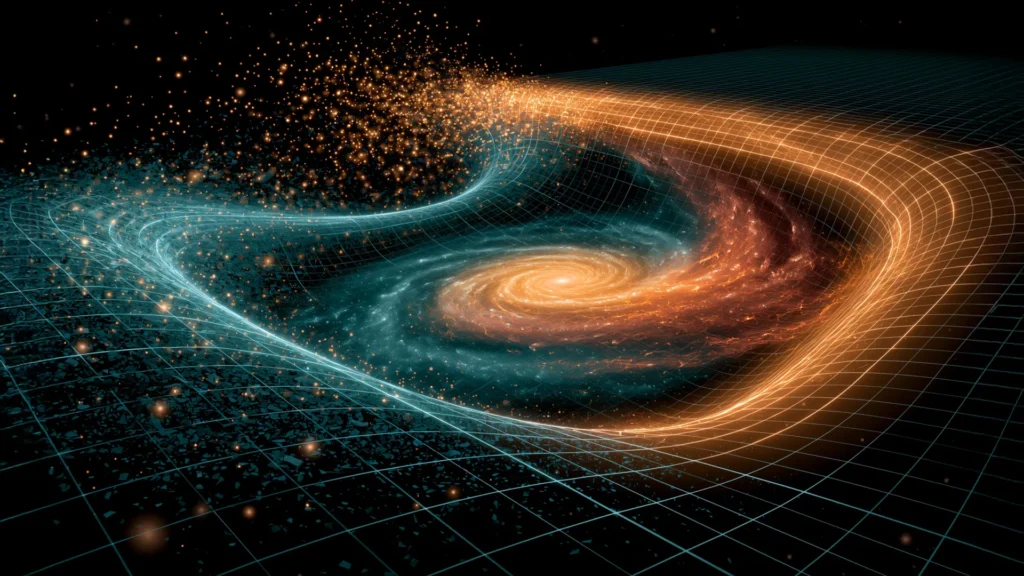
The GfE theory posits that gravity is the result of an informational "tension" between two distinct mathematical structures, or metrics. In general relativity, a metric is the tool used to calculate distances and define the geometry of spacetime. Bianconi’s model introduces a dual-metric system: the actual physical spacetime metric and a second metric produced by the presence of matter fields and the curvature of spacetime itself. The interaction between these two metrics is governed by what is known as the GfE Lagrangian, defined by the Quantum Geometric Relative Entropy (QGRE).
A Chronology of Thermodynamic Gravity
The idea that gravity and heat are inextricably linked is not entirely new, but it has evolved significantly over the last five decades. This chronology provides the necessary context for Bianconi’s latest contribution:
- The 1970s: The Black Hole Revolution: Jacob Bekenstein and Stephen Hawking famously discovered that black holes possess entropy and emit radiation. This was the first definitive proof that the laws of gravity (General Relativity) and the laws of heat (Thermodynamics) were connected at a fundamental level.
- The 1990s: The Holographic Principle: Gerard ‘t Hooft and Leonard Susskind proposed that all the information contained within a volume of space can be described by the data on the boundary of that space. This suggested that spacetime might be a projection of underlying informational states.
- 2010: Entropic Gravity: Physicist Erik Verlinde proposed that gravity is not a fundamental force but an entropic force caused by changes in the information associated with the positions of material objects.
- 2024: The GfE Synthesis: Professor Bianconi’s work advances these ideas by applying them to the evolution of the entire Universe, specifically addressing how complexity can arise during cosmic expansion.
The Volume Element: How Expansion Dilutes Disorder
The core discovery of Bianconi’s analysis lies in the distinction between "total entropy" and "local entropy density." According to the GfE framework, as the Universe expands, its total volume increases. This expansion is the key to the paradox. While the total entropy of the entire Universe continues to rise—satisfying the second law of thermodynamics—the amount of entropy per unit of volume actually decreases.
This "dilution" of entropy means that as space grows, the local environment becomes more capable of sustaining organized structures. In mathematical terms, the Quantum Geometric Relative Entropy (QGRE) represents the local entropy per unit of volume. As the Universe’s physical metric expands the volume element, the QGRE declines. This provides a theoretical "clearance" for matter to undergo self-organization into stars and galaxies without violating the universal mandate for increasing total disorder.
Dynamic Dark Energy and Cosmological Implications
One of the most provocative aspects of Bianconi’s research is its potential to explain Dark Energy, the mysterious force causing the expansion of the Universe to accelerate. In standard General Relativity, Dark Energy is often represented by the Cosmological Constant ($Lambda$), a fixed value that does not change over time. However, the GfE equations suggest a different reality.
At low energies and in regions of weak spacetime curvature, GfE perfectly replicates the predictions of Einstein’s General Relativity. But in more extreme conditions or across vast cosmological timescales, the GfE equations produce a dark energy contribution that is dynamic—it changes as the Universe evolves. This dynamic term acts as a form of "internal energy" within the thermodynamic description of spacetime.
This finding has significant implications for observational cosmology. If Dark Energy is dynamic rather than constant, it would influence the rate at which galaxies cluster and the way the Cosmic Microwave Background (CMB) radiation is distributed. These are effects that future astronomical surveys, such as those conducted by the Euclid space telescope or the Vera C. Rubin Observatory, might be able to detect.
Supporting Data and Theoretical Foundations
The study utilizes Friedmann-Robertson-Walker (FRW) spacetimes, which are the standard mathematical models for an expanding, homogeneous, and isotropic Universe. Within this framework, Bianconi demonstrated that the local geometric components of spacetime follow a version of the first law of thermodynamics: $dU = TdS – PdV$.
In this emergent thermodynamic system:
- Internal Energy ($U$): Corresponds to the dynamic dark energy contribution.
- Entropy ($S$): Corresponds to the Quantum Geometric Relative Entropy (QGRE) per unit volume.
- Temperature ($T$) and Pressure ($P$): Arise naturally as emergent properties of the quantum state of spacetime.
This mathematical alignment suggests that the Universe is not just a stage where thermodynamics happens, but is itself a thermodynamic system. The "heat" of spacetime and the "information" of geometry are two sides of the same coin.
Expert Analysis and Broader Impact
While the GfE theory is still in its early stages, it offers a bridge between several disparate fields of physics. By reconciling the second law of thermodynamics with the emergence of complexity, Bianconi has addressed a philosophical and physical hurdle that has persisted since the mid-19th century.
"This work reveals how the Gravity from Entropy theory can tackle the challenging question to reconcile the second principle of thermodynamics with the emergence of complexity in our Universe," Professor Bianconi stated regarding the implications of the study. She further noted that the results could provide a foundation for understanding "cosmological irreversibility"—the reason why time flows in one direction and why the Universe moves from a simple start to a complex present.
The broader scientific community views such "emergent gravity" theories with cautious optimism. If gravity is indeed entropic, it would simplify the quest for a "Theory of Everything" by providing a common language (information theory) for both Quantum Mechanics and General Relativity. Furthermore, the link to the emergence of life suggests that the biological complexity we observe on Earth is not a cosmic accident but a localized manifestation of the Universe’s fundamental thermodynamic evolution.
Future Outlook
The next phase of this research will likely involve testing the GfE model against high-precision cosmological data. If the predicted dynamic dark energy signature matches observations better than the standard Cosmological Constant model, it could trigger a paradigm shift in our understanding of the cosmos.
For now, the study stands as a robust mathematical proof that order can indeed arise from a law that demands disorder. It suggests that the Universe’s expansion is not just a thinning out of matter, but a sophisticated process of information redistribution that creates the necessary room for galaxies, stars, and eventually, the observers who seek to understand them. In the framework of Gravity from Entropy, the rise of complexity is not a defiance of the laws of nature, but a natural consequence of the way space, time, and information are woven together.