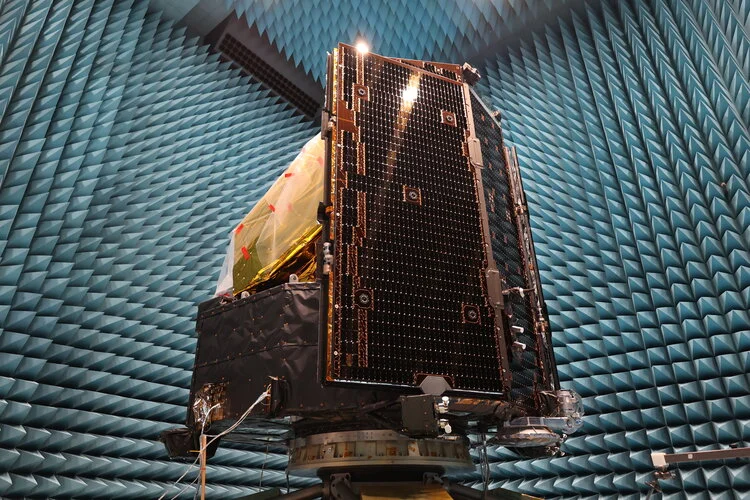
The European Space Agency’s (ESA) groundbreaking planet-hunting mission, Plato, has successfully navigated a critical phase of its pre-launch preparations, demonstrating its readiness for the rigors of space. The sophisticated terrestrial planet hunter recently underwent a series of rigorous electromagnetic compatibility (EMC) tests within the state-of-the-art Maxwell Test Chamber at ESA’s technical heart, ESTEC in the Netherlands. These tests are paramount, ensuring that the spacecraft’s intricate electronic systems will operate harmoniously and without interference in the unforgiving vacuum of space, a crucial step before its scheduled launch in March 2027.
The Maxwell Test Chamber: A Simulated Cosmic Void
The Maxwell Test Chamber at ESTEC is an engineering marvel designed to replicate the unique electromagnetic environment of space with unparalleled accuracy. The photograph accompanying this development captures Plato positioned majestically at the center of this specialized facility. The chamber itself is a shielded enclosure, meticulously constructed with conducting metal walls, floor, and ceiling. This design effectively creates a Faraday cage, an essential barrier that completely screens out all external electromagnetic interference. This isolation is vital, preventing any unwanted signals from the outside world from influencing the delicate measurements and operations of the spacecraft’s sensitive instruments.
Beyond its electromagnetic shielding capabilities, the chamber’s interior is engineered to mimic the acoustic and absorptive properties of space. Standing an impressive 9 meters high, its entire internal surface, from floor to ceiling, is lined with a dense array of specially designed foam spikes. These spikes are not merely aesthetic; they are acoustically engineered to absorb electrical signals and sound waves. This absorption is critical, as it prevents reflections and echoes that could distort test results and ensures that the chamber’s internal environment closely approximates the silent, signal-absorbing nature of the cosmic void. By eliminating internal reflections and external interference, engineers can confidently assess the true electromagnetic behavior of Plato’s systems.
Rigorous Testing for Unforeseen Consequences
Once the chamber was hermetically sealed, a team of highly skilled engineers initiated a series of remote commands, activating and operating Plato’s comprehensive suite of electronic equipment. The core objective of these tests was to meticulously verify that the spacecraft’s complex array of instruments, modules, and communication systems would not interfere with each other. This detailed examination aims to prevent what is known as "crosstalk" – unintended electromagnetic signals bleeding from one component to another, which could lead to erroneous data, system malfunctions, or even irreparable damage to the sensitive electronics.
The necessity for such stringent testing cannot be overstated. In the extreme vacuum of space, the behavior of electronic components can deviate significantly from their performance in a conventional terrestrial laboratory environment. Factors such as the absence of atmospheric pressure, the presence of cosmic radiation, and the unique thermal conditions can all influence how electronics operate. Without thorough testing in a controlled, space-simulating environment like the Maxwell Test Chamber, these potential deviations could manifest as unforeseen consequences, jeopardizing the mission’s ambitious scientific goals or, in the worst-case scenario, leading to the premature failure of critical equipment.
Electromagnetic Compatibility: The Key to Mission Success
The successful completion of these tests in the Maxwell Test Chamber provides a crucial assurance: Plato’s numerous electronic systems can coexist and operate seamlessly in the harsh environment of space without generating disruptive interference. This confirmation of electromagnetic compatibility (EMC) is a fundamental prerequisite for any space mission. It signifies that the spacecraft is not only designed to withstand the physical stresses of launch and the environmental extremes of space but also that its internal electronic architecture is robust and reliable.
A String of Successes: Plato’s Journey to Launch Readiness
The EMC tests represent the final major hurdle in a comprehensive series of examinations that Plato has been undergoing to achieve launch readiness. This rigorous evaluation began earlier this year, in January, with a series of demanding vibration and acoustic tests. These initial tests subjected the spacecraft to the extreme shaking and noise levels it will experience during the powerful ascent into orbit atop an Ariane 6 rocket. Following these mechanical trials, Plato embarked on a month-long sojourn within the Large Space Simulator (LSS) at ESTEC.
The Large Space Simulator is another critical facility, designed to replicate the thermal vacuum conditions of space. Within this colossal chamber, Plato underwent a battery of tests that simulated the intense solar radiation, extreme cold of shadow, and the vacuum of space. The spacecraft "aced" these demanding tests, demonstrating its resilience and ability to withstand the harsh environmental conditions it will encounter throughout its scientific mission. The successful completion of these LSS tests, along with the recent EMC verification, effectively means Plato has graduated from its pre-launch examination phase.
The Plato Mission: Charting Exoplanetary Landscapes
Plato, which stands for PLAnetary Transits and Oscillations of stars, is ESA’s next cornerstone mission in its ambitious Cosmic Vision program. Its primary objective is to discover and study a multitude of exoplanetary systems, with a particular focus on finding and characterizing rocky planets orbiting within the habitable zones of their stars. The habitable zone is the region around a star where conditions might be just right for liquid water to exist on a planet’s surface – a key ingredient for life as we know it.
The spacecraft will employ the transit method, observing stars for slight dips in their brightness that occur when a planet passes in front of them. However, Plato’s innovative approach goes beyond simply detecting exoplanets. It will also measure the subtle oscillations of the stars themselves, a technique known as asteroseismology. By studying these stellar vibrations, scientists can determine the mass and radius of the host stars with high precision. This precise stellar information, combined with the transit data, will allow Plato to accurately determine the sizes and masses of the transiting planets, providing crucial insights into their composition and density.
A Glimpse into the Future of Exoplanet Discovery
Plato’s mission is expected to yield an unprecedented catalog of exoplanets, significantly expanding our understanding of planetary formation and evolution. The mission is designed to discover hundreds of exoplanets, including potentially dozens of Earth-like planets within the habitable zones of Sun-like stars. The data gathered by Plato will not only contribute to the ongoing search for life beyond Earth but will also provide invaluable context for future, more advanced telescopes and missions. The sheer volume and precision of the data are anticipated to revolutionize our understanding of the diversity of planetary systems in our galaxy.
Launch Preparations and the Ariane 6 Partnership
The successful completion of Plato’s rigorous testing program paves the way for its imminent integration with its launch vehicle. Plato is scheduled to lift off on an Ariane 6 rocket, a testament to the strong collaboration between ESA and Arianespace, the European launch service provider. The launch is meticulously planned by Arianespace for March 2027, marking a significant milestone in Europe’s continued leadership in space exploration. The Ariane 6, a versatile and powerful new-generation launch vehicle, is poised to play a crucial role in delivering Europe’s ambitious scientific missions to orbit.
The choice of Ariane 6 underscores the reliability and capability of European launch systems. This partnership ensures that Plato will have a secure and efficient pathway to its orbital destination, ready to commence its groundbreaking scientific endeavors. As the launch date approaches, further integration activities will take place, including the final assembly of the spacecraft with its upper stage and fairing, all under the watchful eyes of ESA and Arianespace engineers.
Significance of the EMC Tests: A Foundation for Scientific Discovery
The electromagnetic compatibility tests, while perhaps less visually dramatic than the vibration or thermal vacuum simulations, are fundamentally critical. Without them, the mission’s success would be perpetually at risk. The ability of Plato’s sophisticated instruments to operate without mutual interference is as vital as its ability to withstand the physical forces of launch or the temperature extremes of space. This meticulous attention to detail in the pre-flight testing phase is a hallmark of ESA’s commitment to mission assurance and scientific excellence.
The implications of these successful EMC tests extend beyond just Plato. They represent a validation of ESA’s advanced testing facilities and methodologies, which will undoubtedly benefit future missions. The knowledge gained and the processes refined during Plato’s testing will serve as a valuable foundation for the development and verification of subsequent spacecraft. As humanity continues its quest to understand our place in the universe, the robust and reliable operation of our scientific instruments is paramount, and the successful EMC testing of Plato is a significant step in ensuring that this ambitious exoplanet hunter will deliver on its profound promise.