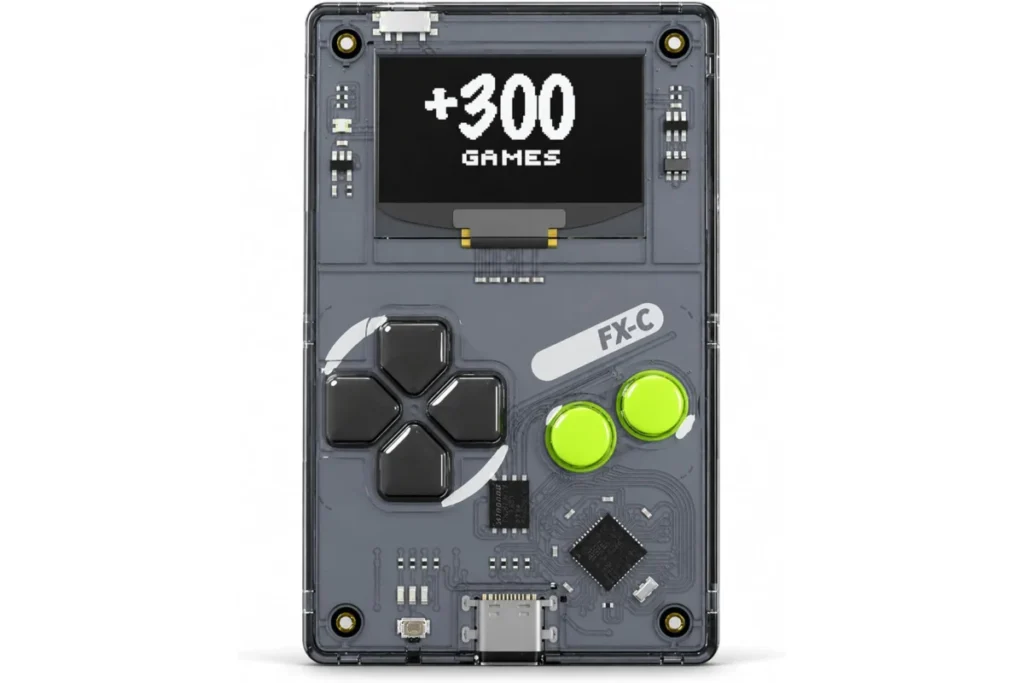
The landscape of handheld gaming has undergone a radical transformation over the last decade, shifting from the dominance of proprietary giants to a flourishing ecosystem of indie hardware and open-source platforms. At the forefront of this movement is the Arduboy, a credit card-sized game console that has consistently punched above its weight class. The latest iteration, the Arduboy FX-C, produced in partnership with Seeed Studio, represents the most refined version of this minimalist vision. Priced at $79, the FX-C manages to balance nostalgia with modern manufacturing standards, offering a library of over 300 community-made games powered by an 8-bit architecture that encourages creativity as much as it does play.
The Evolution of the Arduboy Platform
To understand the significance of the Arduboy FX-C, one must look back at the project’s humble beginnings. Conceived by Kevin Bates, the original Arduboy began as a viral video in 2014 featuring a digital business card that could play Tetris. This concept evolved into a massive Kickstarter campaign in 2015, which raised over $430,000 and established a dedicated community of developers.
The platform’s progression has been marked by a commitment to the "8-bit aesthetic" and the Arduino ecosystem. The original model required users to upload one game at a time via a computer, a limitation that was solved by the introduction of the "FX" (Flash Expansion) version. The FX model added an external flash memory chip, allowing hundreds of games to be stored on the device simultaneously. The new FX-C model further modernizes the hardware by adopting the USB-C standard for charging and data transfer, reflecting the industry’s shift away from Micro-USB while maintaining the ultra-slim form factor that made the original a cult classic.
Technical Specifications and Hardware Architecture
Despite the ubiquity of high-powered microcontrollers like the ESP32 or the Raspberry Pi RP2040, the Arduboy FX-C remains steadfast in its use of the ATMega32u4. This 8-bit AVR microcontroller, while modest by modern standards, provides a standardized environment that ensures every game in the Arduboy library runs exactly as intended.
The hardware specifications of the FX-C include:
- Processor: ATMega32u4 running at 16MHz.
- Memory: 32KB Flash, 2.5KB RAM, 1KB EEPROM.
- Display: 1.3-inch monochromatic OLED with a resolution of 128×64 pixels.
- Storage: 16MB SPI Flash (capable of storing 300+ games).
- Connectivity: USB-C port for programming, charging, and 2-player link cable support.
- Audio: Piezo speaker with software-controlled mute functions.
- Input: Six tactile dome buttons (D-pad and A/B buttons).
- Battery: Thin-film lithium-polymer battery providing approximately 6-8 hours of continuous play.
The monochromatic OLED screen is a standout feature, offering high contrast and clarity that remains legible even in direct sunlight. While the lack of color might seem like a drawback, it serves as a creative constraint for developers, resulting in games that rely on strong art direction and gameplay mechanics rather than visual spectacle.
A Library of 300 Games: Quality Over Quantity
The Arduboy FX-C arrives pre-loaded with over 300 individual games, a feat made possible by the "FX" flash chip. Unlike the "50-in-1" or "99-in-1" bootleg consoles often found in bargain bins—which typically feature five distinct games and dozens of minor palette-swapped variations—the Arduboy library consists of unique, community-developed titles.
The experience of scrolling through the FX-C menu has been compared to playing UFO 50, the acclaimed collection of fictional retro games. On the Arduboy, users can find everything from faithful recreations of classics like Snake and Asteroids to complex, original titles that push the 8-bit hardware to its limits. Notable entries include faux-3D dungeon crawlers, rhythm games, and surprisingly deep RPGs.
The community-driven nature of the software means that the library is constantly expanding. Developers from around the world contribute to the Arduboy Arcade, an online repository where users can download new titles or share their own creations. This ecosystem ensures that the FX-C is not a static product but a gateway to a living archive of indie game development.
The Educational Impact and Maker Philosophy
Beyond its utility as a gaming device, the Arduboy FX-C is designed as a powerful educational tool. It is built on the Arduino platform, making it one of the most accessible entry points for aspiring programmers and game designers. Because the hardware is open-source, the barrier to entry for development is remarkably low.
The "Maker" philosophy is baked into the device’s DNA. By using the Arduino IDE (Integrated Development Environment), a student or hobbyist can write their first line of code and see it manifest as a controllable character on the FX-C screen within minutes. The community has produced extensive documentation, tutorials, and libraries that simplify complex tasks like sprite rendering and collision detection.

This educational aspect is a primary reason for the partnership with Seeed Studio. As a global leader in IoT and hardware manufacturing, Seeed Studio provides the scale necessary to bring the Arduboy to classrooms and maker spaces worldwide. The FX-C serves as a physical manifestation of the "learn by doing" ethos, proving that high-level computer science concepts can be taught through the medium of portable gaming.
Design Considerations and User Feedback
In terms of ergonomics, the FX-C maintains the "credit card" footprint (roughly 85mm x 54mm). It is thin enough to fit inside a standard wallet, though most users prefer to carry it in a pocket or on a keychain. The build quality, handled by Seeed Studio, is robust, featuring a metal backplate that provides rigidity and a premium feel.
However, the pursuit of minimalism does involve certain trade-offs. One point of contention among long-term users is the absence of a physical volume wheel. While the system-inspired hardware of the 1980s and 90s featured analog sliders for audio control, the Arduboy relies on software-level muting. Most games in the library default to a mute mode or offer an in-game toggle, but a hardware switch remains a frequent request for future iterations.
Additionally, the RGB LED—located near the buttons—serves as a multi-purpose indicator for battery life, charging status, and in-game events. While it adds a splash of color to the monochromatic experience, some reviewers have noted that the LED can be excessively bright in dark environments. Given the open-source nature of the device, users have already developed "dimmer" patches, and the hardware itself can be physically modified by those with soldering skills.
Market Positioning and Competitive Analysis
At $79, the Arduboy FX-C occupies a unique niche in the handheld market. It does not attempt to compete with the high-fidelity emulation of devices like the Miyoo Mini or the Anbernic series, nor does it strive for the premium "crank-operated" novelty of the Panic Playdate ($199). Instead, the Arduboy focuses on the "lo-fi" developer experience.
Compared to other 8-bit consoles, the Arduboy’s primary advantage is its size and its community. While devices like the Gamebuino offer similar coding-centric features, they are significantly bulkier. The Arduboy’s ability to be "the console you always have with you" gives it a distinct edge for casual play during commutes or short breaks.
The launch of the "Founders Edition" via the official Arduboy website and the "Standard Edition" through Amazon and Seeed Studio suggests a two-pronged market strategy. The Founders Edition appeals to collectors and early adopters who want to support the project’s creator directly, while the Seeed Studio partnership ensures a steady supply chain for the mass market.
Chronology of the Arduboy Series
The release of the FX-C is the latest milestone in a decade-long timeline:
- 2014: The "Arduboy" prototype is revealed, gaining international media attention.
- 2015: Successful Kickstarter campaign for the original Arduboy.
- 2016: Mass production begins; the device enters retail channels.
- 2017: The Arduboy Tetris MicroCard is released under official license.
- 2020: The "Arduboy FX" is introduced, featuring the W25Q128 16MB flash chip to store the entire library.
- 2022-2023: Development of the "FX-C" begins, focusing on the transition to USB-C and updated manufacturing processes.
- 2024: The Arduboy FX-C officially hits the market, produced in collaboration with Seeed Studio.
Broader Implications for the Gaming Industry
The continued success of the Arduboy platform sends a clear message to the broader gaming industry: there is a significant and growing demand for "transparent" hardware. In an era where modern consoles are increasingly locked down by digital rights management (DRM) and non-serviceable components, the Arduboy FX-C stands as a counter-argument. It is a device that the user truly owns, from the hardware circuits to the source code of the games.
Furthermore, the FX-C highlights the viability of "intentional limitation." By restricting the hardware to 8-bit processing and monochromatic visuals, the platform forces developers to focus on core gameplay loops and innovative mechanics. This "less is more" approach has proven to be a fertile ground for indie developers, many of whom have used the Arduboy as a stepping stone to professional careers in the gaming industry.
Final Assessment
The Arduboy FX-C is more than just a retro-gaming novelty; it is a mature, well-engineered platform that celebrates the intersection of gaming and maker culture. While its tiny buttons and monochromatic screen may not appeal to the "AAA" gaming demographic, its value as an educational tool and a portable library of indie creativity is unmatched.
With the backing of Seeed Studio and a library that continues to grow every week, the Arduboy FX-C ensures that the spirit of the 8-bit era remains alive, portable, and—most importantly—open to everyone. Whether used as a distraction in a waiting room or as a development kit for a first programming project, the FX-C remains a definitive example of what can be achieved when hardware is designed with the community in mind.