The Standard Model of particle physics stands as one of the most successful frameworks in the history of science, providing a comprehensive description of the fundamental particles and the forces—electromagnetic, weak, and strong—that dictate the behavior of the universe. For decades, it has withstood rigorous experimental testing at laboratories across the globe, yet physicists have long recognized that the model is incomplete. It offers no explanation for dark matter, which constitutes the vast majority of the universe’s mass, nor does it account for the observed imbalance between matter and antimatter or the integration of gravity at the quantum scale. These significant gaps suggest the existence of "New Physics"—undiscovered particles or forces that operate beyond the current reach of the Standard Model.
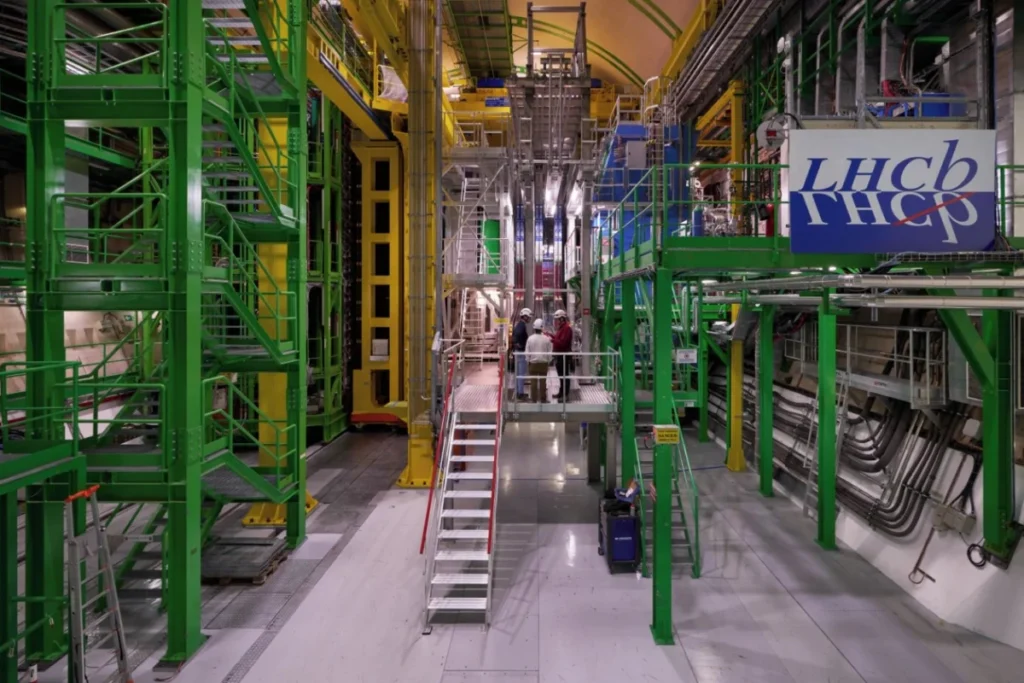
One of the most fertile grounds for identifying these elusive "cracks" in the Standard Model is the study of rare particle decays, specifically those involving the "beauty quark" or "b-quark." At the European Organization for Nuclear Research (CERN), the Large Hadron Collider beauty (LHCb) experiment is dedicated to exploring these phenomena with unprecedented precision. Recent findings published in Physical Review Letters have reignited excitement within the scientific community, revealing a four-standard deviation discrepancy in the angular distribution of decay products from B mesons. This result, led in part by researchers from the Massachusetts Institute of Technology (MIT), suggests that the universe may be hiding secrets that the Standard Model cannot yet reveal.
The Foundation of Particle Physics and the Search for New Frontiers
To understand the weight of the current LHCb findings, one must first appreciate the role of the Standard Model. Developed in the mid-20th century, the model classifies all known elementary particles, such as quarks (which form protons and neutrons) and leptons (such as electrons and neutrinos). It also describes how these particles interact via gauge bosons, the "force carriers." While the Higgs boson discovery in 2012 completed the Standard Model’s particle roster, the theory remains a "low-energy" approximation of a more fundamental reality.
The quest for New Physics often involves looking for particles that are too massive to be created directly, even in the high-energy collisions of the Large Hadron Collider (LHC). However, these heavy, undiscovered particles can still make their presence known through quantum effects. In the quantum world, "virtual" particles can briefly emerge and disappear within the loops of a decay process, subtly altering the behavior of the particles we can see. This is precisely why the decay of beauty quarks is of such high interest; their rarity and complexity make them highly sensitive to the presence of these hidden quantum influences.
The Role of the Beauty Quark in High-Energy Physics
The beauty quark is a third-generation quark, significantly heavier than the up and down quarks that comprise ordinary matter. Because of its high mass, it possesses a unique set of decay channels that are particularly susceptible to New Physics. Many theoretical extensions of the Standard Model, such as Supersymmetry or models involving Leptoquarks, suggest that new forces or particles might couple more strongly to heavier quarks.
The specific decay under scrutiny is the transition of a B meson (a particle containing a beauty antiquark) into a K meson (containing a strange quark) and two muons (heavy cousins of the electron). In the Standard Model, this process—denoted as $B to K^mu^+mu^-$—is extremely rare because it requires a "flavor-changing neutral current," a process that can only occur through complex quantum loops.
Because the Standard Model predicts this decay to be so infrequent, even a tiny contribution from a non-Standard Model particle could result in a measurable shift in the decay’s properties. Specifically, researchers look at the angular distribution—the directions in which the decay products fly apart. If the measured angles do not match the mathematical predictions of the Standard Model, it serves as a "smoking gun" for new physical laws.
The Significance of the Four-Sigma Discrepancy
In the realm of particle physics, the "sigma" ($sigma$) scale is the gold standard for measuring the statistical significance of a result. A one-sigma or two-sigma result is often dismissed as a statistical fluke. However, a four-sigma result is a major milestone. As Eluned Smith, an assistant professor of physics at MIT and a lead researcher on the project, explains, a four-sigma discrepancy corresponds to a p-value of approximately 0.003 percent. This means that if the Standard Model were an absolute and perfect description of reality, there is only a 3 in 100,000 chance that this specific data pattern would occur by accident.
While the "five-sigma" threshold is traditionally required to claim an official "discovery," four-sigma is considered "strong evidence." The importance of this specific measurement is amplified by the fact that it is not an isolated incident. Over the past decade, several measurements of beauty-quark decays have shown similar tensions. When multiple independent measurements point in the same direction, the likelihood that the discrepancy is a result of New Physics—rather than a statistical error—increases significantly.
Chronology of Flavor Anomalies at the Large Hadron Collider
The journey toward this four-sigma result has been a decade-long endeavor characterized by incremental progress and rigorous verification.
- 2013-2015: Early analyses of Run 1 data at the LHCb experiment first hinted at an anomaly in the angular distribution of $B to K^*mu^+mu^-$ decays, often referred to as the "$P_5’$ anomaly."
- 2017-2019: Follow-up studies with larger datasets confirmed that the tension remained, though theoretical uncertainties regarding "hadronic effects" (the complex behavior of quarks within mesons) made it difficult to definitively claim a breakdown of the Standard Model.
- 2021-2022: The LHCb collaboration released results regarding "Lepton Flavor Universality," suggesting that B mesons might decay into electrons and muons at different rates, which would violate a core tenet of the Standard Model. While some later refined analyses showed these specific ratios to be closer to Standard Model predictions than previously thought, the angular distribution anomalies persisted.
- 2024: The latest analysis, performed independently by two separate teams to ensure maximum objectivity, utilized refined theoretical models and the full dataset from the LHC’s second run. The resulting four-sigma discrepancy represents the most precise and robust measurement of this angular tension to date.
Technological Innovation: AI and the Future of LHCb
The ability to detect such subtle deviations requires not only massive amounts of data but also sophisticated technology to process it. The LHC produces millions of collisions per second, creating a "data deluge" that is impossible to store in its entirety. To manage this, the LHCb experiment uses a "trigger" system to decide in real-time which events are worth keeping and which should be discarded.
As the LHC enters its third run (Run 3), the LHCb detector has undergone a massive upgrade. The hardware-based trigger has been replaced with a fully software-based system. This allows for more complex algorithms to analyze particle tracks instantly, enabling the experiment to record beauty decays at a much higher rate.
Looking forward, Eluned Smith and her colleagues at MIT are developing low-latency artificial intelligence systems. These AI models are designed to perform data processing and compression directly on the "front-end" electronics of the detector. By processing data at the source, researchers can handle the even higher collision rates expected in future upgrades, potentially increasing the experiment’s sensitivity by a factor of 40 compared to the original design.
Theoretical Challenges and the Path Toward Discovery
While the experimental evidence for a discrepancy is strong, the scientific community remains cautious. One alternative explanation for the four-sigma result is that our theoretical understanding of the "strong force" (Quantum Chromodynamics, or QCD) is not yet precise enough.
The quarks inside B mesons and K* mesons are bound together by gluons, and the math required to calculate these interactions is notoriously difficult. If physicists have slightly underestimated the complexity of these internal dynamics, the "discrepancy" might simply be a calculation error rather than New Physics. To resolve this, theoretical physicists are using "Lattice QCD"—massive supercomputer simulations—to refine the Standard Model predictions. The convergence of more precise data from the LHCb and more precise calculations from theorists will be the deciding factor in the coming years.
Global Implications for the Scientific Community
The implications of confirming New Physics through beauty quark decays would be transformative. It could provide the first concrete evidence for particles like the "Z-prime" boson or "leptoquarks," which could bridge the gap between quarks and leptons. Such a discovery would provide a roadmap for the next century of physics, potentially offering clues into the nature of dark matter or the origins of the universe’s matter-antimatter asymmetry.
Furthermore, the LHCb is not alone in this search. The Belle II experiment in Japan is also studying beauty quark decays using a different method (electron-positron collisions). If Belle II observes the same four-sigma discrepancy, the case for New Physics will become nearly undeniable.
As the LHC continues its current run, the world’s physics community watches closely. Whether this four-sigma tension eventually reaches the five-sigma threshold of discovery or fades as theoretical models improve, it has already pushed the boundaries of human knowledge and technological capability. For now, the beauty quark remains one of our best windows into the unknown, suggesting that the "Standard Model" is merely the beginning of a much larger and more complex story of the cosmos.