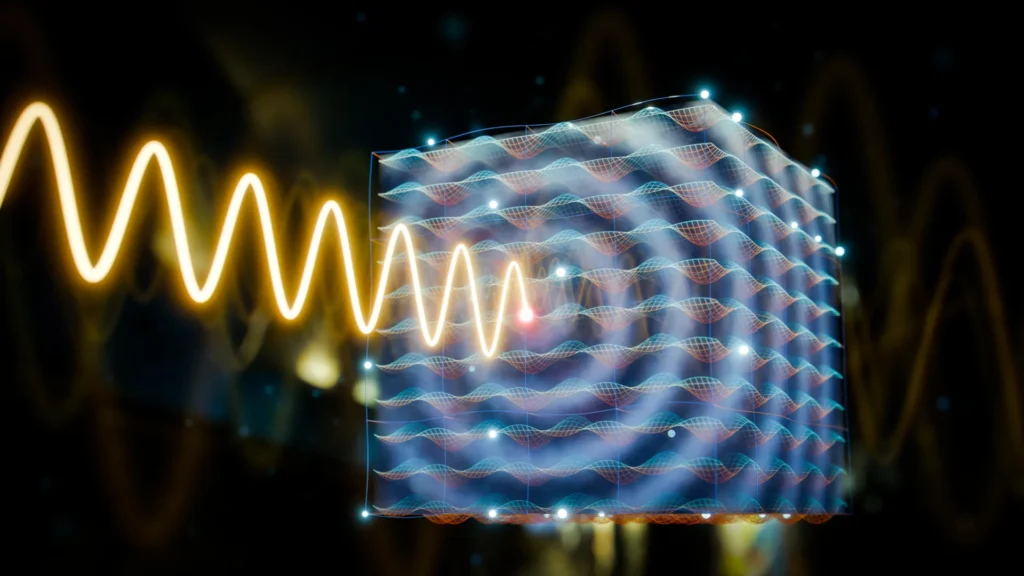
In a landmark achievement for the fields of condensed matter physics and ultrafast optics, an international collaboration of scientists has successfully engineered the first all-optical photonic time crystal (PTC). This new class of material, which modulates its optical properties rapidly and periodically over time, represents a significant leap forward in our ability to manipulate light. The research, published in the prestigious journal Nature, was conducted by a multidisciplinary team from École Polytechnique, the Collège de France, and the Helmholtz-Zentrum Dresden-Rossendorf (HZDR) in Germany. By utilizing the high-intensity terahertz radiation provided by HZDR’s TELBE facility, the researchers have opened a new dimension in photonics, potentially paving the way for the next generation of ultrafast computers, 6G telecommunications, and advanced medical imaging systems.
The Evolution of Photonic Control: From Space to Time
To understand the significance of a photonic time crystal, one must first look at the history of conventional photonic crystals. For decades, scientists have used materials with spatially repeating structures—often referred to as optical lattices—to control the flow of photons. These traditional photonic crystals function much like semiconductors do for electrons; by arranging materials with different refractive indices in a specific pattern, researchers can create "photonic bandgaps" that block certain wavelengths of light while allowing others to pass. This technology is the backbone of modern fiber-optic communications and laser systems.
However, these spatial crystals are inherently static. Once the physical structure of the material is set, its optical properties remain fixed. The concept of a "time crystal" was first theorized by Nobel laureate Frank Wilczek in 2012, describing a state of matter where the atoms repeat a pattern not just in space, but in time. Extending this to photonics, a photonic time crystal is a material whose refractive index or reflectivity changes uniformly and periodically across its entire volume at extremely high speeds.
The primary challenge in creating a PTC has always been the speed of modulation. To influence light effectively, the material’s properties must change on a timescale comparable to a single oscillation of the light wave itself. In the terahertz range, this requires changes occurring within picoseconds (trillionths of a second). The team’s success in achieving this "all-optical" modulation marks the first time such a feat has been recorded, moving the concept from theoretical physics into experimental reality.
Bridging the Terahertz Gap
The research specifically targeted the terahertz (THz) frequency range, a segment of the electromagnetic spectrum located between microwave electronics and infrared photonics. Often referred to as the "Terahertz Gap," this region has historically been difficult to exploit because it is too high-frequency for traditional transistors and too low-frequency for conventional optical lasers.
Yannis Laplace, an assistant professor at École Polytechnique and a lead researcher at the Laboratory of Irradiated Solids (LSI), emphasizes that the THz range is the frontier of modern technology. Terahertz waves can penetrate many non-conducting materials—such as clothing, paper, and wood—and are non-ionizing, making them safer for biological imaging than X-rays. Furthermore, because THz frequencies are roughly 1,000 times faster than the gigahertz frequencies used in today’s electronics, they hold the key to massive increases in data transmission speeds.
"The THz range represents the frontier between electronic and photonic technologies," Laplace explained. "It is a range full of opportunities both for science and for society, yet is still under-developed technologically compared to its electrical and photonic counterparts. Creating photonic crystals could lead the way to the closing of this gap."
Engineering the Metamaterial: A Masterpiece of Nanotechnology
The physical platform for this breakthrough is a sophisticated "plasmonic metamaterial." Developed with the expertise of Thales’ Laboratoire Albert Fert and the Physics of Interfaces (PICM) laboratory at Polytechnique, the device consists of a complex multi-layered architecture.
At its core, the material features micrometer-scale gold structures, resembling the crenelated battlements of a medieval castle, deposited onto an insulating layer. Beneath this lies a semiconductor substrate composed of indium and antimony (InSb). This specific arrangement creates tiny optical cavities that "trap" light between the gold and the semiconductor.
When the semiconductor is excited by an external energy source, it generates "surface plasmons"—coherent oscillations of electrons at the interface between the metal and the semiconductor. These plasmons couple with the trapped photons, allowing the researchers to manipulate the light-matter interaction with unprecedented precision. By rapidly altering the density of electrons in the semiconductor, the team could change the entire material’s optical response almost instantaneously.
The Critical Role of the TELBE Facility
The experimental realization of the PTC would have been impossible without the TELBE superradiant terahertz source at HZDR’s ELBE accelerator in Dresden. To achieve the required "time-crystal" effect, the researchers needed a light source that was not only intense but also phase-stable and tunable.
The TELBE facility provided high-field terahertz pulses that could be synchronized with the material’s internal oscillations. Jan-Christoph Deinert, the coordinator of the TELBE facility, noted that the infrastructure’s ability to generate coherent, ultrafast modulation was the linchpin of the project. The pulses from the TELBE source acted as a "pump," driving the metamaterial into the photonic time crystal regime.
During the experiment, the team observed that the material’s reflectivity changed with a magnitude and speed never before seen. The shift in optical properties was so drastic it could be compared to an object suddenly changing its color entirely, yet this transformation occurred in less than a picosecond—a billionth of a billionth of a second.
Theoretical Validation and the Reduction of Dissipation
To interpret the complex data generated by the experiment, Marco Schiró, a Research Scientist at the Collège de France, developed a robust theoretical model. This model was essential for understanding how photons behave when the rules of their environment are changing in mid-flight.
One of the most significant findings of the study was the effect of the PTC regime on energy loss. In traditional optical systems, "dissipation" occurs when photons are absorbed by the material or scattered in unwanted directions. Schiró’s calculations, confirmed by the experimental results, showed that the periodic temporal modulation of the material actually cut photon dissipation in half.
"The theory not only reproduces the experiment but also provides the basis for guiding future discoveries in this system," Schiró stated. By reducing the energy lost as heat or leakage, the PTC becomes a much more efficient medium for light amplification, which is a prerequisite for creating new types of lasers.
Chronology of the Discovery
The path to the first all-optical PTC was a multi-year journey involving several phases of research:
- Initial Discovery (Pre-2020): The team established that external stimuli like temperature and magnetic fields could influence the light-trapping capabilities of plasmonic metamaterials.
- Theoretical Framework (2021-2022): Researchers at Collège de France and École Polytechnique developed the mathematical models suggesting that rapid temporal modulation could lead to a time-crystal state.
- Material Fabrication (2022-2023): Collaboration with Thales and PICM led to the creation of the gold-InSb metamaterial capable of supporting surface plasmons at THz frequencies.
- Experimental Testing at HZDR (2023): The team utilized the TELBE facility to apply ultrafast THz pulses to the metamaterial, successfully observing the first all-optical PTC signatures.
- Publication (2024): The findings were peer-reviewed and published in Nature, marking the official debut of the technology.
Broader Implications and Future Technology
The successful creation of a photonic time crystal has far-reaching implications for several sectors of technology and science:
Ultrafast Computing
Current electronic computers are limited by the speed at which electrons can move through silicon. Optical computers, which use photons instead of electrons, could theoretically operate at the speed of light. The ability to switch optical properties on picosecond timescales is a fundamental requirement for the "optical logic gates" that would power such machines.
6G and Beyond
As the world moves toward 6G telecommunications, the industry is looking at THz frequencies to provide the necessary bandwidth for holographic communication and massive IoT (Internet of Things) networks. PTCs could serve as highly adaptable switches and modulators for these future networks, allowing for data transfer rates that are orders of magnitude higher than current 5G standards.
Advanced Lasing and Medical Imaging
By further reducing dissipation and increasing the number of trapped photons, this technology could lead to the development of "self-amplifying" terahertz lasers. These lasers would be invaluable for medical diagnostics, capable of identifying specific molecules in the skin or tissues without the risks associated with ionizing radiation.
Quantum Information Science
The ability to control the "time dimension" of light offers a new playground for quantum physics. PTCs could potentially be used to create entangled states of light or to protect quantum information from decoherence, a major hurdle in the development of practical quantum computers.
Conclusion
The production of the first all-optical photonic time crystal is more than just a laboratory curiosity; it is a fundamental expansion of the toolkit available to physicists and engineers. By proving that a material can be manipulated in time as easily as it can be structured in space, the team from École Polytechnique, Collège de France, and HZDR has set the stage for a revolution in how we interact with the electromagnetic spectrum.
Looking ahead, the research team aims to refine the device to achieve even stronger light amplification. Lead author Tingwen Guo, a PhD student at École Polytechnique, summarizes the potential: "By extending photonic crystals from space to time, we open a new dimension for light control—and a novel path toward amplification and lasing. That could be a game-changer for optical technologies at terahertz frequencies and beyond." As this technology moves from the accelerator facility to the manufacturing lab, the "Terahertz Gap" may soon become the most productive region of the spectrum for 21st-century innovation.