The field of high-energy astrophysics has entered a transformative era with the discovery of a previously invisible phase of short gamma-ray bursts (GRBs). On July 4, 2025, the Einstein Probe (EP) satellite, a mission led by the Chinese Academy of Sciences (CAS) in collaboration with the European Space Agency (ESA) and the Max Planck Institute for Extraterrestrial Physics (MPE), detected a signal designated as EP250704a, also known as GRB 250704B. This event has provided the first direct evidence of a prolonged soft X-ray "aftermath" that follows the initial violent collision of compact objects, such as neutron stars. By exposing a ten-minute window of activity that traditional instruments have historically missed, the Einstein Probe has effectively revealed a hidden chapter in the life cycle of stellar remnants.
Short gamma-ray bursts are among the most energetic and violent phenomena in the known universe. Astronomers have long theorized that these bursts occur when two compact objects—typically a pair of neutron stars or a neutron star and a black hole—spiral toward each other due to gravitational radiation. As they merge, they release a colossal amount of energy in the form of gravitational waves and a brief, intense flash of gamma rays. Until now, these events were primarily defined by their brevity, usually lasting less than two seconds. However, the data gathered from EP250704a suggests that the "short" nature of these bursts may be an observational bias caused by the limitations of previous-generation gamma-ray detectors.
Chronology of a Cosmic Collision
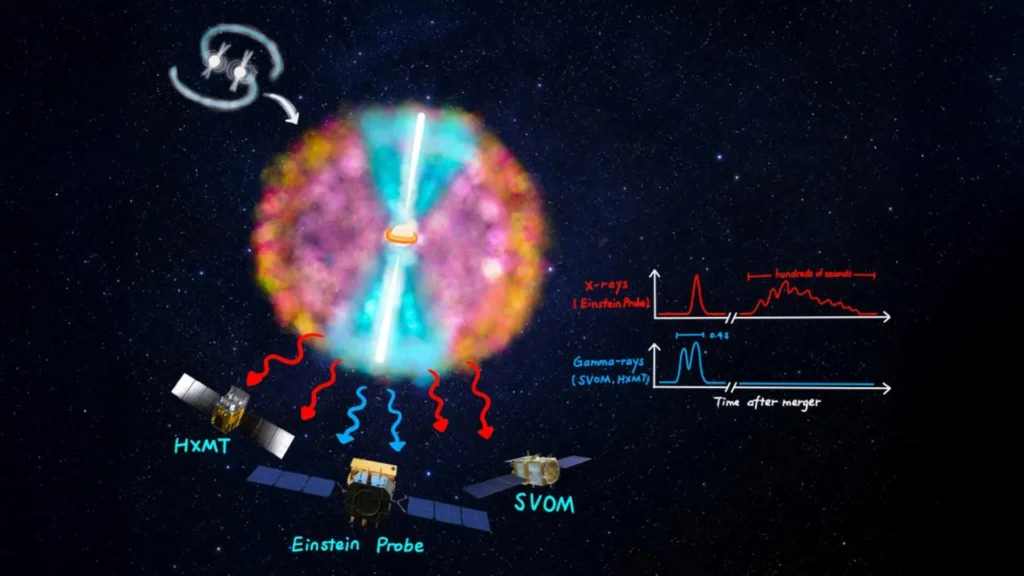
The detection of EP250704a occurred during a routine monitoring session on July 4, 2025. An Li, a doctoral researcher at Beijing Normal University and the Transient Advocate for the Einstein Probe mission, was the first to identify the signal. The event began with a classic "prompt" phase—a bright, high-energy flash lasting less than half a second. This initial spike was captured simultaneously by three major instruments: the Space-based multi-band Variable Object Monitor (SVOM-GRM), the Insight-Hard X-ray Modulation Telescope (Insight-HXMT), and the Einstein Probe’s Wide-field X-ray Telescope (EP-WXT).
Under normal circumstances, a short GRB would fade rapidly, leaving behind a faint afterglow that is difficult to track without immediate repositioning of narrow-field telescopes. However, the EP-WXT, which utilizes innovative "lobster-eye" optics to maintain a wide field of view in the soft X-ray spectrum, observed something unprecedented. Instead of the signal vanishing into the cosmic background, the source continued to emit energetic soft X-rays for nearly ten minutes. This extended emission was not a mere afterglow caused by the blast wave hitting surrounding gas; it was a primary emission originating from the central engine itself.
Following the initial alert, a global mobilization of astronomical resources took place. Within hours, ground-based and space-based observatories across the electromagnetic spectrum were directed toward the coordinates of EP250704a. This coordinated effort was designed to capture the fading light of the explosion and identify the environment in which it occurred.
The Technical Challenge of Soft X-ray Detection
The reason this ten-minute phase remained hidden for decades lies in the specific wavelengths of the light emitted. Conventional gamma-ray instruments, such as the Burst Alert Telescope (BAT) on NASA’s Neil Gehrels Swift Observatory, are optimized for "hard" high-energy radiation. While these instruments are excellent at catching the initial "pop" of a GRB, they are often blind to "soft" X-rays—photons with lower energy and longer wavelengths.
Professor Bin-Bin Zhang of Nanjing University, a co-corresponding author of the study, explained that the spectrum of the extended emission in EP250704a was exceptionally soft. At typical cosmological distances, such a signal would fall below the sensitivity threshold of standard gamma-ray monitors. Consequently, if this event had occurred a decade ago, astronomers would have recorded the half-second gamma-ray flash and assumed the event was over, missing the entire ten-minute sequence of internal activity. The Einstein Probe’s ability to monitor large swaths of the sky in the soft X-ray band (0.5–4.0 keV) has effectively filled a massive gap in the observational record of the universe.
Evidence for a Magnetar Central Engine
The most significant question raised by EP250704a was the nature of the object left behind after the merger. Traditionally, it was assumed that most neutron star mergers result in the immediate formation of a black hole. However, the data from this event suggests a different outcome. Yi-Han Iris Yin, a PhD student at the University of Hong Kong and a lead analyst for the high-energy data, noted that the rapidly changing brightness and evolving spectrum of the ten-minute emission point toward a "live" central engine.
The leading hypothesis among the research team is that the merger produced a magnetar—a highly magnetized, rapidly rotating neutron star. Unlike a black hole, which would swallow surrounding matter and go quiet relatively quickly, a magnetar can continue to pump energy into its surroundings through its intense magnetic field and rotational kinetic energy. This "energy injection" explains why the X-ray emission remained so energetic long after the initial burst of gamma rays had ceased.
The presence of a magnetar has profound implications for nuclear physics. Neutron stars are composed of the densest matter in the universe, and their "equation of state"—the mathematical description of how matter behaves under such extreme pressure—remains one of the greatest mysteries in modern science. If a merger can produce a stable or even a short-lived magnetar rather than collapsing immediately into a black hole, it provides strict constraints on how much mass a neutron star can support before failing.
A Global Multi-Wavelength Campaign
To confirm that the signal was indeed a compact object merger and not a different type of stellar explosion, such as a supernova, the team relied on a multi-wavelength analysis. Professor Eleonora Troja of the University of Rome "Tor Vergata" led the effort to obtain the redshift of the event through spectroscopic analysis. By measuring the expansion of light from the burst’s host galaxy, the team determined its distance and confirmed it was a cosmological event, not a local phenomenon.
The coordinated observations included:
- Optical Telescopes: Searched for a "kilonova"—the radioactive glow of heavy elements like gold and platinum being forged in the merger.
- Radio Observatories: Monitored the long-term interaction of the explosion’s shockwave with the interstellar medium.
- X-ray Follow-up: Utilized the Einstein Probe’s Follow-up X-ray Telescope (FXT) to provide higher-resolution imaging of the fading source.
This comprehensive data set allowed the researchers to rule out a supernova origin. Supernovae are associated with the collapse of massive stars and typically produce "long" GRBs lasting dozens of seconds. The combination of a short initial burst followed by a magnetar-driven X-ray tail is a unique signature of a compact object merger, providing a "smoking gun" for the nature of EP250704a.
Implications for Multi-Messenger Astronomy
The discovery of this soft X-ray component is a landmark moment for multi-messenger astronomy—a field where scientists combine data from electromagnetic radiation (light) and gravitational waves (ripples in spacetime). Since the historic 2017 detection of GW170817, where both gravitational waves and light were seen from a single neutron star merger, astronomers have been searching for more "counterparts" to gravitational wave events.
The Einstein Probe’s findings suggest that soft X-ray transients may be more common than previously thought. As gravitational wave detectors like LIGO, Virgo, and KAGRA become more sensitive, they will detect mergers that are further away or oriented in ways that make their gamma-ray flashes difficult to see. In such cases, the long-lasting soft X-ray emission revealed by EP250704a could serve as a vital beacon, allowing astronomers to pinpoint the location of mergers that would otherwise remain "dark" to traditional telescopes.
Furthermore, this discovery suggests that many historical "short" GRBs may have had similar soft X-ray tails that went undetected. This could mean that the total energy output of neutron star mergers has been consistently underestimated, and the diversity of the remnants they leave behind—black holes versus magnetars—is much broader than once believed.
The Future of the Einstein Probe Mission
The Einstein Probe was launched in January 2024 with the specific goal of surveying the sky for transient X-ray sources. Its success in identifying EP250704a validates its unique design, which uses wide-field optics inspired by the compound eyes of lobsters. This technology allows the satellite to see a large area of the sky at once while maintaining the sensitivity needed to detect faint, soft X-ray signals.
As the mission continues, the scientific community expects the Einstein Probe to uncover even more classes of transient phenomena, from tidal disruption events (stars being torn apart by black holes) to the elusive electromagnetic counterparts of black hole mergers. For the study of neutron stars, the probe has opened a new window into the "hidden phase" of their collisions, providing a direct look at the immediate aftermath of some of the most extreme events in the cosmos.
In the words of Professor Bin-Bin Zhang, the Einstein Probe has demonstrated that the universe is "richer and more complex" than our current models often suggest. By looking where others could not, the mission has not only solved a decades-old mystery regarding the duration of short GRBs but has also provided a new tool for understanding the fundamental laws of physics under conditions that can never be replicated on Earth.