The landscape of fundamental physics research is constantly evolving, driven by both groundbreaking theoretical insights and ingenious technological advancements. While some discoveries stem from entirely novel inventions, many others emerge from the clever recombination of existing technologies, yielding capabilities far exceeding their individual components. This strategic synergy is now poised to revolutionize particle detection, particularly in the challenging quest for weakly interacting particles like neutrinos and elusive dark matter candidates. These particles are notoriously difficult to observe due to their infrequent interactions with ordinary matter, necessitating increasingly large, complex, and expensive detectors to capture their faint signals.
The Quest for Elusive Particles: Current Challenges in Detection
For decades, the pursuit of elementary particles has relied on detectors designed to reconstruct the three-dimensional (3D) paths of particles as they traverse vast volumes of dense material. The predominant method involves scintillators – materials that emit tiny flashes of visible light when a charged particle passes through them. Scientists meticulously analyze these light flashes to deduce a particle’s trajectory and interaction points. To achieve the requisite precision, these scintillators are typically segmented into millions of small, active sections. Optical fibers then funnel the photons produced in each section to highly sensitive sensors, such as photomultiplier tubes (PMTs) or silicon photomultipliers (SiPMs), which count the individual photons.
This segmented approach has been instrumental in groundbreaking experiments worldwide. For instance, the T2K neutrino-oscillation experiment in Japan, a collaborative effort involving hundreds of scientists from 12 countries, utilizes a detector containing approximately two tons of sensitive material, meticulously constructed from some two million individual scintillator cubes and interwoven with 60,000 optical fibers. Similarly, experiments like LHCb at CERN and Mu3e at the Paul Scherrer Institute push the boundaries of spatial resolution, achieving sub-millimeter precision by deploying millions of thin scintillating optical fibers. These sophisticated systems are testament to the power of segmented detectors, enabling pivotal discoveries such as neutrino oscillations and precise measurements of particle properties.
However, this success comes at a significant and escalating cost. As the ambition for larger detectors to enhance the probability of rare particle interactions grows, the manufacturing, assembly, and readout of millions of individual components become an immense technological and financial bottleneck. The intricate wiring, calibration, and maintenance of such vast arrays of discrete elements not only drive up costs but also introduce considerable complexity and potential points of failure. The sheer volume of data generated by millions of sensors also presents formidable computational challenges, demanding advanced processing capabilities to reconstruct particle events accurately. This scaling problem has prompted a critical need for a more elegant and efficient approach to high-resolution particle tracking.
A Radical Shift: Embracing Light Field Photography for Particle Tracking
In response to these burgeoning challenges, researchers at ETH Zurich and EPFL in Switzerland have proposed and prototyped a radically different strategy. Instead of fragmenting the detector into countless individual units, their novel system leverages advanced camera technology to pinpoint the origin of light within a large, unsegmented block of scintillator material. This innovative concept, spearheaded by PhD student Till Dieminger, senior scientist Dr. Saúl Alonso-Monsalve, Professor Davide Sgalaberna and their team at ETH Zurich, in collaboration with Professor Edoardo Charbon’s Advanced Quantum Architecture Lab at EPFL, marks a significant departure from conventional detector design.
The core inspiration for this breakthrough comes from plenoptic cameras, commonly known as light field cameras. Unlike standard cameras, which merely record the intensity of light, light field cameras capture additional information about the direction from which light rays arrive. This unique capability allows them to reconstruct a scene in three dimensions, inferring depth and spatial relationships that are invisible to traditional imaging systems. The technology relies on a micro-lens array (MLA) positioned between the camera’s main lens and its imaging sensor. Each microscopic lens within the array acts as a tiny, independent camera, capturing the same scene from a slightly different angle. By combining the data from all these micro-lenses, the system reconstructs a "light field," a comprehensive representation of the intensity, position, and direction of incoming light.
For particle detection, this directional information is particularly invaluable, especially given the extremely faint nature of scintillation light produced by weakly interacting particles. When plenoptic cameras are paired with highly sensitive single-photon avalanche diode (SPAD) array sensors, they gain the ability to detect individual photons. This makes them exceptionally well-suited for reconstructing particle tracks even in scenarios where very little light is available – a common characteristic of neutrino and dark matter interactions. Despite this promising synergy, light field cameras had not been previously explored for the demanding application of particle tracking until now. The proof-of-concept demonstration and an extensive series of simulations detailing this novel approach were recently published in the prestigious scientific journal Nature Communications, signaling a potentially transformative moment for the field.
PLATON’s Genesis and Prototype Validation
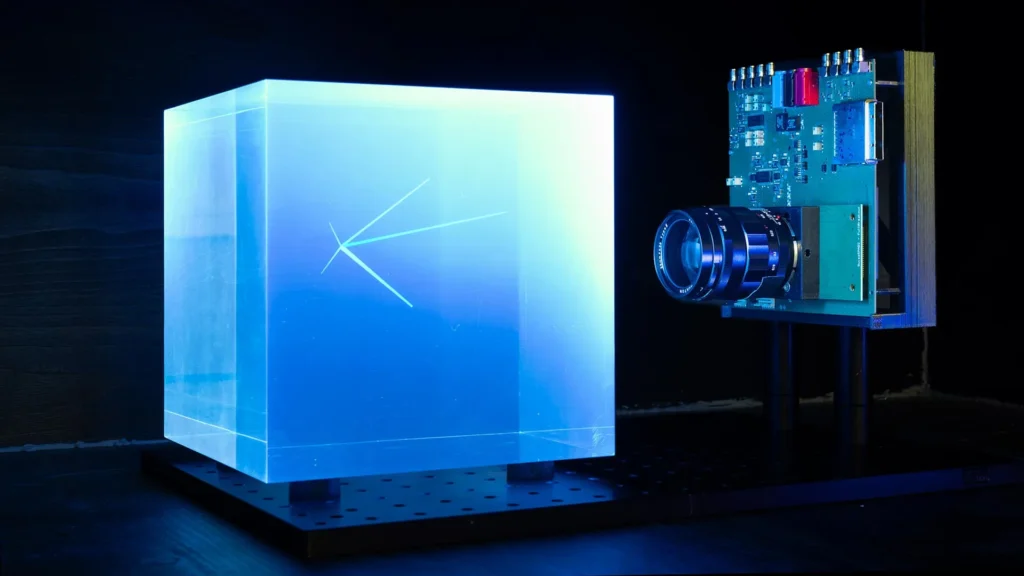
The new system, dubbed PLATON (an acronym derived from its underlying principles), was developed as part of a project funded by the Swiss National Science Foundation (SNSF), a testament to its perceived scientific merit and potential impact. The ETHZ-EPFL team meticulously constructed a proof-of-concept detector by integrating a specialized micro-lens array with a cutting-edge SPAD imaging sensor. The sensor, named SwissSPAD2, was developed in-house by the EPFL team, showcasing their expertise in advanced photon detection. Raytrix GmbH, a company specializing in light field technology, designed the micro-lens array and expertly mounted it directly onto the SwissSPAD2 sensor, creating a compact and highly integrated plenoptic imaging system.
A key feature of SwissSPAD2 is its capability for gated photon detection. This allows researchers to precisely control the time windows during which the sensor records photons. By synchronizing these gates with the expected arrival times of scintillation light, the system can effectively filter out random background signals and other spurious counts, dramatically improving the signal-to-noise ratio – a critical factor when searching for faint signals.
To rigorously evaluate PLATON’s performance, the researchers conducted a series of laboratory experiments. They tested the detector’s spatial resolution across a wide range of light levels, from several hundred detected photons down to an astonishingly low five photons. Furthermore, they assessed the prototype’s ability to detect electrons and reconstruct their positions within a block of plastic scintillator. These electrons were generated using a strontium-90 source, a common radioisotope used in calibration and testing due to its predictable electron emission. Across all diverse test conditions, the experimental measurements closely matched the predictions from detailed simulations, instilling strong confidence among the researchers that their theoretical models accurately describe the detector’s real-world performance. The successful results from this initial demonstrator have not only validated the core concept but have also provided crucial insights, already shaping the team’s ambitious plans for the next, more advanced version of PLATON.
Next-Generation Enhancements: Speed, Sensitivity, and AI
Building on the success of the prototype, the research team is actively developing an upgraded SPAD array sensor designed to achieve even greater photon detection efficiency and provide sub-nanosecond timing for individual photons. The current system assigns photons to fixed time windows, offering a degree of temporal resolution. However, the upgraded version will timestamp each detected photon with remarkable precision, offering an individual, highly accurate temporal marker. This enhanced timing information is expected to significantly improve the system’s ability to determine the precise origin of each photon, thereby refining the reconstruction of complex particle tracks within the scintillator volume.
In parallel, the plenoptic camera’s optical design has been optimized to expand its field of view and collect more light. Simulations presented in the Nature Communications paper strongly suggest that these optical improvements, combined with the advancements in timing and sensitivity, will collectively push PLATON’s spatial resolution to new heights.
Perhaps one of the most exciting developments is the integration of artificial intelligence (AI) for image processing. The team has incorporated a novel image-processing method based on a neural network (NN), specifically a Transformer architecture adapted from the type commonly used in large language models. While typical Transformers analyze patterns in words and sentences, this specialized Transformer examines correlations among the scintillation photons recorded by the detector. It is meticulously designed to identify subtle patterns in the spatial and temporal distribution of these photons, enabling it to reconstruct the original particle interaction with unprecedented accuracy. This represents a powerful synergy between cutting-edge AI and experimental physics, promising to unlock deeper insights from the detector’s raw data.
Performance Projections and Scaling Potential
The potential of an upgraded PLATON system for detecting neutrinos was extensively evaluated through simulations. These simulations, incorporating the new AI-driven image processing, indicated that an unsegmented PLATON detector with a volume of (10x10x10) cm³ could realistically achieve a remarkable spatial resolution below 1 mm. This level of precision is crucial for resolving the fine details of neutrino interactions, which often produce low-momentum particles. The simulations further suggested that the system could identify neutrino interactions that produce low-momentum protons in the final state with both high purity and high efficiency. This means the detector would be adept at distinguishing genuine neutrino events from a multitude of background signals, a critical capability for future neutrino experiments.
Looking ahead, the researchers also explored the technology’s scalability to much larger detector volumes. Due to the immense computational resources required, full neutrino simulations for a one-cubic-meter block of unsegmented scintillator were not performed. Instead, they modeled a simplified point-like source of photons within such a large volume. The results were highly encouraging: these simulations indicated that a PLATON-type detector of this scale could achieve a spatial resolution of a few millimeters. This performance places it on par with some of the most advanced state-of-the-art plastic scintillator detectors, which achieve similar resolutions through segmentation. The truly remarkable aspect is that PLATON accomplishes this without the inherent complexities, costs, and manufacturing challenges associated with dividing the scintillator into millions of individual pieces. The authors are optimistic that further refinements to the optical design and other system components could eventually enable sub-millimeter resolution in PLATON-type detectors with volumes exceeding 1 m³, opening up possibilities for next-generation neutrino observatories and dark matter experiments that are currently prohibitively expensive or complex to build using traditional methods.
Beyond the Collider: Broadening Horizons for PLATON Technology
The implications of PLATON technology extend far beyond the realms of neutrino experiments and particle colliders. The ETH Zurich researchers firmly believe that the system’s ability to reconstruct the position of faint light signals in three dimensions could significantly enhance a wide array of imaging systems across various scientific and medical disciplines.
A prime example of this broader applicability is in positron emission tomography (PET), a vital medical imaging method. PET scans track radioactive tracers introduced into the body to visualize metabolic activity and blood flow in organs and tissues, playing a crucial role in cancer diagnosis, neurology, and cardiology. Till Dieminger, Dr. Saúl Alonso-Monsalve, and Professor Davide Sgalaberna have already recognized this potential and have filed three separate patents involving the application of PLATON technology in PET scanners. These patents cover both innovative scanner designs that could leverage the unsegmented detection principle and the advanced image-processing techniques, including the neural network developed by Alonso-Monsalve, to achieve unprecedented resolution and sensitivity in medical imaging.
This trajectory of fundamental physics research yielding technologies with widespread societal benefits is not new. The World Wide Web, for instance, was conceived at CERN to facilitate information sharing among high-energy physicists. Similarly, proton therapy, a highly precise form of cancer treatment, evolved directly from advances in particle accelerators and radiation physics initially developed for research. PLATON stands poised to become another compelling example in this illustrious history, demonstrating how the pursuit of the universe’s most fundamental secrets can inadvertently lead to transformative technologies with profound scientific and medical applications, ultimately benefiting humanity as a whole.