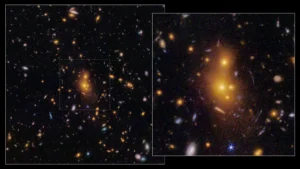
In a discovery that challenges established timelines of the early universe, astronomers at the Massachusetts Institute of Technology (MIT) and several international partner institutions have identified a flickering quasar dating back to the "cosmic dawn." Located just 850 million years after the Big Bang, this celestial object represents the earliest instance of a flickering quasar ever recorded. The detection, made possible through the analysis of over a decade of infrared data, provides a rare glimpse into the feeding habits of ancient supermassive black holes and raises profound questions about how these gravitational giants achieved maturity so quickly in the infancy of the cosmos.
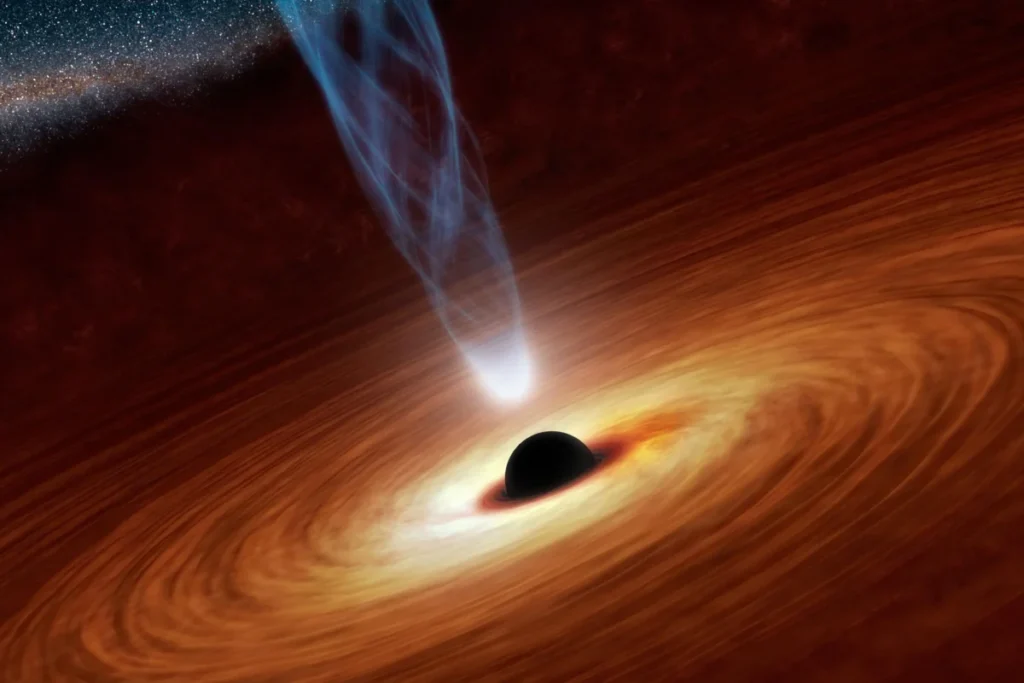
Quasars are among the most luminous and energetic objects in the known universe, powered by supermassive black holes residing at the centers of galaxies. As these black holes consume surrounding matter, the material forms an accretion disk—a swirling whirlpool of gas and dust heated to millions of degrees. This process releases vast quantities of electromagnetic radiation, often outshining the combined light of all the stars in the host galaxy. While astronomers have identified hundreds of quasars from the early universe, the ability to detect "flickering"—the temporal variation in brightness caused by fluctuations in the black hole’s "feeding" process—has remained elusive for objects at such extreme distances until now.
The Mechanics of the Cosmic Engine
To understand the significance of the MIT discovery, one must first grasp the nature of the supermassive black holes (SMBHs) that drive these systems. These objects can possess masses equivalent to billions of our suns. They are not merely passive residents of galaxies; rather, they act as central engines that regulate the growth of their surrounding environments. By emitting radiation and driving powerful winds, they can strip a galaxy of the gas needed to form new stars, effectively shaping the evolution of the galactic ecosystem.
The flickering observed by the MIT team is caused by the uneven rate at which gas is pulled into the black hole. As the black hole takes "bites" of the surrounding material, the energy output fluctuates. By studying the patterns of these fluctuations across different wavelengths of light, scientists can map the structure of the accretion disk. In the case of the newly discovered quasar, the flicker revealed a surprising structural detail: the accretion disk was thin and flat, resembling a "pancake."
In the contemporary universe, flat accretion disks are a hallmark of "mature" black holes that have reached a stable state after billions of years of evolution. Cosmologists had long theorized that black holes in the very early universe—the cosmic dawn—should be surrounded by "puffy," chaotic, and unsettled disks, reflecting a period of rapid, turbulent growth. The presence of a mature-looking disk just 850 million years after the Big Bang suggests that the transition from chaotic infancy to stable maturity happens much faster than previously believed.
Overcoming the Challenges of Deep Space Observation
Detecting a flicker from 13 billion light-years away presents an immense technical hurdle due to the expansion of the universe. As light travels through expanding space, its wavelength is stretched—a phenomenon known as "redshift." Light that was originally emitted in the ultraviolet or visible spectrum by a distant quasar is shifted into the infrared by the time it reaches Earth.
Furthermore, time itself is dilated by this expansion. A fluctuation in brightness that might take a few weeks to occur in the quasar’s local frame of reference appears to take months or even years from our perspective on Earth. To capture such a signal, researchers required a dataset that was both sensitive to infrared light and spanned a long enough duration to account for this temporal stretching.
The breakthrough came from NASA’s Near-Earth Object Wide-field Infrared Survey Explorer (NEOWISE). Originally launched as the Wide-field Infrared Survey Explorer (WISE) in 2009, the mission was repurposed to hunt for asteroids but continued to scan the entire sky in infrared wavelengths for approximately 14 years. By re-processing archival data from this mission, the MIT team, led by postdoc Gene Leung and Assistant Professor Anna-Christina Eilers, was able to identify the subtle, random flickering of the ancient quasar.
The data revealed that the quasar possesses a baseline brightness equivalent to 12 trillion suns. The observed flickering represented a 20 percent fluctuation in this output—a change in brightness equivalent to the power of 2 trillion suns.
A Chronology of the Early Universe and the Discovery
The timeline of this discovery spans nearly the entire history of the universe and several decades of human technological advancement:
- 13.8 Billion Years Ago: The Big Bang occurs, marking the birth of the universe.
- 850 Million Years Post-Big Bang: The quasar in question is at its peak activity. It pulls in material, creates a flat accretion disk, and begins emitting the light that will eventually be detected by the MIT team.
- Early 2000s: Astronomers begin to find evidence of supermassive black holes in the first billion years of the universe, overturning the theory that such objects required several billion years to form.
- 2009: NASA launches the WISE satellite to conduct an all-sky infrared survey.
- 2013: The mission is revived as NEOWISE, focusing on near-Earth objects but continuing to provide a treasure trove of infrared data for astrophysicists.
- 2024: Using re-processed NEOWISE data, the MIT-led team confirms the earliest flickering quasar, publishing their findings in Nature Astronomy.
Implications for Cosmological Models
The "pancake" shape of the accretion disk is more than just a geometric curiosity; it is a piece of evidence that challenges the "Standard Model" of black hole growth. Physicists have struggled to explain how black holes can grow to billions of solar masses in less than a billion years. There are two primary competing theories for the "seeds" of these giants:
- Light Seeds: These are black holes formed from the collapse of the very first generation of massive stars. However, to reach the sizes observed in the cosmic dawn, these seeds would have to consume matter at a rate that exceeds the "Eddington Limit"—the point at which the outward pressure of radiation balances the inward pull of gravity.
- Heavy Seeds: This theory suggests that massive clouds of gas in the early universe collapsed directly into black holes with masses 10,000 to 100,000 times that of the sun, giving them a "head start" in their growth.
The maturity of the accretion disk discovered by Eilers and Leung suggests that the "messy" phase of rapid growth occurs even earlier than 850 million years post-Big Bang. If black holes are already stable and "mature" by this point, the intense period of accumulation must have been incredibly brief and efficient. This lends potential weight to the heavy-seed theory or suggests that our understanding of the Eddington Limit needs refinement for the conditions of the early universe.
Reactions and Scientific Analysis
The scientific community has reacted with significant interest to the MIT findings. Dr. Anna-Christina Eilers noted that the discovery provides "direct evidence that the same feeding processes and structures observed in the nearby universe were already in place at very early times." This uniformity across cosmic epochs suggests that the physics of gravity and accretion are remarkably consistent, even when the surrounding environment—the "cosmic ecosystem"—is vastly different.
Gene Leung emphasized the randomness of the flicker, comparing it to a candle’s flame. This stochastic nature is a key indicator of accretion disk physics. By analyzing how the flicker differs across various infrared wavelengths (which correspond to different temperatures and distances from the black hole), the team could effectively "see" the shape of the disk without needing a telescope powerful enough to resolve the object’s physical dimensions—a feat that is currently impossible for objects at such distances.
The research also highlights the importance of archival data. The NEOWISE mission was not specifically designed to study the cosmic dawn, yet the meticulous re-processing of its 14-year data history by researchers like Kishalay De (now at Columbia University) allowed for a discovery that original mission planners might never have anticipated.
Future Horizons in Deep Space Exploration
While the detection of this flickering quasar answers some questions, it creates several others. If the growth phase happens "very, very early on," as Eilers suggests, the next frontier for astronomers is to look even further back—into the first 500 million years of the universe.
Instruments like the James Webb Space Telescope (JWST) are already beginning to probe these eras. By combining the wide-field temporal data from missions like NEOWISE with the high-resolution spectroscopic capabilities of the JWST, astronomers hope to catch a quasar in its "unsettled" phase. Finding a "puffy" or chaotic accretion disk would provide the missing link in the evolution of supermassive black holes.
For now, the MIT study stands as a testament to the rapid maturation of the early universe. It paints a picture of a cosmos that didn’t just slowly wake up, but rather ignited with structural complexity and massive gravitational engines almost immediately after the first light broke through the primordial darkness. The "pancake" disk of 13 billion years ago serves as a cosmic mirror, reflecting the same physics that governs the black holes in our own neighborhood today, and proving that the "dawn" of the universe was far more sophisticated than we once imagined.