Researchers at the University of Cambridge have unveiled a groundbreaking new technique that harnesses light to modify complex drug molecules, bypassing the need for toxic chemicals and harsh conditions. This innovative approach promises to significantly accelerate drug development timelines, enhance the efficiency of medicine design, and usher in a new era of sustainable pharmaceutical manufacturing. The discovery, detailed in a study published on March 12 in the esteemed journal Nature Synthesis, introduces what the team has termed an "anti-Friedel-Crafts" reaction, fundamentally reimagining a cornerstone of organic chemistry.
Revolutionizing Molecular Modification with "Anti-Friedel-Crafts" Chemistry
Traditional Friedel-Crafts reactions, while indispensable for forming carbon-carbon bonds, typically demand potent chemical reagents, expensive metal catalysts, and rigorous laboratory environments. These stringent requirements often confine such reactions to the nascent stages of drug synthesis, necessitating numerous subsequent chemical steps to achieve the desired final medicinal compound. The new methodology developed by the Cambridge team ingeniously reverses this paradigm, enabling chemists to introduce critical structural alterations to drug molecules much later in the development pipeline. This shift is profound, offering unprecedented flexibility and potentially shaving months off the iterative process of drug optimization.
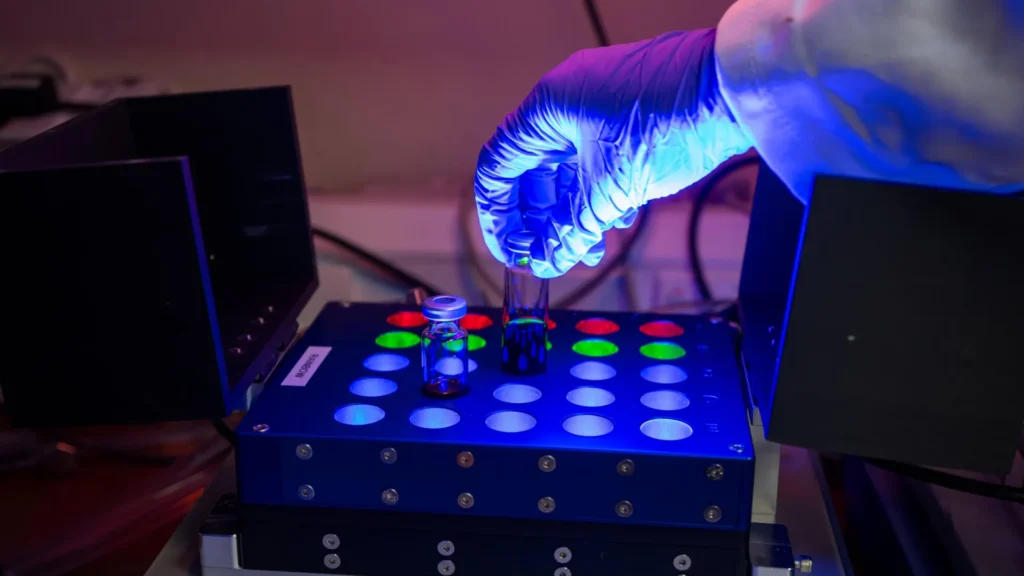
Instead of relying on heavy and often environmentally problematic metal catalysts, the "anti-Friedel-Crafts" reaction is activated by a simple LED lamp operating at ambient temperature. When illuminated, the light initiates a self-sustaining chain process that facilitates the formation of crucial carbon-carbon bonds under remarkably mild conditions, entirely free from toxic or costly reagents. Carbon-carbon bonds form the fundamental backbone of countless organic substances, ranging from fuels and plastics to the intricate biological molecules essential for life. Their efficient and selective formation is a central challenge in synthetic chemistry.
David Vahey, first author of the study and a PhD researcher at St John’s College, Cambridge, underscored the transformative potential of this discovery. "We’ve found a new way to make precise changes to complex drug molecules, particularly ones that have been exceptionally difficult to modify in the past," Vahey explained. "Scientists can spend months rebuilding large parts of a molecule just to test one small change. Now, instead of doing a multistep process for hundreds of molecules, scientists can start with their initial ‘hit’ molecule and make small, targeted modifications later on. This reaction lets scientists make precise adjustments much later in the process, under mild conditions and without relying on toxic or expensive reagents. That opens chemical space that has been hard to access before and gives medicinal chemists a cleaner, more efficient tool for exploring new versions of a drug."
Addressing Core Challenges in Pharmaceutical Research and Development
The pharmaceutical industry faces persistent challenges in drug discovery and development, characterized by high costs, protracted timelines, and low success rates. The average cost to bring a new drug to market is estimated to be over $2.6 billion, with development cycles often spanning 10-15 years. A significant portion of this investment is consumed during the optimization phase, where thousands of molecular variations are synthesized and tested to identify candidates with improved efficacy, reduced toxicity, and better pharmacokinetic profiles. The ability to perform late-stage modifications with such ease and precision directly addresses these bottlenecks.
One of the key advantages of the Cambridge technique is its exceptional selectivity. It allows chemists to alter a specific part of a molecule without inadvertently disturbing other sensitive functional groups or structural elements. This precision is paramount in medicinal chemistry, as even minor structural changes can profoundly influence a medicine’s biological activity, its interaction with target proteins in the body, and its propensity to cause side effects. The technique exhibits "high functional-group tolerance," meaning it can modify one region of a molecule while leaving other chemically reactive groups untouched. This characteristic makes it particularly valuable for late-stage optimization, where fine-tuning molecules is crucial for enhancing drug performance.
Towards a Greener Pharmaceutical Footprint
Beyond accelerating discovery, the new method aligns perfectly with the burgeoning principles of green chemistry and sustainability. By significantly reducing the number of synthesis steps, the process inherently lowers chemical usage, curtails energy consumption, and shrinks the overall environmental footprint of drug development. Traditional pharmaceutical manufacturing often generates substantial amounts of hazardous waste, and the energy demands for complex multi-step syntheses are considerable. Avoiding heavy metals, harsh reaction conditions, and lengthy synthetic pathways directly translates into reduced toxic waste and decreased energy consumption, marking a crucial step towards a more environmentally responsible chemical industry.
Professor Erwin Reisner, Professor of Energy and Sustainability in the Yusuf Hamied Department of Chemistry and lead author of the study, emphasized the dual impact of the work. "This is a new way to make a fundamental carbon-carbon bond, and that’s why the potential impact is so great. It also means chemists can avoid an undesirable and inefficient drug modification process," Reisner stated. His research group is renowned for its work on chemical systems inspired by photosynthesis, exploring sustainable methods to convert waste materials, water, and carbon dioxide into useful chemicals and fuels. This latest breakthrough reflects a commitment to expanding the scope of what chemists can achieve under practical conditions while simultaneously advancing greener manufacturing techniques.
From Serendipity to Strategic Innovation: The Discovery’s Genesis
Remarkably, the genesis of this transformative technique lies in an unexpected laboratory result – a classic tale of scientific serendipity. Much like other iconic scientific breakthroughs such as the discovery of X-rays, penicillin, Viagra, and modern weight loss medications, this innovation emerged from what initially appeared to be a failed experiment.
"Failure after failure, then we found something we weren’t expecting in the mess — a real diamond in the rough. And it is all thanks to a failed control experiment," Vahey recounted. He had been meticulously testing a photocatalyst when, during a control experiment designed to isolate variables, he removed the catalyst entirely. To his astonishment, the reaction not only proceeded without it but, in some instances, performed even better.
Initially, the unusual product seemed to be an error or a contamination. However, instead of dismissing it, the researchers chose to investigate further, a decision that proved pivotal. According to Professor Reisner, recognizing the significance of such unexpected results is a hallmark of successful scientific inquiry. "Recognizing the value in the unexpected is probably one of the key characteristics of a successful scientist," he affirmed. Vahey’s decision to probe the anomaly, rather than discard it as a mistake, was the critical turning point. "David could have dismissed it as a failed control," Reisner observed. "Instead, he stopped and thought about what he was seeing. That moment, choosing to investigate rather than ignore it, is where discovery happens."
Augmenting Discovery with Artificial Intelligence
After meticulously deciphering the underlying chemistry of the accidental reaction, the Cambridge team collaborated with researchers at Trinity College Dublin to develop sophisticated machine learning models. These AI algorithms were trained to predict precisely where the "anti-Friedel-Crafts" reaction would occur on entirely new molecules that had never been tested in the laboratory.
The integration of artificial intelligence represents another significant leap forward. "We generate enormous amounts of data, and increasingly we use artificial intelligence to help analyze it," Reisner explained. "We have an algorithm that can predict reactivity. AI helps because we don’t need chemists to do endless trial and error, but an algorithm will only follow the rules it has been given. It still takes a human being to look at something that appears wrong and ask whether it might actually be something new."
By learning intricate patterns from vast datasets of known chemical reactions, the AI system can simulate possible outcomes and identify promising molecular candidates before any physical experiments are conducted. This drastically reduces the need for laborious and time-consuming trial-and-error experimentation, enabling researchers to identify optimal molecules with unprecedented speed and efficiency. This synergy between human intuition and AI predictive power exemplifies the future trajectory of chemical research.
Industry Validation and Future Implications
To validate the real-world applicability and scalability of their innovation, the researchers rigorously tested the reaction on a broad spectrum of drug-like molecules. They also demonstrated that the technique could be readily adapted for continuous flow systems, a common and highly efficient production method utilized in industrial chemical manufacturing. A strategic collaboration with AstraZeneca, a global pharmaceutical giant, played a crucial role in evaluating whether the new technique could meet the practical and environmental requirements inherent in large-scale pharmaceutical production. This industry partnership underscores the perceived value and readiness for translation of the Cambridge discovery.
The implications for pharmaceutical manufacturing are substantial. "Transitioning the chemical industry to a sustainable industry is arguably one of the most difficult parts of the whole energy transition," Reisner commented, highlighting the broader societal impact of such green chemical innovations. By offering a pathway to cleaner, more efficient synthesis, this technique contributes directly to global efforts to reduce industrial environmental impact.
For Vahey, the immediate satisfaction lies in providing scientists with a powerful new capability. "What industry and other researchers do with it next — that’s where the future impact lies," he reflected. "For us, the lab is mostly average to bad days. The good days are very good days." Reisner added, "As a chemist, you only need one or two good days a year — and those can come from a failed experiment." This sentiment perfectly encapsulates the blend of perseverance, curiosity, and occasional serendipity that drives scientific progress.
Historical Precedents: The Power of Accidental Discovery
The Cambridge team’s experience echoes a long and illustrious history of accidental scientific discoveries that have profoundly shaped human knowledge and technology.
- X-rays (1895): Wilhelm Conrad Röntgen’s observation of a glowing screen near an electrical current experiment led to the discovery of a new radiation type, revolutionizing medical diagnostics.
- Radioactivity (1898): Marie Curie’s meticulous investigation into unexpectedly strong radiation from uranium minerals uncovered polonium and radium, laying the foundation for nuclear physics.
- Vulcanized Rubber (1839): Charles Goodyear’s accidental spill of rubber and sulfur onto a hot stove revealed a process that made rubber durable and elastic, transforming industrial applications.
- Penicillin (1928): Alexander Fleming’s astute observation of mold inhibiting bacterial growth in a contaminated petri dish led to the world’s first widely used antibiotic, saving millions of lives.
- Teflon (1938): Roy Plunkett, a DuPont chemist, inadvertently created a highly slippery and heat-resistant polymer while experimenting with refrigerant gases, leading to nonstick cookware.
- Super Glue (1942): Harry Coover’s failed attempt to create transparent plastics resulted in an intensely adhesive substance, later commercialized as super glue.
- LSD (1943): Swiss chemist Albert Hofmann’s accidental self-exposure to lysergic acid diethylamide revealed its potent psychological effects, influencing neuroscience research.
- Pulsars (1967): Jocelyn Bell Burnell, a graduate student, detected regular radio signals from space, which were later identified as rapidly spinning neutron stars, opening a new astrophysical frontier.
- Viagra (1990s): Researchers at Pfizer, while testing a drug for angina, observed an unexpected side effect that led to the development of sildenafil for erectile dysfunction.
- Weight Loss Injections (2021): Drugs mimicking the GLP-1 hormone, initially developed for Type 2 diabetes, were found to induce significant weight loss, leading to the development of medications like Ozempic and Mounjaro for obesity.
The Cambridge "anti-Friedel-Crafts" reaction now joins this esteemed lineage, a testament to the power of observation, curiosity, and the willingness to investigate the unexpected. It stands as a beacon of innovation, poised to reshape the landscape of drug discovery and contribute significantly to a more sustainable future for the chemical industry.