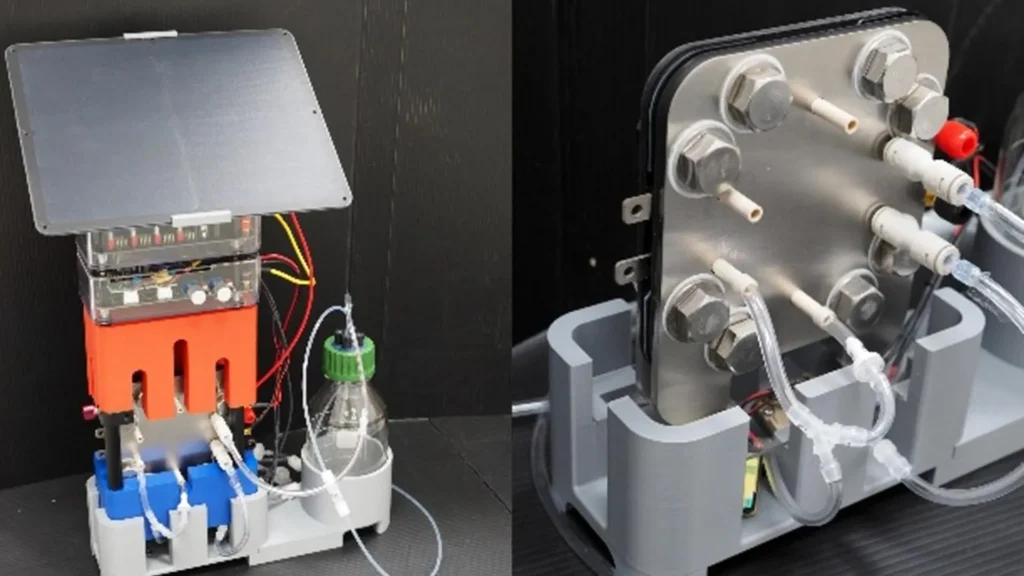
The groundbreaking advance stems from the innovative integration of a self-regulating chemical component directly into the electrolyzer, fundamentally redesigning how solar fuel production systems manage fluctuating energy inputs. This development promises to significantly reduce both system complexity and overall cost, marking a crucial step forward in the quest for sustainable energy solutions. The research, a collaborative effort with Iida Group Holdings Co., Ltd, was recently published in the esteemed journal EES Solar, drawing attention from the scientific community and industry stakeholders alike.
The Promise of Artificial Photosynthesis: Mimicking Nature’s Efficiency
At its core, artificial photosynthesis seeks to replicate and optimize the natural process by which plants convert sunlight, water, and carbon dioxide into energy-rich organic compounds. This biotechnological pursuit holds immense potential for addressing global energy demands and mitigating climate change by offering a pathway to produce clean, renewable fuels. Unlike intermittent renewable energy sources like solar photovoltaics, which directly generate electricity, artificial photosynthesis aims to produce storable chemical fuels, often referred to as "solar fuels." These fuels can then be used on demand, overcoming the inherent variability of sunlight.
One particularly promising product of artificial photosynthesis is formic acid (HCOOH). Formic acid is a versatile chemical that can serve as a direct fuel for certain types of fuel cells, particularly those used in portable electronics and niche industrial applications. More broadly, it functions as an efficient medium for storing hydrogen, a key component of the future hydrogen economy, allowing for safer and more compact storage than compressed gaseous hydrogen. Its relatively high energy density and ease of handling make it an attractive candidate for a wide range of applications, from grid-scale energy storage to powering vehicles and homes. The global market for formic acid, already significant in industries like agriculture, textiles, and rubber, is poised for substantial growth if sustainable production methods, such as artificial photosynthesis, become commercially viable.
The Central Role of Electrolyzers and the Challenge of Intermittency
The operational heart of most artificial photosynthesis systems is the electrolyzer. This electrochemical device is responsible for converting electrical energy, typically supplied by solar cells, into chemical energy stored within the bonds of the produced fuel. In the case of formic acid production from water and carbon dioxide, the electrolyzer facilitates the necessary chemical reactions, breaking down water molecules and reducing carbon dioxide.
However, a major hurdle in the widespread deployment and efficient operation of artificial photosynthesis systems lies in the inconsistent nature of sunlight. Solar irradiance changes continuously throughout the day due to factors such as cloud cover, time of day, seasonal variations, and atmospheric conditions. This variability directly impacts the power output of solar cells, leading to fluctuations in the electrical input to the electrolyzer. For optimal fuel production, the electrolyzer must operate at its most efficient point, which requires a stable and well-matched power supply.
To address this challenge, conventional artificial photosynthesis systems, along with many other solar-powered applications, employ a technique known as Maximum Power Point Tracking (MPPT). MPPT is an algorithmic control strategy designed to continuously adjust the voltage and current supplied by solar cells to ensure they always deliver their highest possible power output, regardless of changing environmental conditions. While highly effective in maximizing energy capture, traditional MPPT setups typically rely on a complex array of external electronic components. These often include DC-DC converters, microcontrollers, and critically, battery banks. Batteries are frequently integrated to smooth out energy flow, storing excess power during peak sunlight hours and discharging it during dips, thereby providing a consistent power supply to the electrolyzer.
The Cost-Complexity Dilemma of Conventional MPPT
While effective in principle, the reliance on these additional components introduces significant practical limitations. The inclusion of batteries, in particular, contributes substantially to both the capital expenditure and the operational complexity of the system. Batteries, especially those designed for high-power cycling, represent a considerable upfront cost. Furthermore, they have a finite lifespan, requiring eventual replacement, which adds to long-term maintenance expenses. Their performance is also susceptible to environmental factors like temperature, and they necessitate sophisticated battery management systems to prevent overcharging, over-discharging, and thermal runaway, further increasing complexity and the potential for points of failure.
Beyond batteries, the electronic converters and control units add to the bill of materials, consume parasitic power, and introduce additional points of failure. The overall system becomes larger, heavier, and more challenging to install and maintain, particularly in remote or distributed energy generation scenarios where simplicity and robustness are paramount. These factors have historically posed a significant barrier to the economic viability and widespread adoption of artificial photosynthesis technologies.
A Paradigm Shift: The Self-Regulating Electrolyzer
Recognizing these limitations, a dedicated team of researchers at the Research Center for Artificial Photosynthesis at Osaka Metropolitan University embarked on a mission to fundamentally redesign the electrolyzer itself. Under the leadership of Associate Professor Yasuo Matsubara and Professor Yutaka Amao, the team collaborated with Iida Group Holdings Co., Ltd, a partnership that brought together academic innovation with industrial expertise, aiming to bridge the gap between laboratory research and practical application.
Their breakthrough lies in the ingenious integration of a specially designed solid electrolyte directly into the electrolyzer device. This innovative material, rather than being a passive conduit for ions, actively participates in the system’s regulation. The crucial aspect of this new design is its ability to automatically perform the MPPT function, essentially embedding the control mechanism within the electrochemical reactor itself. This inherent self-regulation eliminates the need for external, battery-based control systems, along with the associated electronic converters and microcontrollers.
The mechanism behind this self-regulating behavior is elegantly simple yet profoundly impactful. "As sunlight increases, the electrolyzer naturally heats up due to the increased current flow and internal resistance," Professor Amao explained. "The system is meticulously designed so that this warming causes the electrical resistance of the solid electrolyte to drop significantly, allowing electricity to flow more freely and efficiently." This inverse relationship between temperature and resistance means that as more power becomes available from the solar cells, the electrolyzer’s internal electrical characteristics automatically adjust to better match the solar input, effectively drawing the maximum possible power without external intervention. This intrinsic thermal and impedance response mimics the function of an electronic MPPT controller, but without any active electronic components or energy storage devices.
Professor Amao further elaborated on the system’s advantages: "This self-regulating behavior helps keep fuel production more stable throughout the day and automates the entire system, while simultaneously reducing dependence on costly external components and batteries." The removal of these elements not only slashes upfront costs but also significantly reduces maintenance requirements and system footprint, making the technology more robust and accessible for various applications.
A Collaborative Journey and Real-World Validation
The development of this self-regulating electrolyzer is not an isolated scientific endeavor but the culmination of dedicated research and strategic partnerships. The collaboration with Iida Group Holdings Co., Ltd, a diversified Japanese conglomerate with interests in housing and sustainable technologies, underscores the practical focus of the research. This partnership provided crucial insights into engineering for real-world applications and potentially accelerates the path to commercialization.
A significant milestone in the project’s timeline was its showcase at the "Joint Pavilion Iida Group × Osaka Metropolitan University" exhibition, part of the lead-up to the Osaka Kansai Expo 2025. This public demonstration offered an early validation of the system’s capabilities. "We were confident that it would be successful, as we previously showcased this research at the exhibition," Professor Matsubara stated. During the exhibition, the system successfully generated enough formic acid to power a miniature diorama within the pavilion, a tangible and engaging demonstration of its potential. This public display not only validated the technology but also served to educate and inspire, highlighting the tangible benefits of artificial photosynthesis to a wider audience.
Crucially, the researchers did not limit their testing to controlled laboratory environments. They subjected the technology to rigorous evaluation under actual outdoor conditions, where real-world fluctuations in sunlight could truly test its self-regulating capabilities. The results were highly encouraging: the system consistently produced formic acid from water and CO2, even as sunlight levels varied dramatically throughout the day. This robust performance under dynamic conditions is a critical indicator of its potential for practical deployment, distinguishing it from many laboratory-scale prototypes that often struggle outside ideal settings.
Broader Implications and Future Outlook
The implications of Osaka Metropolitan University’s self-regulating electrolyzer are far-reaching, particularly in the context of the global energy transition. By drastically simplifying the architecture of artificial photosynthesis systems, this innovation could unlock new possibilities for decentralized energy production. Imagine homes or communities equipped with compact, self-contained units that convert sunlight, water, and atmospheric CO2 into storable fuel, reducing reliance on centralized grids and fossil fuels. "This shows its potential as an efficient artificial photosynthesis system that could potentially be used to charge applications in our homes," Professor Matsubara envisioned, highlighting the domestic applicability.
Economically, the reduction in cost and complexity could significantly lower the barrier to entry for artificial photosynthesis technologies. Current estimates for the levelized cost of solar fuels often struggle to compete with established fossil fuel pathways, partly due to the auxiliary equipment required. By eliminating expensive battery banks and complex electronics, this new system could dramatically improve the economic competitiveness of solar fuel production, accelerating its journey from research labs to commercial markets. This could be particularly impactful in developing regions or off-grid locations where robust, low-maintenance energy solutions are desperately needed.
Environmentally, the technology offers a dual benefit. Firstly, it provides a clean, renewable pathway for fuel production, reducing reliance on fossil fuels and their associated greenhouse gas emissions. Secondly, by efficiently converting carbon dioxide into a valuable chemical product, it contributes to carbon utilization strategies, potentially turning a waste product into a resource. While the scale of CO2 conversion in such systems is currently modest compared to industrial emissions, every step towards carbon circularity is valuable.
Looking ahead, further research will likely focus on optimizing the materials used in the solid electrolyte for even greater efficiency and longevity, as well as scaling up the system for larger-scale applications. Investigating different solar fuel products beyond formic acid using this self-regulating principle could also be a fruitful avenue. The publication in EES Solar serves as a strong validation of the scientific merit and innovative nature of this work, positioning Osaka Metropolitan University at the forefront of sustainable energy research. This development represents more than just a technological improvement; it is a conceptual leap that brings the vision of a solar-powered, carbon-neutral future significantly closer to reality.