Researchers at the Massachusetts Institute of Technology (MIT), spearheaded by Professor Ju Li, are making significant strides in the development of next-generation energy storage solutions, with a particular focus on sodium-metal batteries. This cutting-edge work, detailed in a recent publication in the journal Joule, addresses a critical bottleneck in the advancement of these batteries: the electrolyte. By meticulously engineering the solvent molecules within the electrolyte, the MIT team has demonstrated a novel approach that could pave the way for more affordable, abundant, and high-performance alternatives to the ubiquitous lithium-ion batteries, crucial for the burgeoning electric vehicle and grid-scale energy storage markets.
The current dominance of lithium-ion batteries, while undeniable, is increasingly challenged by concerns surrounding the supply chains of critical minerals. Lithium, cobalt, nickel, and graphite, essential components of these batteries, are subject to geopolitical risks and potential disruptions, impacting both economic stability and national security. As the global demand for renewable energy, electrified transportation, and advanced digital technologies escalates, the need for energy storage systems that are not only cost-effective and resource-abundant but also capable of rapid charging and discharging has become paramount. It is within this context that the MIT team’s exploration of sodium-metal batteries gains significant relevance.
The Promise and Peril of Sodium-Metal Batteries
Sodium-metal batteries present a compelling alternative due to the inherent advantages of sodium. Sodium is approximately 1,000 times more abundant on Earth than lithium and, crucially, costs roughly one-hundredth as much per unit of weight. This substantial cost reduction and increased availability could democratize access to advanced energy storage technologies. However, the inherent reactivity of metallic sodium poses a significant hurdle. This high reactivity often leads to instability, making it challenging to achieve both long-term battery life and the rapid cycling required for practical applications.
"The electrolyte is supposed to just transmit those ions," explains Professor Ju Li, the Carl Richard Soderberg Professor of Power Engineering at MIT and a leading figure in this research. "It’s supposed to be an ion conductor. But unfortunately, most electrolytes get involved in unwanted chemical reactions with the electrodes, which can greatly undermine battery stability." These detrimental "side reactions" can result in the formation of insoluble compounds that accumulate on the electrodes. This build-up acts as a physical barrier, impeding the flow of ions and ultimately leading to premature battery failure.
A Novel Electrolyte Design Strategy
For years, the quest for a sodium-metal battery electrolyte that exhibits stability at both the anode and cathode, a prerequisite for achieving a long cycle life, remained elusive. A significant breakthrough occurred in 2021 when Professor Li’s group and their collaborators identified a "sulfonamide" molecule, characterized by its sulfur, oxygen, and nitrogen atoms. When used as a solvent in lithium batteries, this molecule, known as DMTMSA, demonstrated remarkable stability at both electrodes.
Building upon this foundational discovery, the MIT team set out to investigate whether structurally similar molecules could offer analogous benefits for sodium-metal batteries. Their objective was twofold: to ensure electrolyte stability and, critically, to enhance the battery’s ability to charge and discharge rapidly. Slow charging can render electric vehicles impractical for daily use, and sluggish discharging limits the power output when it’s most needed.
The researchers conceptualized the electrolyte’s function using an analogy: imagine navigating a crowded street. "You can move more quickly through the crowd with a small backpack that is snug against your body, rather than dragging a bulky suitcase on wheels," illustrated Weiyin Chen, a postdoctoral researcher in Nuclear Science and Engineering (NSE) and one of the lead authors of the Joule paper. In the context of batteries, smaller solvent molecules allow sodium ions to move more freely and swiftly between electrodes, facilitating faster charging and discharging. The challenge, however, lies in the inherent trade-off: highly conductive electrolytes, often facilitated by smaller solvent molecules, tend to be more reactive with electrodes, thereby reducing battery lifespan.
Professor Li noted the strategic advantage of their approach: "reducing the size of solvents provides a new pathway to overcome this trade-off." The team’s hypothesis was that by identifying "congeneric" molecules – those belonging to the same chemical family and possessing similar structures – they could find smaller candidates that retained the desirable stability of DMTMSA.
AI-Powered Discovery and Experimental Validation
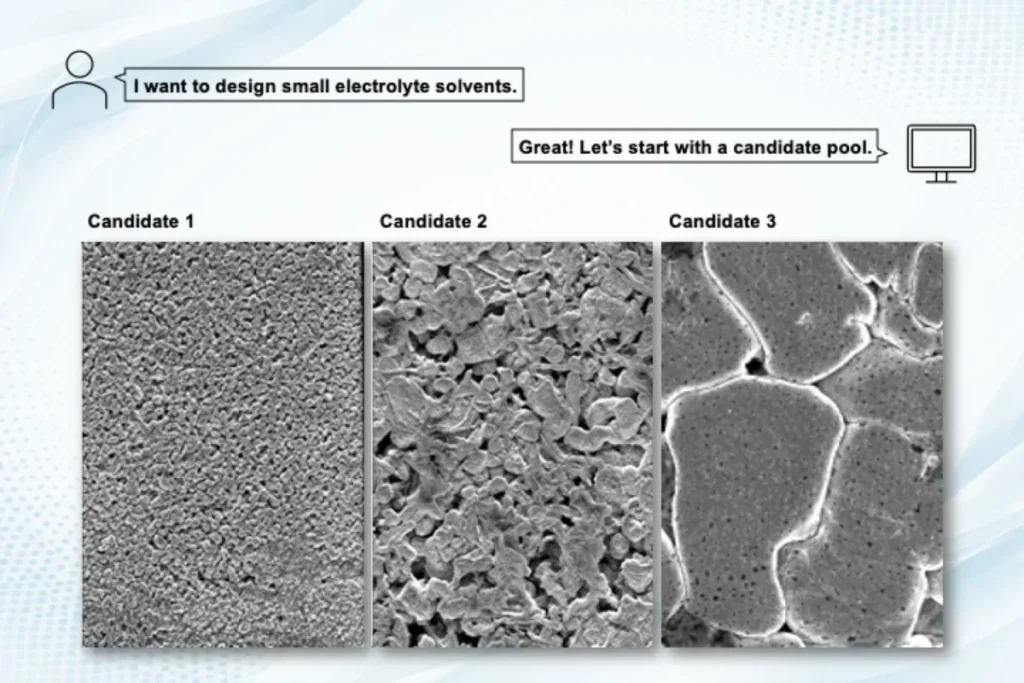
To accelerate this complex molecular search, Chia-Wei Hsu, an MIT PhD student in materials science and engineering, developed an AI-guided algorithm. This innovative tool was capable of designing approximately 100,000 candidate molecules on a computer within a mere 24 hours. Hsu then employed a rigorous set of technical criteria, including structural similarity to DMTMSA and comparable electronic properties, to narrow down this vast pool to 200 promising candidates. From this refined list, 27 representative molecules, spanning the full spectrum of possibilities, were selected for experimental testing.
"We tested them all under the same conditions to make it a fair, head-to-head competition," Chen stated. The results were clear: a standout molecule emerged, a solvent named DMFSA, which proved to be both the smallest among the tested candidates and the most effective in enhancing battery performance.
Expert Reactions and Broader Implications
The significance of this research has been acknowledged by experts in the field. Jinhyuk Lee, an associate professor of materials engineering at McGill University, who was not involved in the study, commented, "This work addresses one of the most persistent challenges in battery research: improving battery performance at high charging and discharging rates without sacrificing long-term stability. By carefully tailoring the size of solvent molecules, the authors demonstrate a new design strategy that could enable lower-cost, higher performance batteries."
The MIT team is not resting on its laurels. A new research phase has already commenced, aiming to identify even more optimized solvents. This subsequent search utilizes DMFSA as the new benchmark, seeking molecules that can build upon its success. Chen expressed optimism about the potential impact, stating, "The new solvents they are uncovering could eventually lead to rechargeable sodium-metal batteries that combine low-cost, abundant materials with fast charging and high-power performance, opening the door to broader energy storage applications."
Beyond the specific advancement of sodium-metal batteries, the researchers emphasize the broader applicability of their electrolyte design methodology. By using solvent size and molecular similarity as key guiding principles, they have introduced a novel approach to electrolyte engineering. This principle, demonstrated effectively with sodium-metal batteries as a model system, holds the potential to influence the design of a wide array of future energy storage technologies.
"Because the concept is broadly applicable," Lee observed, "its impact could extend well beyond sodium batteries and influence the design of a wide range of future energy storage technologies."
Supporting Data and Context
The development of advanced battery technologies is a critical component of global decarbonization efforts. The International Energy Agency (IEA) has projected that by 2030, global electricity generation from renewable sources like solar and wind will surpass coal, a significant shift driven in part by the need for reliable energy storage. Lithium-ion batteries currently account for over 90% of the electric vehicle market, a sector expected to reach tens of millions of vehicles annually within the next decade. However, the reliance on specific mineral resources has led to price volatility. For instance, the price of lithium carbonate surged by over 400% between early 2021 and late 2022, highlighting the economic vulnerabilities of the current supply chain.
The research timeline for this specific breakthrough involved several years of intensive study. The foundational understanding of sulfonamide electrolytes for lithium batteries emerged in 2021. Subsequent work to adapt and optimize these findings for sodium-metal batteries, including the development of the AI algorithm and extensive experimental validation, has culminated in the recent publication in Joule. This process involved the collaborative efforts of 15 members of the MIT team.
Funding and Infrastructure
This pioneering research was made possible through a combination of significant funding and access to state-of-the-art facilities. Partial support was provided by a grant from the National Research Foundation of Korea, funded by the Korean government, underscoring international collaboration in this critical scientific domain. Additionally, the U.S. National Science Foundation provided crucial support through graduate research fellowships. The advanced characterization equipment essential for this project was partly sourced from the MIT.nano Characterization Facilities, a testament to the robust research infrastructure at the institute.
Future Outlook and Analysis
The successful development of stable and high-performance sodium-metal batteries could have profound implications. Firstly, it offers a pathway to significantly reduce the cost of energy storage, making electric vehicles more accessible to a wider consumer base and enabling more widespread deployment of grid-scale storage solutions to integrate intermittent renewable energy sources. Secondly, by utilizing a more abundant element like sodium, it mitigates the supply chain risks associated with critical minerals, enhancing energy independence and security for nations.
The approach of using AI for molecular design and then employing solvent size and molecular similarity as key selection criteria represents a paradigm shift in materials science research. This methodology is not confined to sodium-metal batteries but can be applied to the discovery of novel materials for a wide range of electrochemical applications, potentially accelerating innovation across the energy storage landscape. The ongoing research into even more advanced solvents suggests a continuous improvement trajectory, promising further enhancements in energy density, cycle life, and overall battery performance.
While challenges remain in scaling up production and ensuring long-term durability under real-world operating conditions, the breakthroughs achieved by the MIT team represent a significant leap forward. The transition from laboratory-scale experiments to commercial viability is a complex process, often involving extensive engineering and industrial collaboration. However, the fundamental scientific advancements reported in Joule provide a strong foundation for future development, positioning sodium-metal batteries as a serious contender in the evolving energy storage ecosystem. The broader impact of this work lies not just in the promise of cheaper and more sustainable batteries, but also in the innovative research methodology that could unlock future discoveries across diverse scientific fields.