August promises an unparalleled celestial spectacle for skygazers across the globe, featuring a rare total solar eclipse, the dazzling peak of the Perseid meteor shower, the prominent evening appearance of the planet Venus, and a deep partial lunar eclipse. This confluence of astronomical events elevates the month into a prime period for both casual observers and dedicated astronomers, offering multiple opportunities to witness the wonders of the cosmos.
A Triple Threat of Celestial Phenomena Begins August with a Bang
The astronomical calendar for August is packed with events of significant visual appeal and scientific interest. Kicking off the month is the Last Quarter Moon on August 5th, a gentle prelude to the more dramatic occurrences that lie ahead. However, the undisputed highlight of the month, and indeed one of the most anticipated astronomical events of the year, is the total solar eclipse on August 12th. This spectacular phenomenon will trace a path across the northern hemisphere, offering a breathtaking view of the Sun’s corona to fortunate observers in specific regions.
Total Solar Eclipse: A Path of Totality Across the Northern Hemisphere
On August 12th, the Moon will precisely align between the Sun and Earth, casting a shadow that will create a total solar eclipse. The path of totality, where the Sun is completely obscured, will sweep across a compelling geographical corridor. This celestial drama will unfold over northern Russia, the dramatic landscapes of Greenland and Iceland, and the Iberian Peninsula, specifically northern Spain and a small segment of Portugal. For residents and visitors within this narrow band, the experience will be profound, with the Sun’s fiery corona becoming visible against a suddenly darkened sky.
For those situated outside the path of totality, a partial solar eclipse will be visible. In the United States, this partial obscuration will stretch from the northwestern reaches of Alaska to the southeastern state of North Carolina. The extent of the partial eclipse will vary significantly based on geographic location, with some areas witnessing a more substantial covering of the Sun than others. Even a partial eclipse offers a remarkable sight, as the Moon gradually carves a bite out of the solar disk.
Crucial Safety Precautions for Solar Eclipse Viewing
The allure of observing the Sun during an eclipse is undeniable, but it is paramount to emphasize that direct solar viewing without proper protection can cause irreversible eye damage. Experts universally stress the critical importance of using certified solar eclipse glasses or viewers that meet the ISO 12312-2 international safety standard. Ordinary sunglasses, even those designed for intense sunlight, are not sufficient to protect the eyes from the Sun’s harmful ultraviolet and infrared radiation.
Furthermore, under no circumstances should one look at the Sun through unfiltered binoculars, telescopes, or camera lenses. These instruments magnify the Sun’s intensity, posing an extreme risk to vision. If such equipment is to be used for eclipse observation, specialized solar filters designed specifically for the front of the optical instrument must be securely attached. These filters block the dangerous rays, allowing for safe viewing.
The Perseid Meteor Shower: Dark Skies Promise a Dazzling Display
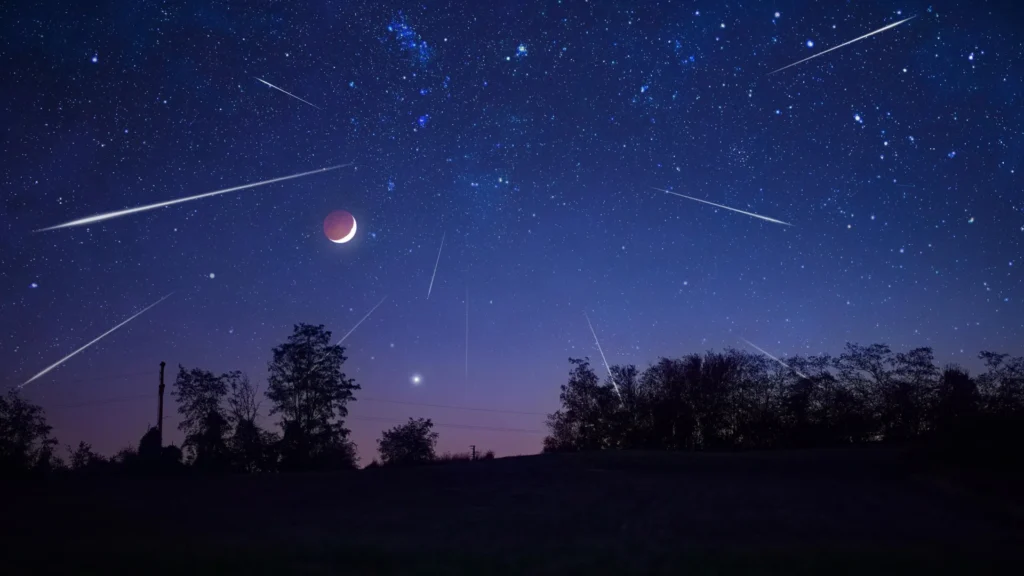
Following closely on the heels of the solar eclipse, the Perseid meteor shower will reach its radiant peak on the nights of August 12th and 13th. This annual event is renowned for its prolific display of bright meteors, often referred to as "shooting stars." This year, the Perseids are poised for an exceptional showing due to a fortunate cosmic alignment: the New Moon also occurs on August 12th.
The absence of moonlight, which typically washes out fainter meteors, will create exceptionally dark skies, providing ideal conditions for observing the shower. This natural phenomenon occurs as Earth traverses the debris trail left behind by Comet Swift-Tuttle. As these minuscule particles, often no larger than grains of sand, enter Earth’s atmosphere at speeds exceeding 130,000 miles per hour, they heat up due to friction, igniting into brilliant streaks of light.
To maximize the viewing experience, astronomers advise seeking out a location far from urban light pollution, with an unobstructed horizon. Patience is key; allowing approximately 30 minutes for the eyes to fully adjust to the darkness will significantly enhance the ability to detect fainter meteors. The Perseids appear to emanate from the constellation Perseus, located in the northeastern sky. However, meteors can streak across any part of the celestial sphere, so observers should scan the entire overhead dome.
Venus: A Brilliant Beacon in the Evening Sky
As the month progresses, the planet Venus will command attention in the western sky after sunset. From August 14th through the 16th, Venus will achieve its greatest eastern elongation, marking the point at which it appears farthest from the Sun as seen from Earth. This celestial geometry will render Venus exceptionally visible and strikingly bright in the twilight hours.
For observers, Venus will be an unmissable sight, shining with an intensity that will outshine all surrounding stars. Its position low in the western sky just after dusk makes it readily accessible to casual observers. Through a telescope, Venus will present a fascinating spectacle, appearing as a crescent or half-illuminated disk, reminiscent of the phases of the Moon. This visibility is due to the planet’s orbit around the Sun, which dictates how much of its sunlit surface is presented to Earth at different times.
A Deep Partial Lunar Eclipse: Earth’s Shadow Dims the Full Moon
Concluding August’s celestial trifecta is a significant partial lunar eclipse on the nights of August 27th and 28th. As the Full Moon rises, it will pass through Earth’s shadow, creating a captivating astronomical event. This particular lunar eclipse is notable for its depth, with a substantial portion of the Moon entering Earth’s umbra, the darkest part of its shadow.
The eclipse will be visible across a vast geographical expanse, encompassing much of North and South America, along with significant portions of Europe and Africa. At the peak of the eclipse, approximately 93% of the Moon’s diameter will be immersed in the umbra. While the Moon will not be completely obscured, the majority of its surface will appear dramatically dimmed, potentially taking on a distinct rusty or coppery hue. This coloration is caused by sunlight refracting through Earth’s atmosphere and casting a reddish light onto the lunar surface, a phenomenon often referred to as a "blood moon."
Unlike solar eclipses, lunar eclipses are entirely safe to view with the naked eye. No special eye protection is required. For those seeking a more intimate view of the celestial mechanics, binoculars or a small telescope can enhance the experience, allowing observers to clearly witness the gradual encroachment of Earth’s curved shadow across the lunar disk.
Historical Context and Scientific Significance of August’s Celestial Events
The convergence of these significant astronomical events in a single month underscores the dynamic nature of our solar system and provides invaluable opportunities for both scientific study and public engagement with astronomy.
Solar Eclipses: Ancient Wonders and Modern Research
Solar eclipses have captivated humanity for millennia, inspiring awe, fear, and scientific inquiry. Ancient civilizations often interpreted them as omens, while modern science utilizes them to study the Sun’s atmosphere. The corona, the Sun’s outermost layer, is incredibly hot but usually obscured by the Sun’s brilliant disk. During totality, the corona becomes visible, allowing scientists to study its structure, temperature, and magnetic fields, which play a crucial role in solar flares and coronal mass ejections that can impact Earth.
The path of totality for the August 12th eclipse, crossing densely populated areas of Europe and parts of North America, offers significant potential for citizen science projects and educational outreach. Researchers from institutions like NASA and the European Space Agency often deploy specialized equipment to study the Sun during these rare moments, gathering data that contributes to our understanding of space weather and its potential effects on satellites and communication systems.
The Perseid Meteor Shower: A Cosmic Time Capsule
The Perseids are among the most dependable and prolific meteor showers, a testament to the predictable orbits of comets. Comet Swift-Tuttle, responsible for the Perseids, has an orbital period of about 133 years. Each year, as Earth passes through its debris trail, we are treated to this celestial display. The composition of these meteoroids offers insights into the early solar system, acting as microscopic time capsules of material formed billions of years ago. Analyzing the spectral signatures of meteors can reveal the elements present in the cometary dust, providing clues about the conditions under which the comet formed.
Venus: Our Celestial Neighbor and a Window into Planetary Evolution
Venus, often referred to as Earth’s "sister planet" due to its similar size and mass, holds significant interest for planetary scientists. Its current prominence in the evening sky, following its greatest eastern elongation, highlights its proximity to Earth. Studying Venus provides crucial data points for understanding planetary evolution, particularly the development of atmospheres and the potential for habitability. The extreme greenhouse effect on Venus, which has made its surface incredibly hot, serves as a cautionary tale and a subject of intense study in the context of climate change on Earth.
Lunar Eclipses: A Safe and Accessible Astronomical Spectacle
Lunar eclipses, while perhaps less dramatic than their solar counterparts, are equally significant from an astronomical perspective. They provide a clear demonstration of the celestial mechanics governing the Earth-Moon-Sun system. The subtle color changes observed during a lunar eclipse are a direct result of Earth’s atmosphere scattering sunlight. By studying the spectrum of light that passes through Earth’s atmosphere and illuminates the Moon, scientists can gain information about the composition and density of our planet’s atmospheric layers. Moreover, lunar eclipses are a fantastic opportunity for public engagement, allowing millions to witness a celestial event safely and without specialized equipment.
Expert Anticipation and Broader Implications
Astronomers and space agencies are keenly anticipating these August events, not only for their visual appeal but also for the scientific and educational opportunities they present.
Dr. Anya Sharma, a planetary scientist at the International Astronomical Union, commented, "August 2024 is shaping up to be a truly extraordinary month for skywatching. The confluence of a total solar eclipse, the peak of the Perseids under dark skies, and a deep lunar eclipse provides an unparalleled opportunity to inspire a new generation of astronomers and engage the public with the wonders of space exploration and scientific discovery."
The implications of such a rich astronomical calendar extend beyond the scientific community. These events often spark widespread public interest in astronomy, leading to increased engagement with science museums, planetariums, and educational programs. They serve as powerful reminders of our place in the universe and the vastness of the cosmos.
For amateur astronomers, the month offers a chance to hone their observational skills, photograph celestial phenomena, and contribute to citizen science initiatives. For educators, it provides a timely and engaging backdrop for teaching fundamental concepts in physics, astronomy, and Earth science.
As August unfolds, the celestial theater will be on full display, inviting all to look up and witness the grandeur of the universe. From the dramatic obscuration of the Sun to the fiery trails of meteors and the shadowed beauty of the Moon, this month promises a truly unforgettable astronomical journey.