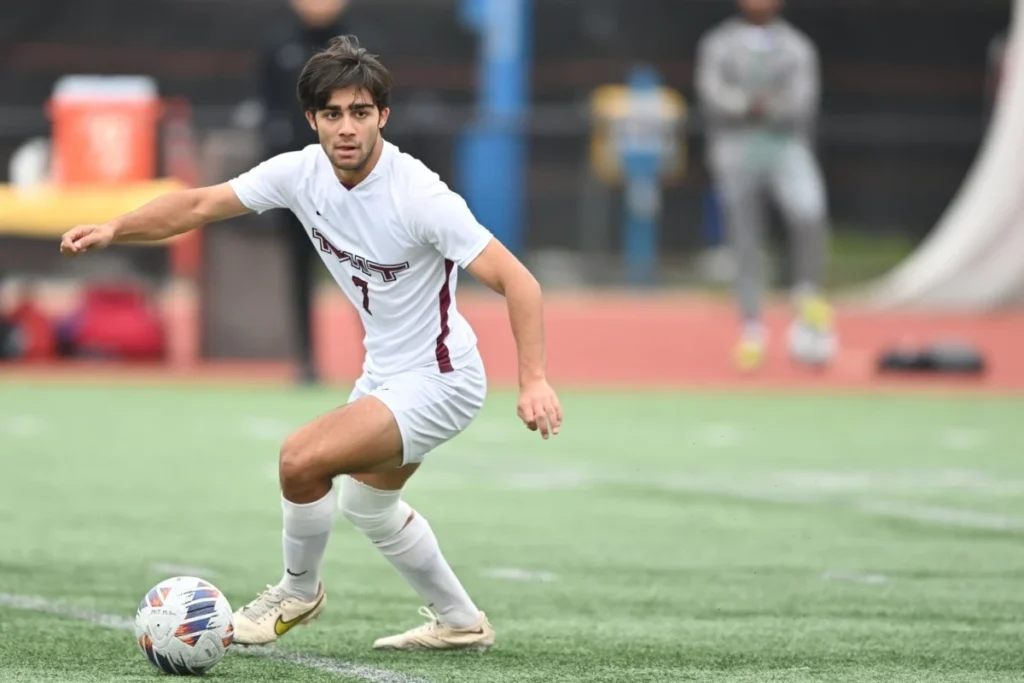
Dilin Meloni, a rising senior at the Massachusetts Institute of Technology, is redefining the traditional archetype of the collegiate athlete by balancing the rigors of elite-level soccer with the complexities of nuclear science and physics. As a standout attacking midfielder for the MIT Engineers and a double major in Course 22 (Nuclear Science and Engineering) and Course 8 (Physics), Meloni represents a unique intersection of physical prowess and intellectual ambition. His journey from being a highly sought-after high school prospect to a leader in student governance at one of the world’s most prestigious technical institutions offers a window into the evolving landscape of Division III athletics, where the "student-athlete" moniker is treated with literal and intense gravity.
From Needham to the Nuclear Lab: A Strategic Choice
Meloni’s path to Cambridge was paved with accolades. During his tenure at Needham High School in Massachusetts, he was recognized as the Massachusetts Boys Soccer Player of the Year and earned the distinction of All-American. For an athlete of his caliber, the recruitment process often involves weighing offers from powerhouse Division I programs where athletics frequently take precedence over academic exploration. However, Meloni’s decision-making process was driven by a specific intellectual spark.
As a junior in high school, Meloni encountered a research paper published by the MIT Plasma Science and Fusion Center (PSFC). The paper detailed advancements in fusion energy—a field often described as the "holy grail" of clean energy. This exposure fundamentally shifted his priorities. While he remained committed to soccer, his goal became twofold: to be an "Engineer" on the pitch and a nuclear engineer in the laboratory. By choosing MIT, Meloni opted for an environment where his athletic talents would be matched by the intellectual demands of his coursework.
This dual commitment is currently manifesting in his professional development. This summer, Meloni is serving as an intern at Commonwealth Fusion Systems (CFS), an MIT spin-off company focused on commercializing fusion energy. CFS is currently working on SPARC, a compact, high-field fusion device designed to produce net energy. Meloni’s transition from studying theoretical physics to working in the practical application of fusion technology mirrors his transition from high school star to collegiate leader.
The Social Architecture of MIT Athletics
One of the most persistent misconceptions about MIT is that its students are siloed in laboratories, disconnected from the traditional social structures of university life. Meloni argues that the reality is quite the opposite, with the athletic community serving as a primary driver of social cohesion. At MIT, approximately 20% of the undergraduate population participates in varsity sports, making the Department of Athletics, Physical Education, and Recreation (DAPER) one of the most significant social hubs on campus.
For Meloni, the soccer team provided an immediate support system upon his arrival. The "preseason" period—a two-week window before the start of the fall semester—is a critical time for student-athletes. While the rest of the student body has yet to arrive, athletes are immersed in an environment of shared goals and rigorous schedules. Meloni notes that this common ground facilitates connections that might be more difficult to forge in a purely academic setting.
This sense of community extends beyond the field. Meloni’s living situation—a fraternity largely comprised of members from the soccer, football, swimming, and track teams—illustrates how athletic bonds form the bedrock of student life. However, he emphasizes that this community is not exclusionary. The "MIT ecosystem," as he describes it, allows for a fluidity where athletes and non-athletes interact in labs and classrooms, preventing the "jock" stereotype from taking root. Instead, being an athlete is viewed as another facet of a student’s identity, alongside their research interests and academic pursuits.
Leadership through the Student-Athlete Advisory Committee
Beyond his performance as an attacking midfielder, Meloni has taken on a significant leadership role as a representative on the Student-Athlete Advisory Committee (SAAC). The SAAC is a mandated organization at NCAA member institutions, designed to provide a voice for student-athletes in the administration of their athletic departments. At MIT, which boasts 33 varsity sports—one of the largest programs in the country—the task of representing the diverse needs of hundreds of athletes is a complex logistical challenge.
Meloni’s involvement in student governance began in his freshman year, spurred by a recommendation from his coach. His background in high school student government, including serving on his town’s school committee and representing students at the state level in Massachusetts, provided him with a foundation in advocacy and administration.
Under Meloni’s leadership, the SAAC has focused on identifying "pain points" across the 33 teams. This process involves meeting with coaches and athletes to compile a list of actionable improvements. The issues range from broad concerns, such as the quality of nutritional options and preseason scheduling, to highly specific facility requirements.
Navigating the Logistics of a 33-Team Program
The management of MIT’s athletic facilities is a prime example of the challenges Meloni faces in his SAAC role. With 33 teams vying for limited space, conflict is inevitable. The new Sports Performance Facility, a state-of-the-art strength and conditioning center, serves every varsity athlete, necessitating a complex system of time allocation.
Meloni highlights the friction that can arise between teams that share specific types of facilities. For instance, seven different teams utilize the major turf fields, while the pool is a shared resource between the swimming and diving teams and the water polo program. Part of Meloni’s role is to act as a mediator between the student body’s desires and the administrative realities.
"Students are going to ask for more than they’re going to get," Meloni admits, noting that the desire for priority access to fields is a constant theme. His role often involves explaining the "cost associated with everything" and the logistical hurdles faced by the administration. By fostering a culture of compromise, Meloni seeks to bridge the gap between the aspirations of competitive athletes and the practical constraints of university infrastructure.
Data and Context: The MIT Athletic Landscape
To understand the weight of Meloni’s advocacy, one must look at the scale of MIT’s athletic department. MIT competes in the New England Women’s and Men’s Athletic Conference (NEWMAC) at the NCAA Division III level. Unlike Division I programs, Division III schools do not offer athletic scholarships, meaning every athlete is there by choice, balancing their sport with the same academic requirements as any other student.
MIT has consistently ranked at the top of the NACDA Directors’ Cup, which measures the overall success of collegiate athletic programs. This success is achieved while maintaining the highest academic standards. The university’s commitment to athletics is evidenced by its expansive facilities, including the Zesiger Sports and Fitness Center and the Johnson Athletics Center. However, as Meloni points out, the sheer volume of participants—over 800 varsity athletes—puts a constant strain on these resources.
Meloni’s double major in Nuclear Science and Physics is a rarity even within the high-achieving environment of MIT athletics. He notes that while many athletes gravitate toward Course 6 (Electrical Engineering and Computer Science) or Course 2 (Mechanical Engineering), the "hard" sciences like physics and nuclear engineering see less varsity representation. Meloni has made it a personal mission to recruit younger players into these fields, arguing that the analytical skills developed in the lab are not unlike the tactical awareness required on the soccer pitch.
Broader Impact and the "Tipping Point"
According to Meloni, the past year has represented a "tipping point" for student-athlete relations at MIT. The Department of Athletics, Physical Education, and Recreation (DAPER) and the Office of Student Life have shown an increased willingness to overhaul existing protocols based on SAAC feedback. This shift is significant because it recognizes the athlete community not just as a subset of the student body, but as a vital stakeholder in the university’s broader mission.
The implications of Meloni’s work extend beyond field schedules and cafeteria food. By advocating for the needs of student-athletes, he is helping to ensure that MIT remains an attractive destination for high-caliber individuals who refuse to choose between elite athletics and elite academics. In an era where the "transfer portal" and "Name, Image, and Likeness" (NIL) deals are dominating the headlines of collegiate sports, the Division III model at MIT offers a counter-narrative of intrinsic motivation and holistic development.
Meloni’s perspective is grounded in a realistic optimism. He acknowledges that while a perfect system is unattainable, the existence of open communication channels between students and administrators is the key to incremental progress. "As long as we have this communication channel open, I think we can make small changes that’ll lead to big changes eventually," he states.
Conclusion: The Engineer of the Future
As Dilin Meloni enters his senior year, his focus remains divided between the soccer field, the physics classroom, and the CFS internship. His story is a testament to the fact that the skills required for success in high-stakes athletics—discipline, leadership, and the ability to perform under pressure—are the same skills required to solve the world’s most pressing energy challenges.
In the laboratory, Meloni is working toward a future powered by clean, sustainable fusion energy. On the field, he is leading a team of "Engineers" toward a conference championship. And in the boardroom of the SAAC, he is engineering a better experience for the hundreds of student-athletes who follow in his footsteps. Meloni’s tenure at MIT serves as a blueprint for the modern student-athlete: a figure who is not siloed by their interests, but rather enriched by the fusion of their diverse passions.