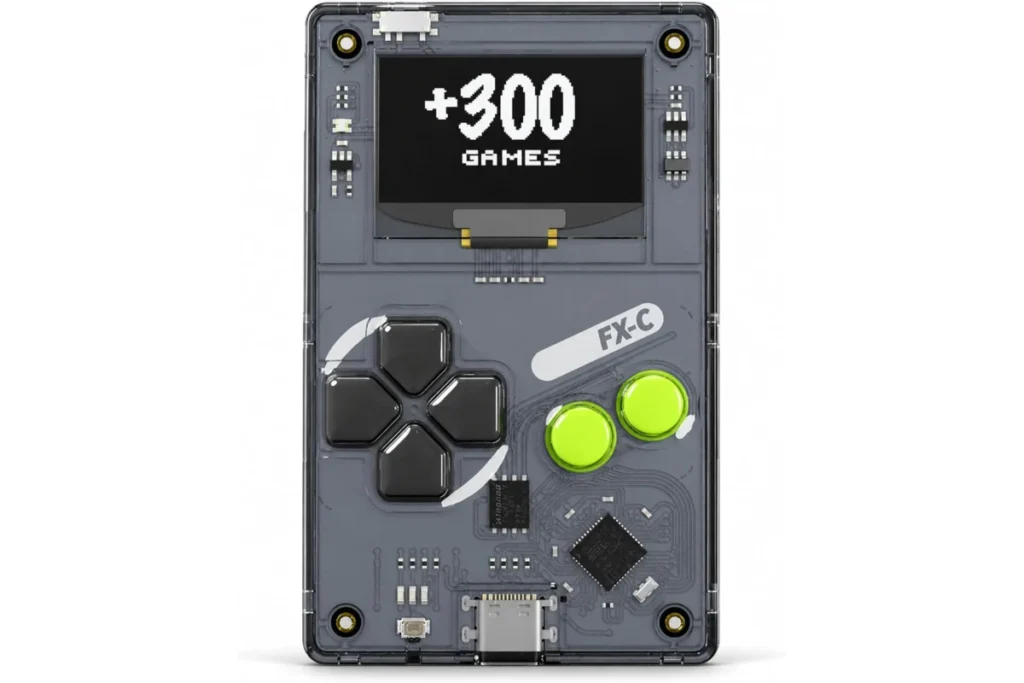
The release of the Arduboy FX-C marks the latest evolution in a lineage of ultra-portable, open-source gaming hardware that has captivated the maker community for over a decade. Manufactured in partnership with Seeed Studio, this credit-card-sized console retains the minimalist charm of its predecessors while integrating modern hardware standards, most notably the transition to USB-C. Priced at $79, the Arduboy FX-C serves as both a retro-style gaming device and a robust educational platform for aspiring developers, powered by the venerable 8-bit ATMega32u4 microcontroller. Despite the proliferation of high-performance handhelds utilizing ESP32 or ARM-based architectures, the Arduboy FX-C leans into the elegance of constraints, offering a curated library of over 300 community-developed titles pre-installed on its internal flash memory.
Technical Specifications and Hardware Architecture
At the heart of the Arduboy FX-C is the ATMega32u4, an 8-bit AVR microcontroller running at 16MHz. While these specifications may seem modest in an era of multi-core mobile processors, they provide a standardized environment that simplifies the development process for those familiar with the Arduino ecosystem. The device features 32KB of internal flash memory for the bootloader and active program, but the "FX" designation signifies the inclusion of a 16MB external flash memory chip. This addition is the defining feature of the FX series, allowing the device to store hundreds of games simultaneously, which can be cycled through via an on-screen menu without the need for a PC connection.
The display is a 0.96-inch monochromatic OLED with a resolution of 128×64 pixels. This high-contrast screen ensures visibility in various lighting conditions, including direct sunlight, which is often a challenge for traditional backlit LCDs. The tactile interface consists of six buttons—a four-way directional pad and two action buttons—providing a classic "Game Boy" style input layout. For connectivity and charging, the FX-C has moved away from the aging Micro-USB standard in favor of USB-C, a move that aligns with modern cable standards and enhances the durability of the port. This port also facilitates "link cable" functionality, allowing two Arduboy units to connect for head-to-head multiplayer gaming.
A Chronology of the Arduboy Platform
The journey of the Arduboy began in 2014 when creator Kevin Bates released a video of a digital business card that could play Tetris. The viral success of this prototype led to a highly successful Kickstarter campaign in 2015, which raised over $430,000 from more than 7,000 backers. The original Arduboy was praised for its sleek stainless-steel back and polycarbonate front, establishing a design language that emphasized portability and "hackability."
In the years following the initial launch, the community expanded the platform’s capabilities, leading to the development of the "Arduboy FX" mod. Originally a DIY upgrade for existing units, the FX modification added an external flash chip to overcome the 32KB storage limit of the ATMega32u4. Recognizing the demand for this feature, Bates eventually integrated it into the official production line. The FX-C represents the most refined version of this vision, streamlining the manufacturing process through Seeed Studio and updating the physical interface to meet 2024 standards. This timeline reflects a rare success story in the "maker-pro" space, where a community-driven project successfully transitions into a long-term commercial product without losing its open-source roots.

The Software Ecosystem: A Universe in Your Pocket
The Arduboy FX-C is often compared to a hardware manifestation of UFO 50, the acclaimed collection of fictional retro games. However, unlike a single-developer collection, the Arduboy library is the result of a decade of global community contributions. The 300+ games included on the device are not mere clones or minor variations; they represent a wide spectrum of genres and technical achievements. Users can find everything from high-speed racing games and complex RPGs to puzzle games and "faux-3D" first-person shooters that push the 8-bit processor to its absolute limits.
The software experience is characterized by its immediacy. Upon powering on the device, the user is greeted with a bootloader menu that categorizes games by genre or title. Because the games are written in C++ and optimized specifically for this hardware, there is no emulation lag. The "FX" chip allows for nearly instantaneous loading of new titles, effectively turning the device into a self-contained arcade. Furthermore, the inclusion of an RGB LED provides developers with a secondary output for visual feedback, such as indicating health levels in a game or signaling status changes in a non-gaming application.
The Maker Perspective and Educational Impact
Beyond its utility as a gaming device, the Arduboy FX-C is fundamentally a learning tool. It is fully compatible with the Arduino IDE, meaning that anyone with a basic understanding of coding can write a program and upload it to the device. The Arduboy community has produced an extensive library of tutorials, libraries, and forums that guide beginners through the process of game design, from drawing sprites to managing memory and handling collision detection.
The educational value of the Arduboy lies in its constraints. Modern game development often relies on heavy engines like Unity or Unreal, which can obscure the underlying logic of how a computer processes game data. On the Arduboy, every byte of RAM and every cycle of the CPU counts. This environment encourages "clean" coding practices and a deep understanding of hardware-software synergy. For educators, the Arduboy FX-C provides a tangible, high-engagement platform for teaching STEM concepts, as students can see their code come to life in a device they can carry in their wallets.
Market Positioning and Competitive Analysis
In the current handheld market, the Arduboy FX-C occupies a unique niche. It does not compete directly with high-powered retro handhelds like the Miyoo Mini or the Anbernic RG series, which focus on emulating 16-bit and 32-bit consoles. Instead, it competes in the "boutique" and "maker" categories alongside devices like the Panic Playdate. While the Playdate offers a more advanced screen and a unique crank input at a higher price point ($199), the Arduboy FX-C emphasizes affordability, open-source transparency, and the specific aesthetic of 8-bit minimalism.
The $79 price point reflects the costs of specialized, small-scale manufacturing and the premium materials used in the "Founders Edition" and standard Seeed Studio models. While some critics point to the availability of cheap "50-in-1" handhelds sold at mass retailers for $20, those devices typically use proprietary "NES-on-a-chip" hardware that is not programmable and offers a poor user experience. The Arduboy FX-C’s value proposition is rooted in its status as a platform rather than a static toy.

Official Responses and Community Reception
The partnership with Seeed Studio has been viewed as a strategic move to stabilize the Arduboy supply chain, which, like many hardware projects, faced challenges during the global semiconductor shortages of the early 2020s. Seeed Studio’s expertise in PCBA (Printed Circuit Board Assembly) and logistics allows the Arduboy team to focus on software and community engagement while ensuring that the hardware meets high quality-control standards.
Early adopters of the FX-C have praised the transition to USB-C and the continued support for the existing library of games. Feedback from the community forums suggests that while the lack of an external volume wheel remains a point of contention for some, the software-based mute functions in the majority of games have mitigated this issue. The brightness of the RGB LED has also been noted as a potential distraction in low-light environments, though users have pointed out that because the system is open-source, the LED intensity can be adjusted in the code by the user.
Broader Implications for the Future of Indie Hardware
The continued success of the Arduboy platform suggests a growing market for "distraction-free" technology. In an era dominated by smartphones and high-fidelity gaming, there is a clear appetite for devices that do one thing well. The Arduboy FX-C’s focus on 8-bit aesthetics and community-driven content resonates with a broader cultural trend toward "lo-fi" and retro-computing.
Furthermore, the Arduboy FX-C serves as a blueprint for other indie hardware creators. It demonstrates that a product can survive and thrive by fostering a dedicated community and remaining committed to open-source principles. As the FX-C reaches more users through platforms like Amazon and Seeed Studio’s global storefront, it is poised to inspire a new generation of developers to explore the possibilities of low-power, high-creativity computing. Whether used as a pocket-sized time-waster or a gateway into the world of computer science, the Arduboy FX-C remains a testament to the enduring appeal of the 8-bit era.