In a significant advancement for the field of nanocell engineering, a collaborative research team has successfully designed a hollow CdS@polydopamine (PDA) nanoreactor that replicates the sophisticated architectural and functional characteristics of living cells. This breakthrough, led by Professor LI Can from the Dalian Institute of Chemical Physics (DICP) of the Chinese Academy of Sciences (CAS), alongside Professor Jian Liu’s team at Inner Mongolia University, marks a pivotal step toward bridging the gap between biological efficiency and synthetic chemical production. The study, published in the Journal of the American Chemical Society, details how this biomimetic system can significantly enhance the efficiency of light-driven chemical reactions, specifically the photosynthesis of hydrogen peroxide (H2O2).
The Engineering of a Synthetic Cell Analog
The quest to replicate cellular functions within synthetic materials has long been a "holy grail" of nanotechnology. Living cells are the ultimate chemical factories, performing thousands of simultaneous reactions with nearly 100% selectivity and remarkable energy efficiency. They achieve this through compartmentalization—organizing enzymes and reactants within specialized organelles and membranes that control the flow of ions and molecules.
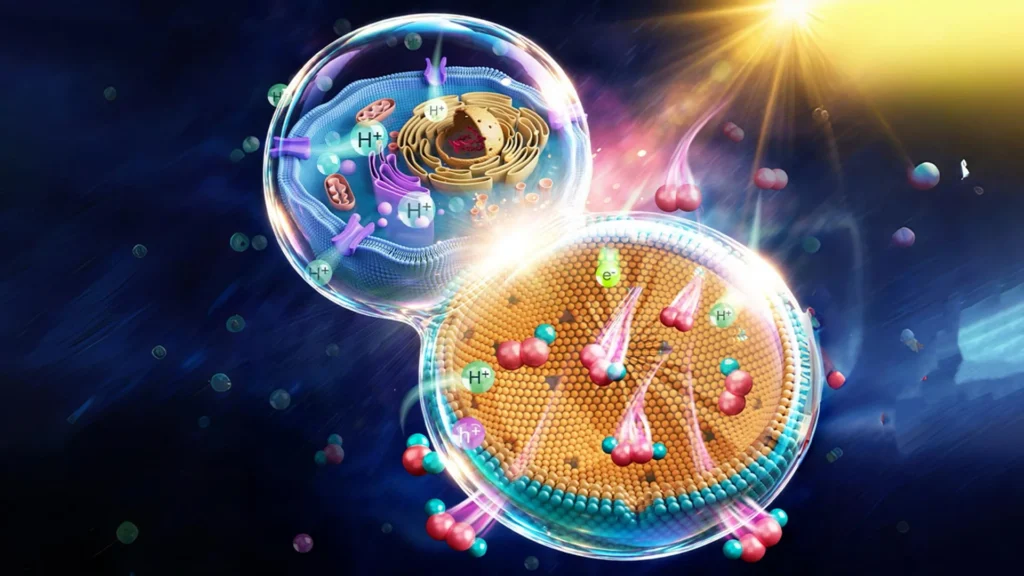
The newly developed nanoreactor adopts a "hollow" architecture, featuring a cadmium sulfide (CdS) core and a polydopamine shell. This design is not merely aesthetic; it is a functional recreation of the cellular environment. By creating a confined space at the nanoscale, the researchers have managed to concentrate reactants and manage the movement of protons and electrons in a way that mimics the inner workings of a biological cell. This approach, known as nanocell engineering, allows scientists to move beyond traditional flat-surface catalysis into three-dimensional, highly organized reaction environments.
The Dual Pillars of Biomimicry: Proton Relays and Compartmentalization
The success of the CdS@polydopamine nanoreactor rests on two primary biomimetic features that distinguish it from previous synthetic catalysts.
1. The Dynamic Proton Relay System
One of the most complex tasks in biological photosynthesis is the management of protons. In living plants, proton pumps and relays facilitate the movement of hydrogen ions to ensure that electron transfer occurs smoothly. The research team replicated this by utilizing the chemical properties of the polydopamine shell.
The shell contains a dynamic catechol/o-benzoquinone redox pair. Unlike a mechanical pump that requires external energy to move ions against a gradient, this chemical pair acts as a "proton relay." It functions by repeatedly accepting and releasing protons, thereby accelerating the process of proton-coupled electron transfer (PCET). In artificial photosynthesis, the movement of electrons is often hindered by the slow movement of protons; by synchronizing these two processes through the PDA shell, the researchers achieved a much higher reaction velocity than previously possible in non-biological systems.
2. Structural Compartmentalization and Light Harvesting
The second feature is the nanoreactor’s physical structure. It consists of a nanoscale hollow cavity surrounded by a porous shell. This "room" within the material serves several purposes. First, it creates a confined environment where oxygen and water molecules can accumulate, increasing the frequency of molecular collisions and reactions.
Second, the hollow structure acts as a light trap. When visible light enters the cavity, it bounces off the internal walls multiple times, increasing the probability of photon absorption by the CdS semiconductor. This "multiple scattering" effect ensures that more energy from sunlight is harvested to drive the chemical reaction. Finally, the porous nature of the PDA shell allows for the efficient diffusion of reactants in and products out, preventing the "clogging" that often limits the lifespan of synthetic catalysts.
Achieving High-Efficiency Hydrogen Peroxide Photosynthesis
Hydrogen peroxide is a vital industrial chemical used in everything from medical disinfection and wastewater treatment to rocket propellant and paper bleaching. However, the current industrial method for producing H2O2—the anthraquinone process—is energy-intensive, involves hazardous solvents, and produces significant waste.
The DICP-led team sought a "green" alternative: using sunlight to drive the reaction between water and oxygen. This process involves two half-reactions: oxygen reduction and water oxidation. In most synthetic systems, these two reactions occur at vastly different speeds, leading to an imbalance that reduces overall efficiency.
The CdS@polydopamine nanoreactor solves this bottleneck. By utilizing the Z-scheme heterojunction—a pathway that mimics the two-stage electron excitation found in natural leaves—the system balances the two half-reactions. Under visible-light illumination in an aqueous solution, the nanoreactor achieved an H2O2 photosynthesis rate of 3.24 mmol per gram of catalyst per hour (mmol gcat.-1 h-1). Perhaps more impressively, it reached a solar-to-chemical conversion efficiency of 1.2%, a figure that places it among the top performers in the field of artificial photosynthesis.
Analytical Validation and Chronology of the Research
The development of the nanoreactor followed a rigorous multi-year timeline of synthesis and testing. The project began with the selection of polydopamine due to its biocompatibility and rich functional groups, which are similar to the melanins found in human skin and eyes.
To understand why the nanoreactor performed so well, the researchers employed a suite of advanced analytical techniques:
- In situ Spectroscopy: This allowed the team to watch the chemical reactions happen in real-time at the molecular level, confirming the role of the catechol/o-benzoquinone pair.
- Finite Element Simulations: These computer models mapped how light moved within the hollow cavity and how reactants diffused through the pores.
- Photochemical Analysis: This measured the speed and efficiency of electron movement within the Z-scheme heterojunction.
By combining these methods, the team was able to prove that the "cell-like" features were indeed responsible for the performance gains, rather than just the chemical composition of the materials alone.
Practical Application: The Hydrogel Matrix
One of the primary criticisms of many high-performance nanomaterials is that they are difficult to recover and reuse, often existing only as powders in a laboratory beaker. To address this, Professor Li’s team took the research a step further by embedding the nanoreactors into a sodium alginate hydrogel matrix.
Sodium alginate is a natural polymer derived from seaweed, making it an environmentally benign choice for industrial applications. By incorporating the nanoreactors into this "jelly-like" solid structure, the researchers created a stable, recyclable photocatalytic system. In testing, these hydrogel beads could be placed in water under natural sunlight to produce H2O2 and then easily filtered out and reused for multiple cycles without a significant loss in performance. This move from "nanoscale powder" to "macroscale material" is a critical step toward the commercialization of solar-to-chemical technologies.
Broader Implications and Official Commentary
The implications of this research extend far beyond the production of hydrogen peroxide. By demonstrating that cellular principles—like proton relays and compartmentalization—can be effectively translated into synthetic nanomaterials, the study opens the door for a new generation of "smart" catalysts.
Professor LI Can emphasized the transformative potential of this approach: "Our study provides a new strategy for engineering biomimetic nanoreactors that increasingly replicate the sophisticated functions of living cells. This is not just about hydrogen peroxide; it is about opening new opportunities in artificial photosynthesis, energy catalysis, and synthetic chemistry."
Industry analysts suggest that this technology could eventually be integrated into decentralized chemical production. Instead of large, carbon-intensive factories, small-scale "solar chemical farms" using hydrogel-based nanoreactors could produce essential chemicals on-site using only sunlight, water, and air. This aligns with global efforts to reach "Net Zero" carbon emissions, as it replaces fossil-fuel-dependent processes with renewable-driven ones.
Furthermore, the collaboration between DICP and Inner Mongolia University highlights the growing strength of interdisciplinary research in China. By combining expertise in semiconductor physics, polymer chemistry, and biological modeling, the team has provided a blueprint for how future materials might be designed: not by looking at chemicals in isolation, but by looking at how nature organizes them into functional, living systems.
Conclusion
The creation of the CdS@polydopamine nanoreactor represents a milestone in the field of artificial photosynthesis. By successfully mimicking the proton-handling and spatial organization of a living cell, the researchers have achieved record-breaking efficiencies in a sustainable, recyclable format. As the world continues to seek cleaner ways to produce energy and chemicals, the lessons learned from the "nanocell" may provide the key to a truly green industrial revolution. The study serves as a reminder that after billions of years of evolution, nature remains the most proficient engineer, and our best path forward may be to follow its design.