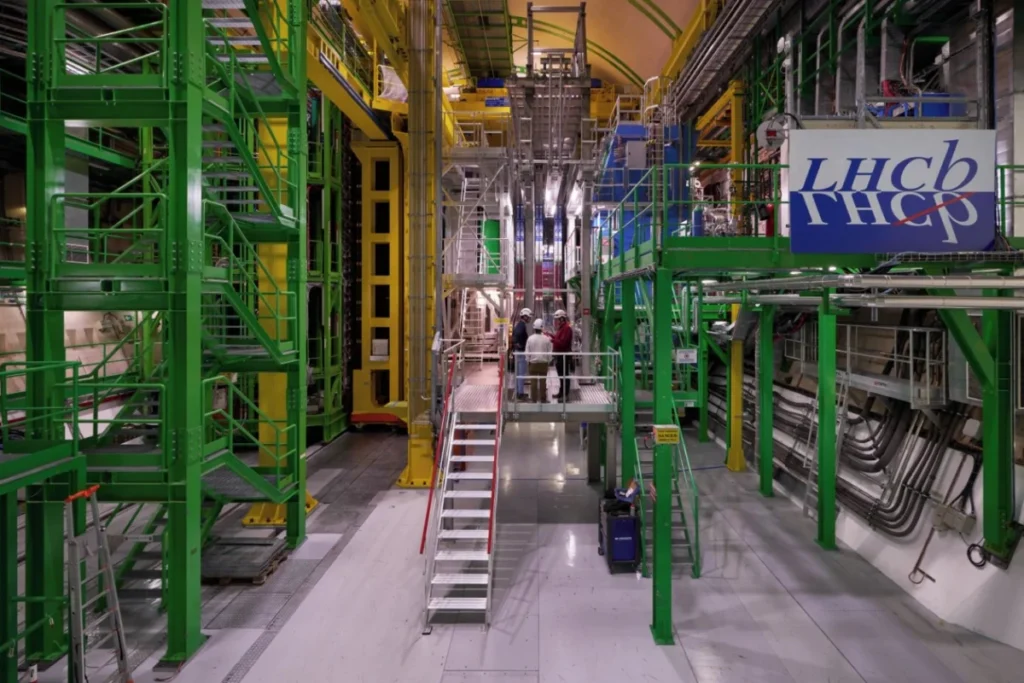
The Large Hadron Collider beauty (LHCb) experiment at CERN has reported a significant deviation from the Standard Model of particle physics, marking a potential turning point in our understanding of the fundamental constituents of the universe. According to a new analysis published in the journal Physical Review Letters, researchers have identified a four-standard deviation (4-sigma) discrepancy in the angular distribution of particles resulting from the decay of B mesons. This finding, spearheaded in part by researchers at the Massachusetts Institute of Technology (MIT), reinforces a decade-long pattern of "tensions" in the behavior of beauty quarks, suggesting that the current mathematical framework governing particle physics may be incomplete.
The Standard Model has long served as the bedrock of modern physics, successfully predicting the existence of the Higgs boson and describing how three of the four fundamental forces—electromagnetism, the weak nuclear force, and the strong nuclear force—interact with matter. However, the model is notoriously silent on several of the universe’s greatest mysteries, including the nature of dark matter, the mechanism of gravity at the quantum level, and the overwhelming prevalence of matter over antimatter in the observable cosmos. The search for "New Physics"—phenomena that cannot be explained by the Standard Model—is the primary objective of the high-energy experiments conducted at the Large Hadron Collider (LHC).
The Mechanics of the Beauty Quark Decay
At the heart of this discovery is the "beauty quark," or "b quark," a third-generation elementary particle that is significantly heavier than the up and down quarks found within protons and neutrons. Because of their high mass, beauty quarks are unstable and rapidly decay into lighter particles. One specific and highly sensitive decay channel involves a B meson (a particle composed of a beauty antiquark and another quark) transforming into a K meson and a pair of muons ($B to K^mu^+mu^-$).
In the Standard Model, this specific decay is considered "rare" because it does not happen through a simple, direct process. Instead, it occurs via complex "quantum loops" where virtual particles—particles that blink in and out of existence for a fraction of a second—intervene to facilitate the transformation. Because these loops are sensitive to every particle in nature, even those we have not yet discovered, they act as a natural laboratory for detecting New Physics. If an unknown particle, such as a "Z’ boson" or a "leptoquark," exists in nature, it would theoretically enter these quantum loops and alter the trajectory and angular distribution of the resulting K* mesons and muons.
The recent LHCb analysis focused specifically on these angular distributions. By measuring the angles at which the decay products fly away from the point of collision, physicists can create a multi-dimensional map of the decay process. The new data shows that the particles are not behaving in the way the Standard Model predicts, reaching a statistical significance of four sigma.
Understanding Statistical Significance: The Four-Sigma Threshold
In the realm of particle physics, the "sigma" ($sigma$) measurement is the gold standard for determining whether a result is a genuine discovery or a mere statistical fluke. A one-sigma result is common and often disappears with more data. A three-sigma result is considered "evidence" of a phenomenon. A five-sigma result is the official threshold for a "discovery," representing a probability of about 1 in 3.5 million that the result is a random fluctuation.
The current 4-sigma discrepancy corresponds to a p-value of approximately 0.00003, or a 0.003 percent chance that the observed pattern would occur if the Standard Model were perfectly accurate. While not yet meeting the 5-sigma discovery threshold, the result is considered extremely compelling by the scientific community because it is not an isolated incident. Similar anomalies have been observed in independent datasets and different decay modes involving beauty quarks over the last ten years.
To ensure the validity of the findings, the LHCb collaboration employed a rigorous "blind" analysis technique. Two independent teams worked on the data without communicating their results until the final stage. One of these teams was led by Eluned Smith, an assistant professor of physics at MIT and a researcher at the Laboratory for Nuclear Science. The convergence of results from independent methodologies provides a high degree of confidence in the robustness of the measurement.
A Decade of Tension: The Chronology of Flavor Anomalies
The quest to understand beauty quark decays is not a new endeavor. The scientific community has been monitoring "flavor anomalies"—unexpected behaviors in different "flavors" or types of quarks—for over a decade.
The timeline of these observations highlights a persistent trend:
- 2013: Initial measurements of the $B to K^*mu^+mu^-$ decay at the LHCb experiment first hinted at a discrepancy in an angular observable known as $P’_5$. This sparked immediate interest among theoretical physicists.
- 2015: Follow-up analyses with larger datasets from the LHC’s Run 1 confirmed that the tension in the $P’_5$ observable remained, suggesting the 2013 result was not a simple statistical error.
- 2020-2021: LHCb reported further anomalies in "lepton universality" tests, which suggest that beauty quarks might decay into muons less often than they decay into electrons—a direct violation of a core Standard Model principle.
- 2024: The current open-access analysis, published in Physical Review Letters, provides the most precise measurement to date of the overall angular distribution, reinforcing the 4-sigma discrepancy and integrating more sophisticated theoretical corrections.
Throughout this period, theorists have debated whether these anomalies are signs of new particles or if they stem from "hadronic uncertainties"—difficulties in calculating the complex effects of the strong nuclear force (Quantum Chromodynamics or QCD) that binds quarks together. The new results provide more data points to help distinguish between these two possibilities.
The Role of MIT and Technological Innovation
The contribution of MIT researchers like Eluned Smith has been pivotal in advancing the precision of these measurements. Beyond the statistical analysis, the team is heavily involved in the technical infrastructure that makes such rare observations possible. The LHCb detector is a specialized "forward spectrometer" designed specifically to capture the particles produced by beauty quarks, which tend to fly at small angles relative to the proton beam.
One of the most significant recent upgrades to the LHCb experiment is the implementation of a fully software-based "trigger" system. In previous iterations of the LHC, hardware limitations meant that many potentially interesting particle collisions were discarded in real-time because the system could not process the data fast enough. The new software-based trigger allows researchers to record and analyze far more beauty quark decays than ever before.
Looking toward the future, Smith and her colleagues are developing low-latency Artificial Intelligence (AI) systems. These AI algorithms are designed to perform real-time data processing and compression directly within the radiation-intense electronics of the detector. This advancement is expected to increase the experiment’s data collection rate by up to 40 times compared to the original detector design, providing the massive datasets required to move from 4-sigma "evidence" to 5-sigma "discovery."
Implications and Theoretical Prospects
If the 4-sigma discrepancy is eventually confirmed as New Physics, it would necessitate a fundamental rewrite of our understanding of the universe. Several theoretical models are already being explored to explain the data.
One leading candidate is the existence of "Leptoquarks"—hypothetical particles that would bridge the gap between leptons (like electrons and muons) and quarks. Another possibility is the "Z’ boson," a heavy, neutral cousin of the Z boson that mediates the weak force. If these particles exist, they could be the "missing link" that explains why the Standard Model fails to account for gravity or dark matter.
However, the scientific community remains cautious. There is a possibility that the discrepancy arises from the immense difficulty of calculating "Standard Model predictions" for processes involving the strong force. Quarks are never found in isolation; they are always bound by gluons, and the mathematics of these interactions is notoriously complex. If the theoretical calculations have underestimated certain "hadronic" effects, the discrepancy might disappear as the math improves.
The Road Ahead for LHC Run 3
The LHC is currently in its third major operational period, known as Run 3. With the detector’s recent upgrades and the increased energy of the proton collisions, the volume of data being produced is unprecedented. Over the next several years, the LHCb collaboration will analyze this new influx of information to determine if the 4-sigma tension strengthens or fades away.
The stakes are high. Confirmation of New Physics would be the most significant breakthrough in particle physics since the discovery of the Higgs boson in 2012. It would open a "window" into a hidden sector of the universe, potentially leading to new technologies and a deeper understanding of the origins of space and time.
As Professor Eluned Smith noted, the combination of more data and improved theoretical models will be the deciding factor. Whether the answer lies in a new force of nature or a more nuanced understanding of the forces we already know, the 4-sigma result from the LHCb has ensured that beauty quark decays will remain at the forefront of the global scientific agenda for years to come.