For centuries, water has been the primary subject of chemical inquiry, serving as the universal solvent and the foundation of biological life. Yet, despite its ubiquity, water continues to yield surprises when its environment is altered. One of the most persistent mysteries in modern physical chemistry involves the behavior of water when it is restricted to spaces only a few molecules wide—a state known as nanoconfinement. A seminal study published in the journal Science Advances has finally provided a definitive answer to a decade-old debate, revealing that the perceived changes in water’s reactivity in these tiny spaces are driven not by the confinement itself, but by intense internal pressures and specific surface interactions.
The Mystery of Water at the Nanoscale
At the macroscopic level, the properties of water are well-understood. We know its boiling point, its density, and its ability to act as both an acid and a base through a process called autoionization. This process occurs when water molecules spontaneously split into two charged ions: the hydronium ion (H3O+) and the hydroxide ion (OH-). The concentration of these ions determines the pH of a solution, which in turn dictates the speed and nature of countless chemical reactions, from the metabolic processes within a human cell to the electrochemical cycles inside a lithium-ion battery.
However, when water is squeezed into nanoscale pores—such as those found in geological formations, biological membranes, or synthetic carbon nanotubes—its behavior shifts. For the past decade, the scientific community has been divided. Some experiments suggested that nanoconfined water becomes significantly more reactive, splitting into ions much more frequently than bulk water. Others found no such change, or even a decrease in reactivity. These contradictions have hindered the development of technologies that rely on nanofluidics, including advanced water filtration systems and next-generation energy storage.
The new research, led by a team from the University of Cambridge’s Yusuf Hamied Department of Chemistry and the Cavendish Laboratory, suggests that the "confinement effect" is a more nuanced phenomenon than previously realized. By leveraging advanced machine learning and quantum mechanical simulations, the researchers have identified the hidden variables that led to years of conflicting results.
A New Framework: Pressure and Chemical Potential
The central breakthrough of the study lies in its application of thermodynamics to the nanoscale. Traditionally, researchers focused on the geometric constraints of the pores—the "size" of the space—as the primary driver of chemical changes. The Cambridge team, however, discovered that the apparent increase in water reactivity is largely a function of density and pressure.
"The contradictions in the literature were largely because scientists were comparing systems at different effective pressures or densities without realizing it," explained Xavier R. Advincula, the study’s lead author.
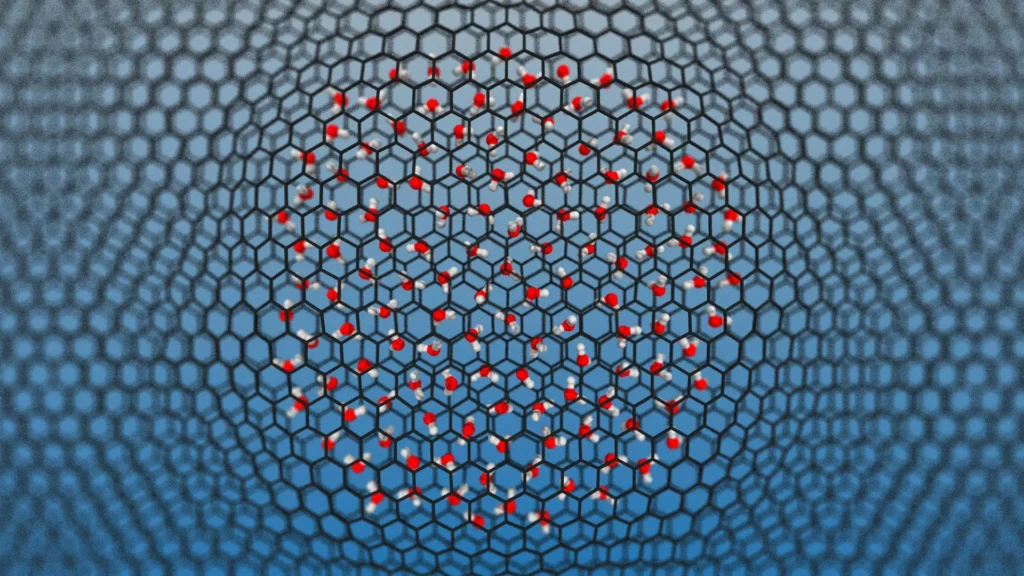
When water is confined between two-dimensional materials like graphene, it is subjected to immense internal pressure. The study found that even without an external force, water trapped between atomically thin layers can reach pressures of several gigapascals. To put this in perspective, one gigapascal is roughly 10,000 times the atmospheric pressure at sea level, comparable to the conditions found deep within the Earth’s mantle or at the bottom of the deepest oceanic trenches.
This pressure is generated by van der Waals forces—the weak attractive forces that exist between all atoms. While these forces are negligible in everyday life, they become incredibly powerful when distributed over the large surface area of two-dimensional sheets. These sheets act like a molecular vice, pulling together and compressing the water molecules trapped between them.
The researchers demonstrated that when confined water and bulk water are compared under the same thermodynamic conditions—specifically at the same chemical potential and pressure—the intrinsic "confinement effect" mostly disappears. The water reacts more not because it is in a small space, but because it is under extreme pressure.
The Role of Machine Learning in Molecular Discovery
Investigating the chemistry of water at the nanoscale is an immense computational challenge. Traditional quantum mechanical simulations, which provide the highest level of accuracy by accounting for the behavior of individual electrons, are too slow to study the wide range of conditions necessary to solve this puzzle. Conversely, simpler classical simulations often miss the subtle chemical shifts that occur during water splitting.
To bridge this gap, the research team utilized machine learning models trained on quantum mechanical data. These "neural network potentials" allow for simulations that possess the accuracy of quantum physics but operate at a fraction of the computational cost. This enabled the team to simulate water trapped between different materials, such as graphene and hexagonal boron nitride (hBN), across various temperatures and pressures.
By using these advanced tools, the researchers were able to observe the exact moment water molecules dissociated and how those ions interacted with the surrounding walls. This level of detail was previously impossible to achieve, providing a "molecular movie" of the chemistry unfolding within the nanoconfined space.
Surface Chemistry: Beyond the Vice Grip
While pressure was identified as the primary driver of reactivity, the study also highlighted the critical role of the confining material’s surface chemistry. Not all "nano-vices" are created equal.
The team compared water confined by graphene with water confined by hexagonal boron nitride (hBN). Graphene, consisting of a single layer of carbon atoms, is chemically inert. It provides the pressure to squeeze the water but does not interact with the resulting ions. In contrast, hBN, often called "white graphene," has a similar structure but contains nitrogen and boron atoms.
The simulations revealed that in hBN-confined environments, the hydroxide ions (OH-) formed during water splitting actually bond with the surface of the material. This chemical bonding stabilizes the ions, making it energetically "cheaper" for the water molecules to split in the first place. This discovery proves that while pressure sets the stage, the chemical identity of the walls can actively catalyze or suppress water dissociation.
Timeline of the Nanofluidic Debate
The journey to this discovery has been marked by several key milestones in the field of materials science and chemistry:
- 2004: The discovery of graphene at the University of Manchester opens the door to studying two-dimensional confinement.
- 2010–2015: Initial studies on "nanofluidics" report anomalous water behavior, including faster-than-expected flow rates and altered dielectric constants.
- 2016–2020: A series of conflicting papers are published regarding the pH of water in carbon nanotubes and graphene slits. Some suggest water becomes as acidic as vinegar, while others find it remains neutral.
- 2021: The rise of machine learning in chemistry allows researchers to simulate complex interfaces with unprecedented precision.
- 2024: The Cambridge study provides a unified thermodynamic framework, reconciling the previous decade of research by identifying pressure and surface interaction as the true catalysts.
Implications for Future Technology
The ability to control the reactivity of water at the nanoscale has profound implications for several "green" technologies.
Hydrogen Fuel Cells and Electrolyzers
Hydrogen is a clean energy carrier, but producing it efficiently requires splitting water. By understanding how nanoconfinement and surface chemistry enhance water dissociation, engineers can design more efficient catalysts for electrolyzers, potentially lowering the cost of green hydrogen.
Battery Technology
The electrolytes in batteries often operate in confined spaces within porous electrodes. The findings of this study could lead to the development of batteries with higher power densities and faster charging times by optimizing the ion-transport properties of confined fluids.
Desalination and Water Purification
As global water scarcity increases, the demand for efficient desalination is rising. Many desalination membranes rely on nanoscale pores to filter out salts. Understanding how the "internal pressure" of these pores affects water chemistry will allow for the design of membranes that are less prone to fouling and more efficient at ion separation.
Biological Insights
The human body is a masterpiece of nanoconfinement. From the ion channels in our neurons to the protein pores in our cell membranes, water is constantly being squeezed into tiny spaces. This research provides a new lens through which biologists can examine how the body regulates pH and ion balance at the molecular level.
Expert Analysis: A Design Principle for the Future
The significance of this work extends beyond academic debate. It provides what Dr. Christoph Schran of the Cavendish Laboratory calls a "practical design principle" for engineering.
"Rather than focusing solely on the size of pores or channels, we can tailor water reactivity by choosing a confining material whose surfaces interact with the products of water dissociation and by controlling the pressures generated within confined spaces," Schran noted.
This shift from "geometric engineering" to "thermodynamic and chemical engineering" marks a new era in nanotechnology. Instead of simply trying to make things smaller, scientists can now focus on the specific interactions between the fluid and its container to achieve desired chemical outcomes.
Future Research Directions
Following this breakthrough, the Cambridge team plans to expand their research into even more complex environments. Real-world materials are rarely perfect; they contain defects, edges, and chemical impurities. The researchers intend to study how these "imperfections" further influence water chemistry.
Furthermore, the team is currently screening large databases of two-dimensional materials beyond graphene and hBN. By identifying materials with specific electronic properties, they hope to find combinations that can "tune" water reactivity for specific industrial applications—potentially creating environments where water splits almost effortlessly or, conversely, remains highly stable under extreme conditions.
In the words of Professor Angelos Michaelides, "Once pressure and chemical potential are properly accounted for, a great deal of the complexity simply falls into place." This study not only clears the fog of a decade-long scientific mystery but also lights the path for the next generation of nanoscale engineering, where the most basic substance on Earth—water—can be manipulated with surgical precision.