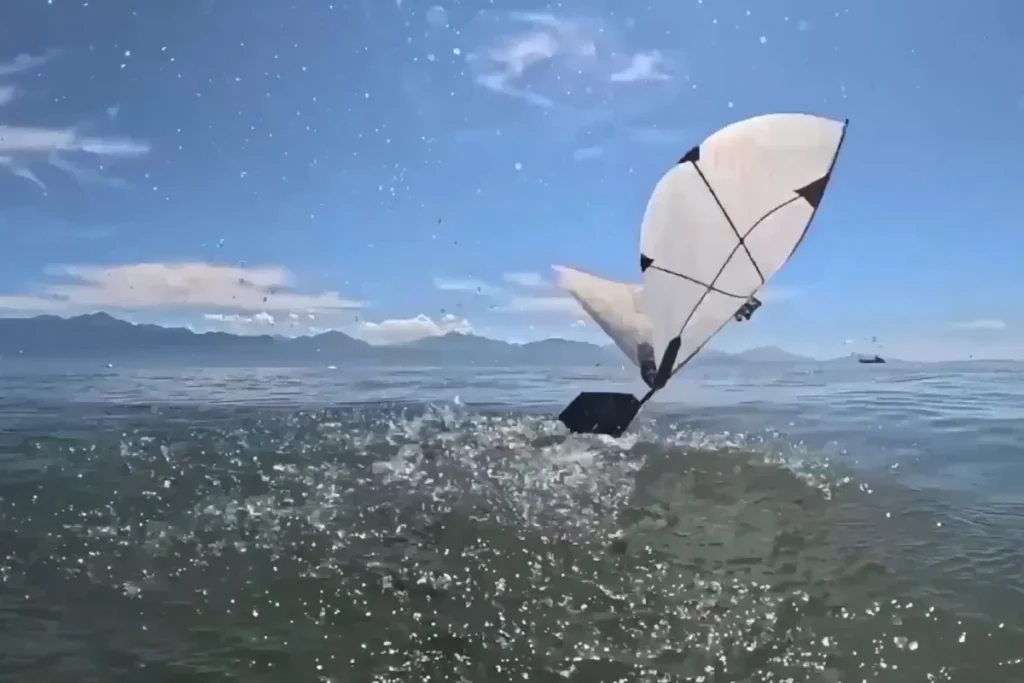
In a significant leap forward for robotic engineering and environmental science, a collaborative team from the Massachusetts Institute of Technology (MIT) and EPFL in Lausanne, Switzerland, has successfully developed a novel robot capable of seamlessly transitioning between underwater swimming and aerial flight. This pioneering device, dubbed the "flapping-wing aerial-aquatic vehicle" (FAAV), draws its inspiration from the remarkable biomechanics of diving birds such as loons, gulls, puffins, and petrels – approximately 100 known species that possess the unique ability to both plunge through water in pursuit of prey and effortlessly launch back into the air. The engineers’ findings, which detail the design and experimental validation of this amphibious robot, were published today in the prestigious journal Science, signaling a potential paradigm shift in how scientists approach the study of aquatic environments and the very mechanics of multi-medium locomotion.
The FAAV represents a culmination of interdisciplinary research, weighing in at a mere 300 grams (roughly half a pound), making it remarkably lightweight for its dual capabilities. Its primary design objective is to serve as a research platform, offering unprecedented opportunities to dissect the complex mechanical principles that enable diving birds to navigate two profoundly different physical mediums: water and air. Beyond fundamental scientific inquiry, the researchers envision the FAAV as the progenitor of a new class of aerial-aquatic drones, poised to revolutionize oceanography and marine biology by providing access to hazardous or remote aquatic regions that are currently inaccessible or prohibitively expensive for traditional ocean vessels.
The Bio-Inspired Imperative: Bridging Two Worlds
The conceptualization of the FAAV stems from a deep admiration for nature’s engineering marvels. Diving birds face an extraordinary challenge: adapting their propulsion systems to mediums with vastly different physical properties. Water is approximately 1,000 times denser and significantly more viscous than air. This disparity means that the forces required for movement, such as lift and drag, vary enormously between the two environments. An object designed for efficient flight in air typically performs poorly in water, and vice-versa. Yet, diving birds defy this conventional wisdom, executing rapid transitions with apparent ease.
For centuries, naturalists have marveled at species like the Atlantic Puffin (Fratercula arctica), which uses its wings to "fly" underwater, propelling itself with powerful strokes to depths of over 60 meters, only to emerge, shake off water, and take to the skies in search of nesting sites or new feeding grounds. Similarly, species like the Common Murre (Uria aalge) and various cormorants demonstrate exceptional underwater agility. This natural precedent served as a powerful motivator for the MIT and EPFL teams, proving that a unified mechanism for locomotion across both air and water was not merely theoretical but demonstrably achievable.
The lead author of the study, Raphael Zufferey, Assistant Professor of Mechanical Engineering at MIT, heads the AURA Lab (Aerial-aquatic Robotics and Sensing for Environmental Exploration), where the core mission revolves around engineering small, bio-inspired aerial and aquatic vehicles. These robots are meticulously designed for unobtrusive exploration and the monitoring of marine and freshwater ecosystems. Zufferey articulated the ambitious scope of the project: "Our dream vision is for oceanographers, marine biologists, and members of coastal communities to launch this robot from a boat, or from shore, and it would fly close to the area of interest, such as an iceberg or a port facility, or over a pod of whales. It would dive into the water to take a measurement or collect a sample, and fly back to deliver the data at a fraction of the cost of traditional methods. Then it could go back out to dive for more."
Engineering the Amphibious Robot: A Closer Look at the FAAV’s Design
The FAAV’s physical architecture mirrors the fundamental elements of its avian muses. It comprises a central body, or fuselage, which houses the essential electronics, battery, and a waterproof electric motor. This motor drives a crankshaft mechanism responsible for the rhythmic up-and-down motion of two flexible, flapping wings. A steerable tail, also motorized, provides directional control both in air and water, enabling the robot to pitch and yaw as needed.
Modularity is a key aspect of the FAAV’s design, allowing for the wings and tail to be easily swapped out for different sizes. This adaptability proved crucial during the experimental phase, enabling the researchers to systematically investigate the optimal configurations for seamless medium transition. The wings themselves are crafted from thin, resilient membranes coated with hydrophobic nanoparticles. This specialized coating is vital for shedding water quickly upon exiting the aquatic environment, minimizing drag and facilitating immediate aerial performance.
The engineering team delved extensively into existing scientific literature on diving bird biomechanics to inform their design parameters. They observed that smaller diving birds typically flap their wings at around 10 times per second (10 Hertz) when flying through air, a frequency that reduces to approximately 4 Hertz when swimming underwater. Larger birds, with their broader wingspans, tend to exhibit slightly lower flapping frequencies in both mediums. The FAAV was consequently engineered to operate within similar frequency ranges, specifically around 5 Hertz, a sweet spot that proved effective for both underwater propulsion and aerial lift.
Experimental Validation and Key Discoveries
The development process involved a rigorous series of experiments, beginning in a controlled water tank environment and culminating in real-world field tests in Lake Geneva, Switzerland. The researchers fabricated and tested three distinct sets of wings: small (60 centimeters wide), medium (80 centimeters), and large (100 centimeters). Their methodology involved submerging the robot approximately half a meter below the water surface and programming its wings to flap at specific frequencies while the tail was set to various pitch angles. High-speed cameras and sensors meticulously recorded the robot’s performance as it ascended through the water, broke the surface, and initiated flight.
The data gathered from these numerous trials provided critical insights into the optimal operational parameters for the FAAV. The team discovered that the medium-sized wings (80 cm span) offered the best balance for reliable flight, swimming, and, crucially, the transition between water and air. The flexibility of the wings emerged as a paramount factor: they needed to be supple enough to minimize amplitude and resistance during underwater propulsion yet sufficiently rigid to generate the necessary lift and thrust for sustained aerial flight.
Performance metrics demonstrated the FAAV’s impressive capabilities:
- Underwater Speed: The robot achieved speeds of almost 1 meter per second while flapping at approximately 5 Hertz.
- Aerial Speed: In the air, it reached speeds of about 6 meters per second, maintaining a similar flapping frequency.
- Take-off Angle: For a successful launch from water into air, the robot required a relatively steep pitch angle of 70 degrees. This angle was critical to prevent the wingtips from re-contacting the water surface during the powerful upward flapping motion, which would otherwise destabilize the launch.
One of the most surprising and significant findings from the experiments was the FAAV’s ability to transition from water to air without the need for additional appendages for propulsion, specifically "feet." Many diving birds, such as puffins and ducks, utilize their webbed feet for paddling at the water’s surface to assist in takeoff, in conjunction with wing flapping and tail pitching. Zufferey noted this unexpected outcome: "If you look at birds, most birds need to paddle at the surface to take off. And the question was, do we need the same for robots? And it turns out we don’t." This discovery simplifies the mechanical requirements for future aerial-aquatic robotic designs, potentially reducing complexity and increasing robustness.
Implications and Future Horizons for Ocean Science
The successful development of the FAAV holds profound implications across several scientific and technological domains. From a fundamental scientific perspective, the robot provides a tangible, controllable platform to better understand the nuanced adaptations that allow diving birds to operate effectively in such disparate environments. By manipulating parameters like wing flexibility, flapping frequency, and body shape in a robotic system, researchers can gain insights into the evolutionary pressures and biomechanical compromises that have shaped these incredible avian species.
Technologically, the FAAV paves the way for a new generation of unmanned aerial-aquatic vehicles (UAVs/UUVs). Current drones are typically specialized for either air or water, limiting their operational versatility. An amphibious robot capable of seamless transition opens up entirely new mission profiles.
For oceanography and marine biology, the potential is particularly transformative. Traditional methods for collecting oceanographic data often involve large research vessels, which are costly, slow, and constrained by weather conditions and accessibility. Deploying human-crewed submersibles or remotely operated vehicles (ROVs) also carries significant operational expenses and safety concerns, especially in hazardous areas like polar regions near icebergs or turbulent coastal zones.
The FAAV offers a solution to these challenges:
- Access to Remote and Dangerous Areas: The robot could fly over vast distances to reach specific points of interest – whether it’s monitoring the health of coral reefs, observing whale migration patterns, inspecting underwater infrastructure in ports, or surveying conditions near melting glaciers. Its ability to dive would allow it to collect samples or data directly from the water column, even in areas too risky for larger vessels.
- Frequent and High-Resolution Data Collection: As Zufferey highlighted, the FAAV could be deployed not just weekly but hourly. This capability enables scientists to gather high-frequency data, capturing transient phenomena or rapid environmental changes that are often missed by episodic sampling. This could include monitoring pollutant dispersion, tracking algal blooms, or studying short-term oceanographic processes like internal waves.
- Cost-Effectiveness: By reducing reliance on expensive ship-time and specialized personnel, such robots could drastically lower the cost of oceanographic research and environmental monitoring, making critical data collection more accessible to a wider range of researchers and organizations.
- Environmental Impact: The small size and unobtrusive nature of the FAAV align with the goal of minimally invasive research, particularly important when studying sensitive ecosystems or wildlife.
Looking ahead, the research team is already working on further enhancements for the FAAV. Future iterations will focus on improving wing design to allow for active turning and maneuvering in addition to simple flapping. This would grant the robot greater agility and control in complex environments. Another critical area of development involves testing the robot’s performance under turbulent conditions, such as navigating choppy waters during takeoff and landing, or maintaining stable flight in gusty winds. These real-world challenges are essential to validate the FAAV’s robustness and operational reliability for practical deployment.
Ultimately, the vision extends to equipping these aerial-aquatic robots with an array of sophisticated sensors to collect diverse data – from water temperature, salinity, and pH to dissolved oxygen levels, chlorophyll concentrations, and even biological samples for DNA analysis. This comprehensive data acquisition, delivered rapidly and repeatedly, promises to unlock new frontiers in understanding the health and dynamics of our planet’s oceans and waterways.
This pioneering work, supported in part by a Marie Skłodowska-Curie Actions fellowship grant, underscores the power of biomimicry and intercontinental collaboration in pushing the boundaries of what robotic systems can achieve. The FAAV is not merely a testament to engineering ingenuity but a beacon for a future where robotic companions assist humanity in unraveling the mysteries of the natural world, safeguarding ecosystems, and charting courses through previously uncharted scientific waters.