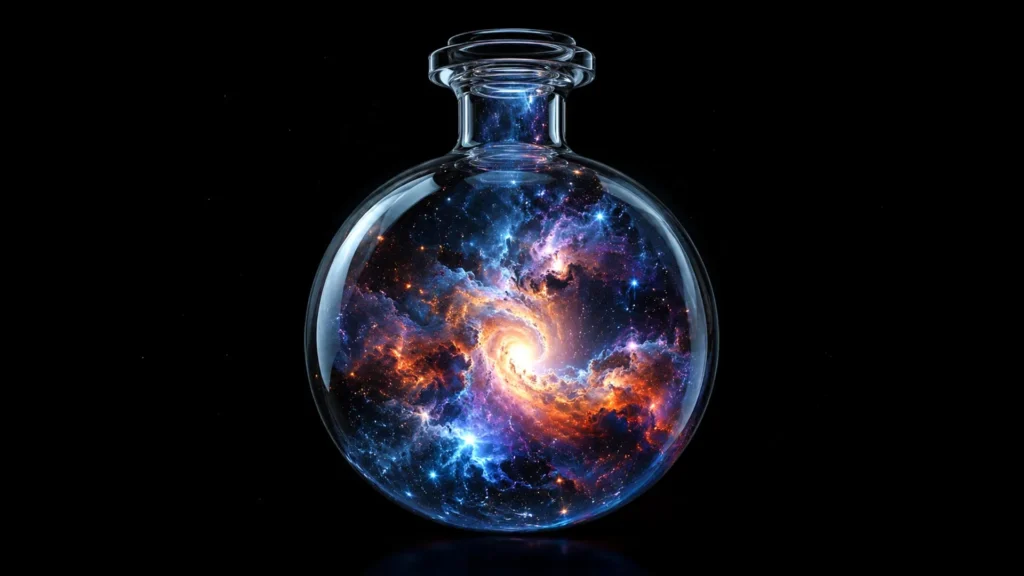
A doctoral researcher at the University of Sydney has achieved a significant milestone in the field of astrochemistry by successfully synthesizing cosmic dust from scratch within a controlled laboratory environment. By recreating the extreme conditions of the deep universe inside a glass vessel, the experiment has provided groundbreaking insights into how the fundamental chemical ingredients for life may have been forged in the hearts of stars and distributed across the cosmos long before the formation of Earth.
Linda Losurdo, a PhD candidate specializing in materials and plasma physics at the University of Sydney’s School of Physics, led the research project. Her work involved the use of a specialized plasma reactor to simulate the high-energy environments found in the proximity of aging stars and within the violent aftermath of supernova remnants. The results of this study, which have significant implications for our understanding of abiogenesis and the chemical evolution of the universe, were recently published in The Astrophysical Journal, a peer-reviewed publication of the American Astronomical Society.
Replicating the Energetic Environments of Deep Space
The synthesis of cosmic dust on Earth is a complex undertaking that requires the replication of near-vacuum conditions and the application of immense energy. To achieve this, Losurdo and her supervisor, Professor David McKenzie, utilized a series of glass tubes connected to high-capacity vacuum pumps. By evacuating the air from these tubes, the team created a low-pressure environment that approximates the "near-nothingness" of interstellar space.
Once the vacuum was established, the researchers introduced a precise mixture of gases: nitrogen, carbon dioxide, and acetylene. These gases were chosen because they contain the primary elements found in organic matter. To trigger the chemical transformation, the mixture was subjected to an electrical potential of approximately 10,000 volts for one hour. This intense electrical discharge converted the gas into plasma—a fourth state of matter consisting of ionized gas.
In this "glow discharge" plasma, the energy is sufficient to break the covalent bonds of the starting molecules. The resulting free atoms and molecular fragments then collide and recombine, forming increasingly complex structures. Over the course of the experiment, these new compounds coalesced into solid particles, which settled onto silicon chips placed within the reaction chamber. The resulting material was a fine, carbon-rich dust that visually and chemically resembles the "stardust" found in the interstellar medium and preserved within the interiors of comets and meteorites.
The Significance of CHON Molecules in Astrobiology
The laboratory-grown dust is particularly notable for its high concentration of "CHON" molecules—complex combinations of carbon (C), hydrogen (H), oxygen (O), and nitrogen (N). These four elements are the essential building blocks of all known life, forming the basis of amino acids, DNA, and proteins.
In the vacuum of space, these molecules are formed under conditions that are difficult to observe directly. They are often found in "cosmic nurseries," where new stars are born from collapsing clouds of gas and dust, or in the expanding shells of gas "puffed out" by red giant stars. By creating these molecules in a "bottle," the Sydney team has demonstrated that the specific chemical pathways leading to life-relevant chemistry are a natural byproduct of high-energy plasma interactions.
"We no longer have to wait for an asteroid or comet to come to Earth to understand their histories," Losurdo stated. "You can build analogue environments in the laboratory and reverse engineer their structure using the infrared fingerprints." This ability to "reverse engineer" cosmic material allows scientists to determine exactly what temperatures, pressures, and radiation levels a particular piece of space debris has encountered during its multi-billion-year journey.
Infrared Spectroscopy: The Universal Language of Molecules
To verify that the laboratory-created dust was a faithful analogue of actual cosmic material, the researchers employed infrared spectroscopy. Every chemical compound absorbs and emits infrared light at specific frequencies, creating a unique "molecular fingerprint."
When Losurdo compared the infrared signatures of her laboratory samples to the telescopic data collected by astronomers observing distant nebulae and star-forming regions, the match was nearly identical. This correlation proves that the plasma-based reactions in the Sydney lab accurately mimic the processes occurring in stellar envelopes and the interstellar medium.
This breakthrough provides astronomers with a vital new tool. By creating a comprehensive database—a "fingerprint library"—of different types of laboratory-made cosmic dust, researchers can more accurately interpret the data coming from advanced observatories like the James Webb Space Telescope (JWST). When the JWST detects a specific infrared signal from a distant galaxy, scientists can now look at the Sydney database to identify the exact chemical composition and the physical conditions required to produce that signal.
A Timeline of Earth’s Organic Enrichment
The research contributes to a long-standing scientific debate regarding the origins of life on Earth. While some theories suggest life began in localized terrestrial environments, such as deep-sea hydrothermal vents, another prominent theory—lithopanspermia—proposes that the organic precursors to life were delivered to Earth from space.
Between 4.56 billion and 3.5 billion years ago, during the Hadean and early Archean eons, the young Earth was subjected to a period of intense bombardment by meteorites and comets. This era, often referred to as the Late Heavy Bombardment, saw millions of tons of extraterrestrial material deposited on the planet’s surface. Much of this material was rich in organic compounds, similar to the carbonaceous dust produced in Losurdo’s experiment.
The Sydney study suggests that the chemical "programming" for life may have been written in the stars long before the Earth even existed. By showing that CHON-rich dust forms readily in stellar environments, the research supports the idea that the universe is "primed" for life, with the necessary raw materials being manufactured in the outer envelopes of stars and then distributed throughout the galaxy.
Decoding the History of Meteorites through Reverse Engineering
Professor David McKenzie, a co-author of the study and a leading expert in applied physics, emphasized that this research allows scientists to read the "hidden record" contained within meteorites. Every asteroid fragment or micrometeorite that falls to Earth carries a chemical history of its transit through space.
"By making cosmic dust in the lab, we can explore the intensity of ion impacts and temperatures involved when dust forms in space," Professor McKenzie explained. "This also helps us interpret what a meteorite or asteroid fragment has been through over its lifetime. Its chemical signature holds a record of its journey, and experiments like this help us learn how to read that record."
This "reading" of the chemical record is essential for understanding the dynamics of the early Solar System. It allows researchers to distinguish between materials that formed in the hot, inner regions near the Sun and those that formed in the frigid, radiation-heavy outer reaches of the solar nebula.
Institutional Recognition and Future Outlook
The importance of this work has already been recognized by the international scientific community. Late last year, Linda Losurdo received the award for best presentation for this research at the Annual Meeting of the Meteoritical Society, a prestigious gathering of world-leading planetary scientists.
The study was supported by the Australian Research Council and utilized the facilities of the University of Sydney node of Microscopy Australia. The researchers reported no competing interests, emphasizing the purely academic and foundational nature of the discovery.
Moving forward, the team plans to expand their experiments to include a wider variety of gas mixtures and energy levels. By introducing trace elements like phosphorus and sulfur—also vital for biological processes—they hope to create even more complex analogues of cosmic material. This could eventually lead to the laboratory synthesis of pre-biotic molecules like adenine or ribose, further bridging the gap between the chemistry of space and the biology of Earth.
Ultimately, the ability to recreate "the universe in a bottle" represents a shift in how we study our origins. Rather than being passive observers of the stars, scientists are now active participants in the stellar laboratory, recreating the ancient, high-energy events that set the stage for the emergence of life on our planet. Through this work, the dust that once seemed like mere celestial debris is being revealed as the essential scaffolding of the biological world.