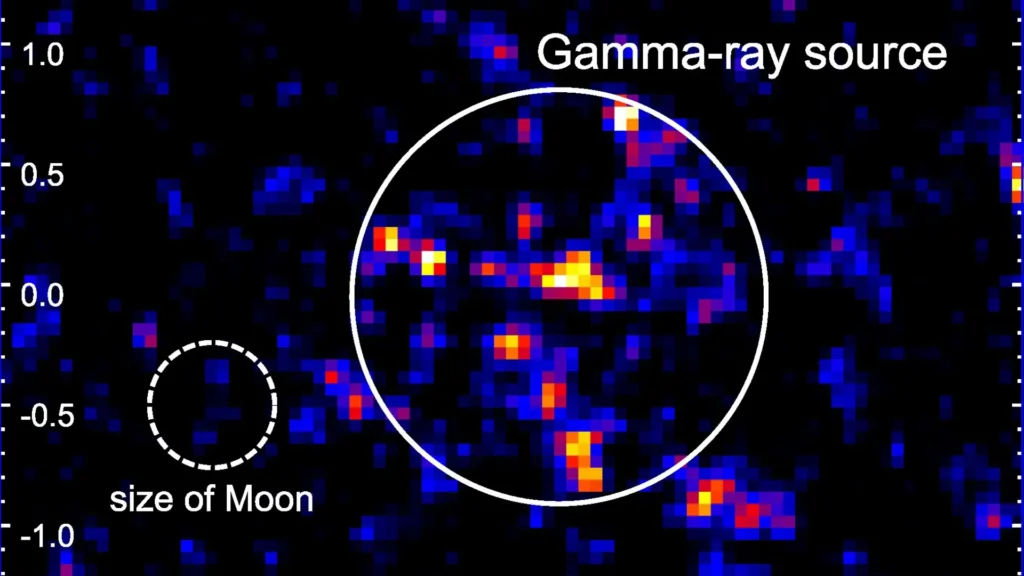
In a landmark achievement for high-energy astrophysics, an international research collective led by Hiroshima University has conclusively identified a source within the Milky Way galaxy capable of accelerating protons to some of the highest energy levels ever recorded. This discovery, centered on the celestial object known as LHAASO J1912+1014u, marks a significant milestone in the century-long quest to understand the origins of cosmic rays—the ultra-fast particles that permeate the interstellar medium and influence the evolution of galactic structures.
The findings, published in The Astrophysical Journal on July 16, 2026, provide the most definitive evidence to date of a "proton PeVatron" within our own galaxy. By combining data from a suite of ground-based and space-borne observatories, the team has successfully distinguished the signatures of high-energy protons from those of electrons, solving a diagnostic challenge that has long hampered the study of the galaxy’s most powerful natural particle accelerators.
The Mystery of the Galactic Particle Accelerators
Cosmic rays are primarily composed of protons, representing approximately 90% of these high-speed particles, with electrons and heavier atomic nuclei making up the remainder. Since their discovery over a century ago, scientists have been baffled by the mechanisms that allow these particles to reach kinetic energies far beyond the capabilities of any human engineering.
To put this in perspective, the Large Hadron Collider (LHC) on the Franco-Swiss border—the world’s most powerful man-made accelerator—can propel protons to energies of several tera-electron volts (TeV). However, the Milky Way contains natural "PeVatrons" capable of pushing particles into the peta-electron volt (PeV) range, which is 1,000 times more energetic than a TeV. One PeV is equivalent to one quadrillion (10^15) electron volts. Identifying where and how these particles are energized is essential for understanding the energy balance of the Milky Way and the lifecycle of stars.
"This immense energy makes cosmic rays important in astronomy and astrophysics," explained Tsunefumi Mizuno, an associate professor at Hiroshima University’s Hiroshima Astrophysical Science Center and the study’s first author. "Finding a cosmic-ray proton accelerator above that PeV level is one of the most exciting topics in modern astrophysics."
Distinguishing Protons from Electrons: A Scientific Hurdle
The primary difficulty in identifying a PeVatron lies in the "noise" created by high-energy electrons. Both protons and electrons can produce gamma rays—the most energetic form of light—when they interact with their environment.
When high-energy protons collide with ambient interstellar gas, they produce neutral pions, which almost immediately decay into gamma rays. This is known as the hadronic process. Conversely, high-energy electrons can produce gamma rays through "Inverse Compton scattering," where they collide with low-energy photons (like those from the Cosmic Microwave Background) and kick them up to gamma-ray energies. They also produce X-rays through synchrotron radiation as they spiral through magnetic fields.
Because both processes result in gamma-ray emissions, researchers previously struggled to confirm whether a specific source was accelerating protons (a true PeVatron) or merely electrons. The breakthrough regarding LHAASO J1912+1014u came from a "multiwavelength" approach, using different parts of the light spectrum to isolate the proton signature.
The "Three Arrows" of Evidence: A Multi-Observatory Strategy
The research team employed a strategy Mizuno likened to an old Japanese proverb: "One arrow is easy to break, but three arrows bundled together are not." In this context, the "arrows" were data sets from three distinct types of astronomical observations that, when combined, created an irrefutable profile of a proton accelerator.
1. The Fermi Large Area Telescope (Gamma Rays)
The NASA-led Fermi-LAT mission, which Hiroshima University helped develop, provided crucial data on gamma rays in the giga-electron volt (GeV) range. The researchers found that the gamma-ray signal from LHAASO J1912+1014u extended smoothly from 400 MeV all the way up to over 100 TeV. This broad, continuous spectrum is a hallmark of proton interaction rather than electron-driven processes, which typically show a different spectral shape at lower energies.
2. The FUGIN Radio Survey (Interstellar Gas)
The FOREST Unbiased Galactic plane Imaging survey (FUGIN), conducted with the Nobeyama 45-meter telescope in Japan, provided high-resolution radio maps of molecular gas in the region. The researchers discovered a near-perfect spatial correlation between the GeV gamma-ray emissions and the distribution of interstellar gas clouds. Since protons must hit gas to produce gamma rays, this physical overlap strongly suggested that the gamma rays were the result of proton-gas collisions.
3. The Chandra X-ray Observatory (X-rays)
NASA’s Chandra X-ray Observatory provided the final piece of the puzzle. If the source were dominated by high-energy electrons, it should have emitted a significant amount of "diffuse" X-rays due to synchrotron radiation. However, Chandra detected only very weak X-ray emissions. The absence of a strong X-ray signal allowed the team to effectively rule out electrons as the primary drivers of the high-energy activity, leaving protons as the only viable explanation.
Chronology of the Discovery
The identification of LHAASO J1912+1014u did not happen overnight; it was the result of decades of incremental progress in gamma-ray astronomy:
- 1990 – Present: The Tibet AS gamma experiment, a joint venture between Japan and China, begins monitoring the northern sky for ultra-high-energy cosmic rays and gamma rays.
- 2021: China’s Large High Altitude Air Shower Observatory (LHAASO) begins releasing data, identifying several dozen "UHE" (Ultra-High-Energy) sources that exceed 0.1 PeV.
- 2024: LHAASO J1912+1014u is officially discovered in the constellation Aquila, near the star Altair. Initial theories suggested it might be a supernova remnant or a pulsar wind nebula.
- 2025 – Early 2026: The Hiroshima-led team initiates a deep multiwavelength analysis, correlating LHAASO data with archival and new observations from Fermi-LAT, Chandra, and Nobeyama.
- July 16, 2026: The team publishes their conclusion in The Astrophysical Journal, confirming the source as a proton PeVatron.
Analysis of Implications: Why This Matters
The confirmation of J1912+1014u as a PeVatron has profound implications for our understanding of the "knee" in the cosmic ray spectrum. For decades, physicists have observed a specific point in the energy distribution of cosmic rays (around 3 PeV) where the flux of particles drops off. This "knee" is thought to represent the maximum energy to which galactic sources can accelerate particles.
By finding a source that operates right at this threshold, scientists can now study the physical conditions—such as magnetic field strength and shockwave velocity—required to reach these energies. This helps determine whether the most energetic cosmic rays in our galaxy come from supernova remnants (the traditional theory) or other exotic objects like massive star clusters or the galactic center.
Furthermore, the study of PeVatrons is vital for "multi-messenger" astronomy. High-energy protons interacting with gas not only produce gamma rays but also neutrinos—ghostly particles that can travel across the universe without being diverted by magnetic fields. Confirming proton accelerators helps neutrino observatories like IceCube in Antarctica know where to look for cosmic neutrino sources.
Global Collaboration and Institutional Support
The success of the study underscores the necessity of international cooperation in modern big-science projects. The research involved a diverse group of co-authors from institutions including Gifu University, Miyazaki University, and Julius-Maximilians-Universität Würzburg in Germany.
The Fermi-LAT collaboration itself is a testament to global partnership, receiving ongoing support from NASA and the Department of Energy (DOE) in the United States; the CEA and CNRS/IN2P3 in France; ASI and INFN in Italy; MEXT, KEK, and JAXA in Japan; and the Wallenberg Foundation and Swedish Research Council in Sweden.
Financial backing for the study was provided by several organizations, including the Japan Society for the Promotion of Science (JSPS) through various KAKENHI grants and the National Astronomical Observatory of Japan (NAOJ).
The Future of Galactic Exploration
While the identification of LHAASO J1912+1014u is a major victory, the work is far from finished. There are dozens of other candidate sources identified by LHAASO and the Tibet AS gamma experiment that remain unconfirmed.
"In this study, the three arrows—Fermi-LAT GeV gamma-ray data, FUGIN radio data, and Chandra X-ray data—revealed that our target is a cosmic-ray proton PeVatron," Mizuno said. "We now plan to study other candidates more comprehensively."
The team’s next objective is to determine if PeVatrons are a homogeneous group or if different types of celestial objects—ranging from the debris of exploded stars to the powerful winds of young, massive stellar clusters—act as the galaxy’s "engines." As more sources are confirmed, the scientific community moves closer to a unified theory of how our galaxy generates its most energetic and elusive inhabitants: the cosmic rays.