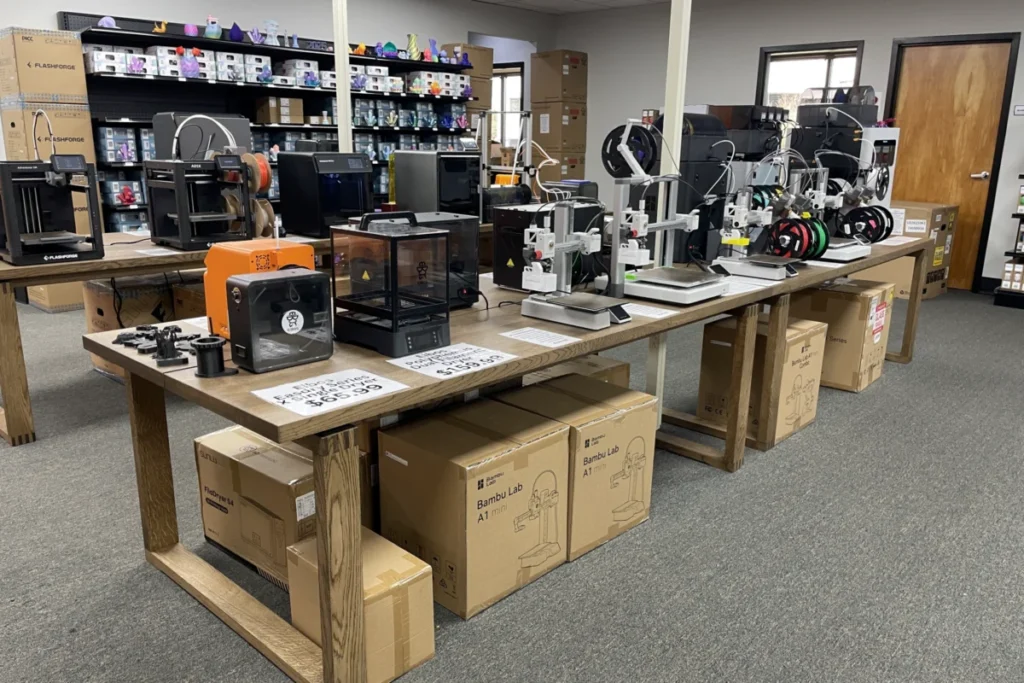
It’s a sunny Monday morning in St. Charles, Missouri, when AM Media arrives at 3DSHQ (short for “3D Supply Headquarters”) for an unusual site visit. Unlike the typical nondescript industrial buildings that dot the highways, often requiring paperwork and safety glasses, 3DSHQ presents a distinctly different facade. Located just 20 minutes outside of St. Louis, this brick-and-mortar establishment operates as a hybrid retail store and comprehensive training facility, meticulously designed not only to sell equipment but also to foster a vibrant community around 3D printing. The space is intentionally public, welcoming a diverse spectrum of individuals, from those new to the technology and CAD novices to seasoned hobbyists, engineers exploring side ventures, students, and educators.
As the AM Media representative approached the building, an encounter with a recent convert to hobbyist 3D printing highlighted the very purpose of 3DSHQ. The individual was grappling with an issue concerning the hot-end of their Creality 3D printer, seeking assistance from 3DSHQ for potential diagnostics and repair guidance. This interaction exemplifies 3DSHQ’s core mission: to serve as an accessible and supportive resource for all 3D printing users. However, the organization, and its parent company Jamplast, view each visitor not just as a potential customer, but as a potential contributor to the future landscape of industrial additive manufacturing.
The Genesis of a Community Hub
3DSHQ emerged as a strategic initiative from Jamplast, a well-established plastics recycler and processor. Recognizing the burgeoning potential of additive manufacturing technology, observed at prominent industry trade shows like NPE, Jamplast’s leadership launched 3DSHQ as its dedicated additive manufacturing division. While Jamplast excels in recycling and material science, 3DSHQ has adopted a more holistic approach to the 3D printing ecosystem. The company offers a comprehensive suite of services, encompassing the sale of machines and equipment, crucial repair services (including fulfilling warranty repairs for Bambu machines), and extensive training programs.

The newly inaugurated facility features a spacious classroom environment outfitted with 30 laptops and a corresponding number of 3D printers, enabling large groups to engage in hands-on learning experiences. Furthermore, contract manufacturing services are an integral part of 3DSHQ’s offerings, demonstrating a commitment to supporting businesses at various stages of additive adoption.
As a retailer, 3DSHQ concentrates on desktop-sized fused filament fabrication (FFF) and photopolymerization 3D printers, along with a wide array of associated materials and accessories. The company proudly features brands like Bambu, AnyCubic, and Creality, known for their consumer-friendly appeal, while continuously evaluating emerging manufacturers and technologies to expand its product line.
A Spectrum of Materials and Expertise
The material selection at 3DSHQ is equally impressive, offering a vibrant palette of colors and diverse material types from numerous suppliers, including Ziro, Bambu, and the locally based Fusion Filaments. The filament offerings span common materials like PLA and ABS, alongside specialty variants such as specialty PLA, TPU, ASA, and PFS, with plans to introduce further options. These materials are showcased alongside sample parts meticulously produced by 3DSHQ employees, allowing potential customers to physically interact with and assess the quality and characteristics of the materials before making a purchase.
While 3DSHQ does stock some industrial-grade equipment, such as large-format extrusion 3D printers from specialists like GZero and IC3D, its primary clientele comprises hobbyists and individuals passionate about 3D printing. Regardless of whether customers engage with the technology for professional or personal pursuits, 3DSHQ believes that nurturing this community is paramount to cultivating the next generation of industrial additive manufacturing professionals.

The Enduring Value of a Physical Presence
The St. Charles facility, which officially opened its doors to the public on September 6, 2025, represents a significant evolution from its previous iteration housed within a local mall. 3DSHQ has consistently found value in maintaining a tangible physical presence. This allows for direct engagement with local makers, the provision of practical training, and the creation of an accessible entry point for individuals eager to embark on their 3D printing journey. The former mall location proved instrumental in generating foot traffic and introducing 3DSHQ and the broader concept of 3D printing to a local audience who might otherwise have remained unaware of its potential.
While other retailers, such as Best Buy and Micro Center, have incorporated 3D printers into their inventories in recent years, their offerings are often limited. 3D printing typically represents just one facet of their extensive technology portfolios, and their sales staff may not possess the specialized knowledge required for in-depth support. In contrast, 3DSHQ provides a more extensive and curated selection, enabling customers to physically examine machines, filaments, and sample prints. Crucially, this is complemented by a knowledgeable staff and an engaged customer base eager to share firsthand expertise.
"3D printing is the hobby and the passion of everyone on staff," states Andrew Kramer, general manager of 3DSHQ. "On any given day, our employees can be found assisting customers with selecting their first 3D printers, choosing the appropriate materials, troubleshooting technical issues, or resolving specific print challenges." These spontaneous customer interactions and problem-solving scenarios were a significant catalyst for the company’s expansion to a larger facility and the subsequent integration of classroom-style education into its service offerings.
A Comprehensive Educational Framework
Currently, 3DSHQ offers a robust curriculum encompassing 15 distinct classes. These range from foundational courses like "Intro to 3D Printing" and "Troubleshooting and Maintaining Your 3D Printer" to advanced levels of slicing techniques and design-focused classes utilizing software such as Tinkercad and Blender. Beyond formal instruction, 3DSHQ also hosts a variety of community events, including birthday parties, educational outings for Boy Scout and Girl Scout troops, and themed holiday workshops where participants can personalize pre-selected objects.

Local Engagement and National Reach
While deeply rooted in the St. Louis community, 3DSHQ’s educational mission extends its influence beyond Missouri’s borders. The company has recently established a partnership with The Society of Plastics Engineers (SPE) to enhance the latter’s grant program for classroom educators. As an initial undertaking, Akron Public Schools in Ohio will be the first district to benefit from this collaboration, receiving FlashForge 3D printers, materials, and dedicated support from 3DSHQ.
To bolster these extensive educational initiatives, 3DSHQ has enlisted Dr. Laura Holt-Hovis, an expert in pedagogical studies, to lead courses and develop comprehensive curricula centered on 3D printing. A primary objective of this endeavor is the creation of state-specific curricula, initially targeting Missouri, with the aim of aligning coursework with each state’s educational standards for academic credit.
The emphasis on education is a cornerstone of 3DSHQ’s philosophy, particularly given its physical footprint. Unlike the impersonal nature of online retail, 3DSHQ cultivates a more personal introduction to 3D printing, fostering a community-driven experience. "We don’t want to spread negative word-of-mouth about 3D printing," Kramer emphasizes. "The worst possible outcome is for someone to begin 3D printing and have a bad experience." Such negative encounters can have a ripple effect, influencing friends, family, the wider community, and professional circles, potentially impacting broader industry adoption. Consequently, ensuring user success is not only beneficial for individual customers but also crucial for the advancement of 3D printing as a whole. "The education needs to be in place to welcome all these individuals," Kramer concludes.

Bridging the Gap to Industrial Adoption
While 3DSHQ’s most visible activities cater to newcomers and hobbyists utilizing desktop 3D printers, its operations also significantly benefit industrial users and clients. In addition to supplying professional AM users with industrial-grade equipment and materials, 3DSHQ functions as a contract manufacturer. Its services encompass Design for Additive Manufacturing (DFAM), which includes developing drawings and plans to transition from additive to traditional manufacturing processes as demand scales. They also offer Printing as a Service (PaaS) and product development support to assist clients in transforming concepts into additive-ready product versions.
In close proximity to the new storefront, the company is actively establishing a print farm within a warehouse space. The initial deployment is planned for 100 3D printers, with the capacity to accommodate several hundred more as demand escalates.
What distinguishes 3DSHQ is the seemingly holistic integration of its business components. Each activity and investment appears meticulously designed to address different stages of the additive adoption pipeline. An individual with no prior manufacturing background can visit the store, enroll in an introductory class, and potentially discover a passion for 3D printing, leading them to purchase equipment and materials from 3DSHQ. This initial engagement can evolve into the conception of a novel product or the establishment of a 3D printing-based business. As their ventures grow, these customers may return for additional equipment, materials, or even utilize 3DSHQ’s manufacturing services.
This trajectory also provides a pathway for established manufacturers to integrate additive manufacturing through a less conventional approach. "We have Boeing in town, and numerous small and medium-sized engineering firms," Kramer notes. This presence fosters a significant population of engineers in the St. Louis area who exhibit an interest in 3D printing, even if solely as a hobby. "These are engineers who might not operate a 3D printer at work but have one at home or possess a keen interest in the technology."

This personal interest can readily translate into workplace adoption within engineering departments or on factory floors. An engineer who is already proficient and comfortable with 3D printing in their personal life is more inclined to leverage the technology to address challenges at work, sometimes even initially utilizing their personal equipment. "And that becomes justification for a company to purchase a 3D printer," Kramer explains. "An engineer doing 3D printing as a hobby is, in many ways, the greatest asset." This organic integration, driven by personal passion and demonstrated utility, serves as a powerful catalyst for broader industrial adoption of additive manufacturing.