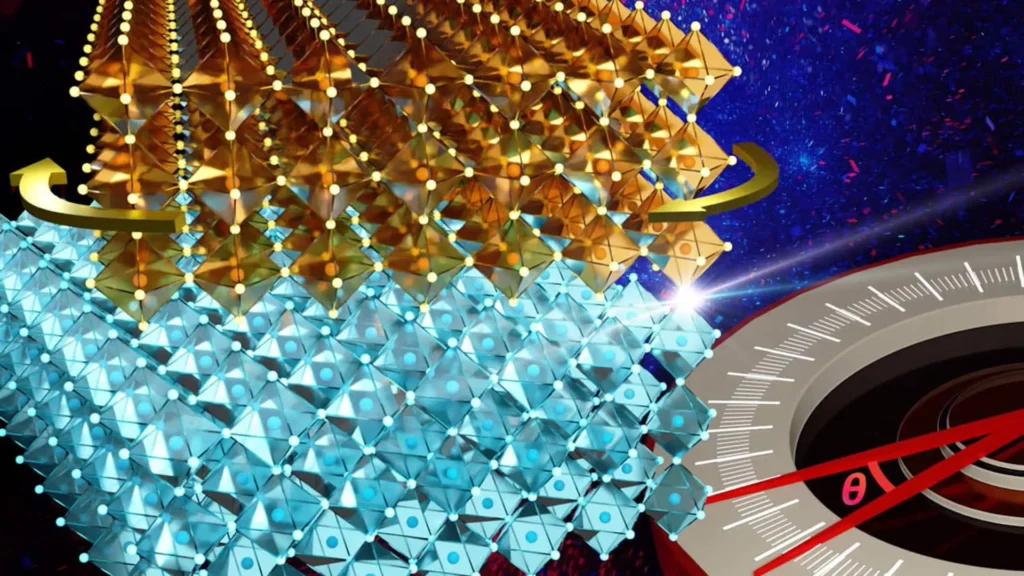
The field of materials science has reached a significant milestone with the development of a new methodology that allows for the creation of twisted oxide materials over unprecedentedly large areas while maintaining atomic-level precision. This breakthrough, led by researchers at North Carolina State University, marks a departure from traditional twistronics, which has historically relied on the weak interlayer forces of two-dimensional (2D) materials like graphene. By successfully applying these principles to complex oxides held together by strong chemical bonds, the research team has opened a new frontier in the design of next-generation electronic devices, potentially leading to advancements in superconductivity, ferroelectricity, and quantum computing.
The Evolution of Twistronics: From Graphene to Complex Oxides
To understand the significance of this development, one must look at the relatively brief but explosive history of twistronics. The field gained international prominence in 2018 when researchers discovered that rotating two layers of graphene to a specific "magic angle" could induce superconductivity—a state where electricity flows without resistance. This phenomenon occurs because the misalignment of atomic lattices creates a "Moiré pattern," which alters the electronic environment of the material.
However, most research in twistronics has been confined to materials bonded by van der Waals forces. These are relatively weak intermolecular attractions that allow layers to slide past one another easily. While this makes them ideal for laboratory-scale experiments using mechanical exfoliation (often called the "Scotch tape method"), it presents significant challenges for industrial scaling. Van der Waals materials are often fragile, difficult to produce in large sheets, and their layers can easily shift, losing the precise "twist" required for specific electronic properties.
The new research published in ACS Nano addresses these limitations by shifting the focus to complex oxides. Unlike graphene, these oxides are characterized by strong ionic or covalent bonds. Ruijuan Xu, an assistant professor of materials science and engineering at North Carolina State University and the study’s corresponding author, notes that while the field was built on weak bonds, her team’s work proves that strong chemical bonds can be harnessed to create stable, large-scale twistronic structures.
Methodology: Precision Engineering at the Macro Scale
The research team utilized sodium niobate (NaNbO3) as their primary model system. Sodium niobate is a complex oxide known for its interesting dielectric and piezoelectric properties. The challenge lay in how to stack these crystalline membranes with a specific rotational offset without damaging the delicate crystalline structure.
The process began with the growth of high-quality crystalline NaNbO3 membranes. To solve the problem of alignment, the team integrated a classic microfabrication technique: photolithography. By etching visual reference markers around the edges of each oxide membrane, the researchers created a "map" that allowed them to track the orientation of the crystals.
Once the markers were in place, the team used a specialized transfer process to lift one membrane and position it atop another. By observing the alignment of the reference markers under high-powered microscopy, they could rotate the layers to a deterministic angle. This level of control is a departure from previous methods that often relied on trial and error or were limited to micron-sized flakes.
The final and perhaps most critical step in the process was the annealing treatment. After reaching the desired orientation, the stacked membranes were subjected to a thermal process tailored to the specific thermal and chemical properties of NaNbO3. This annealing facilitated the formation of strong chemical bonds across the interface, essentially "locking" the twist in place and creating a unified, albeit twisted, superlattice.
Scientific Findings: Atomic Distortion and Phase Transitions
The structural integrity of these twisted oxides was verified using synchrotron X-ray diffraction, a high-energy imaging technique that allows scientists to see the arrangement of atoms within a material. The results, obtained through collaborations with Argonne National Laboratory and Oak Ridge National Laboratory, revealed that the interface between the two oxide layers was not merely a passive boundary.
Because the chemical bonds between the layers are so strong, the atomic lattices of the two membranes actually exert physical force on one another. This results in what the researchers describe as a "gradual rotation" of the atomic lattice at the interface. Instead of a sharp, abrupt change in orientation, the atoms shift slightly to accommodate the twist, creating a structural gradient.
Furthermore, the researchers observed changes in the material’s phase structure. In crystallography, a "phase" refers to a specific arrangement of atoms that dictates a material’s properties—such as whether it is magnetic, ferroelectric, or metallic. The strain induced by the twist and the subsequent chemical bonding caused the NaNbO3 to adopt phases that are not typically found in its bulk, untwisted form.
"We’ve demonstrated the ability to control many of the materials’ characteristics—including phase structure and domain configuration—in ways that offer new routes for designing materials and devices tailored to specific applications," Xu explained. While the full electronic implications of these structural changes are still being studied, the ability to "engineer" a material’s phase through geometry alone is a powerful tool for physicists.
Supporting Data and Technical Specifications
The study’s success is rooted in the "deterministic" nature of the fabrication. In traditional 2D material stacking, the "yield" of correctly aligned samples is often low. The NC State team’s use of photolithographic markers significantly improves the reproducibility of the process.
Key data points from the research include:
- Material System: Crystalline sodium niobate (NaNbO3) membranes.
- Scale: The membranes were fabricated over areas significantly larger than typical van der Waals flakes, moving from the micron scale toward centimeter-scale compatibility.
- Bonding Type: Transition from physical adhesion (van der Waals) to robust chemical bonding (covalent/ionic).
- Measurement Precision: Sub-degree control of the twist angle facilitated by optical reference markers.
- Structural Impact: Synchrotron data confirmed lattice reconstruction and phase transition at the interface, a phenomenon rarely seen in weaker bonded materials.
Institutional Collaboration and Funding
The complexity of this research required a multi-institutional effort. The lead authors, Reza Ghanbar and Eli Rodrigues, worked alongside a diverse team at NC State, including undergraduate and Ph.D. students. The technical depth of the study was bolstered by expertise from Oak Ridge National Laboratory, Argonne National Laboratory, and Duke University.
Funding for the project was provided by several major scientific organizations, reflecting the high level of interest in the future of oxide electronics. Supporters included:
- The National Science Foundation (NSF)
- The American Chemical Society Petroleum Research Fund
- The Army Research Office
- The Research Corporation for Science Advancement (Scialog grant)
- The U.S. Department of Energy
This broad support suggests that the military, energy, and academic sectors all recognize the potential of twist-engineered oxides for future technologies.
Broader Implications: The Future of Oxide Twistronics
The transition from 2D van der Waals materials to complex oxides is more than just a change in ingredients; it is a expansion of the "toolkit" available to electronics designers. Complex oxides are a vast family of materials that exhibit a much wider range of properties than graphene or molybdenum disulfide. Some oxides are "multiferroic," meaning they can be both magnetic and ferroelectric simultaneously. Others are high-temperature superconductors.
By applying twistronics to these materials, scientists can theoretically create "tunable" interfaces where these properties can be turned on or off, or even combined in ways that do not occur in nature. For example, a twisted oxide interface could potentially create a material that is a superconductor in one direction and an insulator in another, or a material whose magnetism can be flipped by a small change in electrical voltage.
Moreover, the ability to produce these materials over large areas is the "missing link" between laboratory curiosity and industrial application. For twistronics to move into the consumer electronics market—such as in high-efficiency sensors, advanced memory storage, or quantum processors—the materials must be compatible with existing semiconductor manufacturing processes. The use of large-area membranes and photolithography markers brings the field several steps closer to this reality.
Analysis of Industrial Impact
From an industrial perspective, the NC State research addresses the "stability problem" that has plagued twistronics. In van der Waals systems, the "magic angle" is often unstable; the layers want to rotate back into a more energy-efficient, untwisted alignment. By forming strong chemical bonds through annealing, Xu’s team has created a structure that is thermally and mechanically stable. This stability is essential for any material intended for use in real-world devices that must operate under varying temperatures and physical stresses.
As the research moves forward, the team plans to explore how these structural distortions affect the transport of electrons and phonons (heat-carrying particles). If the "gradual rotation" of the lattice can be used to steer electrons or block heat, it could lead to a new class of "topological" insulators or ultra-efficient thermoelectric materials.
The study concludes that while NaNbO3 was the model, the technique is likely applicable to a wide array of other complex oxides. This suggests that we are at the beginning of a "Moiré revolution" for oxides, one that could eventually redefine the limits of solid-state electronics.