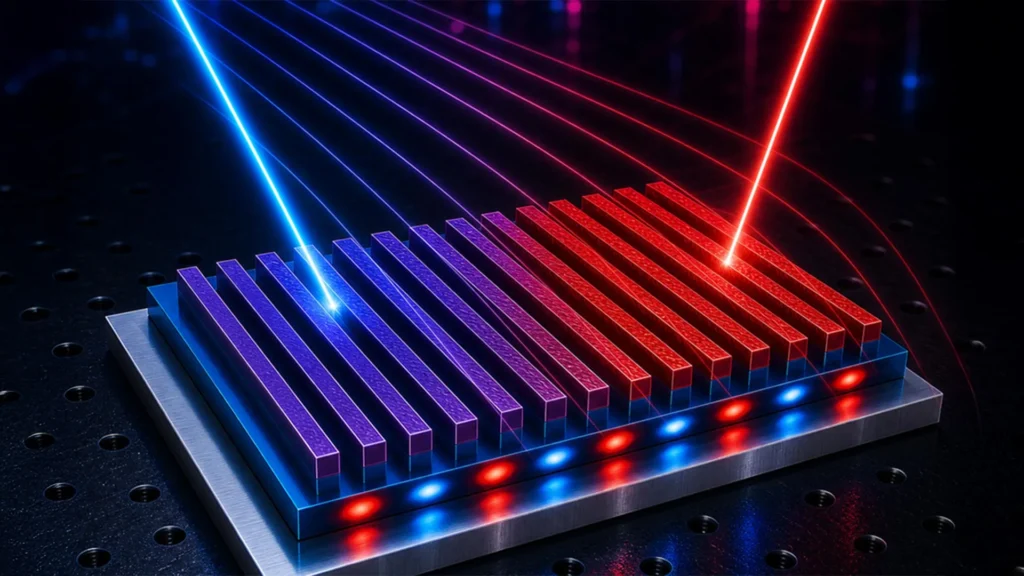
In a significant departure from classical thermodynamics, an international research team led by scientists at Osaka Metropolitan University (OMU) has developed a groundbreaking device capable of independently controlling the absorption and emission of thermal energy. This innovation effectively bypasses the long-standing principle of reciprocity, a fundamental law of physics that has historically dictated that any material which absorbs heat efficiently from a specific direction must also emit it in the same manner. By decoupling these two processes, the researchers have opened the door to a new era of "smart" thermal management, where heat can be directed, stored, and manipulated with the same precision as electrical currents in a microprocessor.
The research, led by Professor Koichi Okamoto and Dr. Shunsuke Murai of the OMU Graduate School of Engineering, utilizes a sophisticated combination of magneto-optical materials and phase-change substances. The resulting device not only allows for the non-reciprocal flow of thermal radiation but also features a non-volatile memory component, meaning it can retain its programmed thermal state even after power is disconnected. This development is expected to have far-reaching implications for energy conversion, infrared sensing, and the emerging field of photonic computing.
The Scientific Foundation: Overturning Kirchhoff’s Law of Thermal Radiation
For more than 160 years, the field of thermodynamics has been governed by Kirchhoff’s Law of Thermal Radiation, proposed by Gustav Kirchhoff in 1860. The law states that the equilibrium absorptivity of a body is equal to its emissivity at a given temperature and wavelength. In practical terms, this means that if a surface is designed to be a good absorber of heat from a certain direction, it is inherently a good emitter in that same direction. While this symmetry is a cornerstone of classical physics, it presents a significant hurdle for engineers trying to design efficient energy systems.
In many applications, such as solar energy harvesting or the cooling of electronic components, it is desirable for a material to absorb energy from a source (like the sun) but prevent that same energy from being radiated back toward the source. Breaking this reciprocity allows for "one-way" heat flow, which can theoretically exceed the efficiency limits of traditional thermal systems. Until now, achieving this has required bulky equipment or extreme conditions that were impractical for commercial or industrial use.
The OMU team’s breakthrough centers on "non-reciprocal" thermal radiation. By breaking time-reversal symmetry—a requirement for Kirchhoff’s Law—the researchers have created a system where the path heat takes entering the material does not have to be the path it takes leaving it. This is achieved through the application of a magnetic field to specific materials, a process known as the magneto-optical effect.
The Technical Innovation: Magneto-Optics and Phase-Change Materials
The device developed by Professor Okamoto and Dr. Murai is a multilayered structure that integrates a magneto-optical material with a phase-change material known as GST (Germanium-Antimony-Tellurium). GST is a chalcogenide glass already widely used in optical disc technology (such as rewritable DVDs) and non-volatile random-access memory (NVRAM). Its primary advantage is its ability to switch between crystalline and amorphous states when exposed to heat or electrical pulses, with each state having drastically different optical and thermal properties.
By pairing GST with a magneto-optical layer, the researchers created a device whose thermal behavior can be "tuned" and then "locked." When a magnetic field is applied, the magneto-optical layer alters the way light and heat interact with the device. Simultaneously, the GST layer acts as a switch. By changing the state of the GST, the researchers can enable or disable the non-reciprocal thermal radiation effect.
One of the most significant achievements of this design is its "non-volatility." In previous attempts to create programmable thermal materials, the device would revert to its original state as soon as the external power or magnetic field was removed. The OMU device, however, maintains its configuration. This means that once the thermal path is set, it remains set without further energy input, mimicking the way a computer chip stores data.
Chronology of Development and Experimental Success
The journey toward this breakthrough involved several years of theoretical modeling and experimental refinement. The challenge was not just breaking reciprocity, but doing so in a way that was efficient and practical.
- Theoretical Modeling (2018–2020): Researchers began exploring the use of Weyl semimetals and magneto-optical resonators to break Kirchhoff’s Law. While theoretically possible, early models required massive magnetic fields that could only be generated in laboratory settings.
- Material Selection (2021): The team identified GST as the ideal candidate for adding a "memory" component to thermal radiation. The challenge shifted to integrating GST with magneto-optical thin films without degrading the performance of either.
- Prototype Fabrication (2022–2023): The OMU team fabricated a prototype using sophisticated thin-film deposition techniques. They focused on optimizing the thickness of each layer to ensure that the device could function at "normal incidence"—meaning light striking the surface straight on.
- Validation (2024): Recent testing confirmed that the device could successfully decouple absorption and emission. Most importantly, it demonstrated high efficiency at normal angles of incidence, a major improvement over previous technologies that only worked at steep, glancing angles.
Addressing the Angular Efficiency Gap
A critical limitation of earlier non-reciprocal thermal devices was their dependence on the angle of the incoming light or heat. Most experimental models required light to hit the surface at extremely steep angles (often greater than 80 degrees) to observe any significant decoupling of absorption and emission.
"Earlier technologies typically required light to hit the material at very steep angles to achieve similar effects," Dr. Murai noted during the project’s announcement. This was a major drawback because, in real-world applications like solar panels or sensors, energy often arrives from a variety of angles, including directly from above. When light hits a surface at a steep angle, the effective area for absorption is reduced, leading to lower overall efficiency.
The OMU device overcomes this by utilizing a resonance-based design that functions effectively at normal incidence (0 degrees). This allows the device to absorb or emit heat with maximum surface area efficiency while still maintaining the ability to steer that energy in different directions. This "normal incidence" capability is what makes the technology viable for integration into compact electronic devices and high-efficiency industrial coatings.
Implications for Energy and Industry
The ability to program heat radiation like data has profound implications for several global industries. As the world moves toward "Green Transformation" (GX) goals, the demand for more efficient thermal management is at an all-time high.
1. Advanced Thermal Management in Electronics:
As microprocessors become smaller and more powerful, heat dissipation becomes the primary bottleneck for performance. Current cooling systems are "passive" or rely on mechanical fans. A programmable thermal device could allow a chip to "direct" its heat away from sensitive components and toward a heat sink with surgical precision, even changing the direction of heat flow dynamically as different parts of the chip are taxed.
2. Space Exploration and Satellites:
In the vacuum of space, radiation is the only way to shed heat. Satellites experience extreme temperature swings as they move from direct sunlight into the Earth’s shadow. A non-reciprocal thermal emitter could allow a satellite to absorb solar energy to power its systems while preventing that same energy from being radiated back out, or conversely, it could be "switched" to dump excess heat into deep space without absorbing incoming radiation.
3. Enhanced Infrared Sensing and Stealth Technology:
Infrared (IR) sensors rely on detecting thermal signatures. A material that can control its emission independently of its absorption could be used to create "thermal cloaks" or highly sensitive sensors that are tuned to specific thermal frequencies while remaining invisible to others.
4. Photonic Memory and Computing:
The researchers specifically highlighted the potential for "photonic memory." Current computers rely on the movement of electrons, which generates heat as a waste product. Photonic computing uses light (photons) to process information. The OMU device’s ability to store a state based on its thermal radiation profile suggests a future where data could be stored and retrieved using light and heat, potentially leading to faster and more energy-efficient computers.
Expert Reactions and Future Outlook
The scientific community has reacted with cautious optimism to the OMU findings. Independent researchers in the field of nanophotonics have noted that while the laboratory results are impressive, the next challenge will be scaling the technology for mass production and reducing the strength of the magnetic field required to trigger the magneto-optical effect.
Professor Koichi Okamoto remains focused on the long-term vision. "Our ultimate goal is to develop compact devices that can actively control heat radiation, much like electronic circuits control the flow of electricity," he stated. "Such devices could be used in smarter infrared sensors, more efficient energy systems, and new types of photonic memory."
The team’s work is currently moving into a second phase of testing, which will involve integrating these devices into a working microcircuit to demonstrate real-time thermal switching in a simulated computing environment. If successful, the technology could transition from the lab to industrial prototypes within the next five to ten years.
By breaking a century-old rule of physics, the researchers at Osaka Metropolitan University have not just created a new material; they have introduced a new logic for how we interact with energy. In a world increasingly defined by the need for efficiency and the management of heat, the ability to "program" thermal radiation may become as fundamental to the 21st century as the transistor was to the 20th.