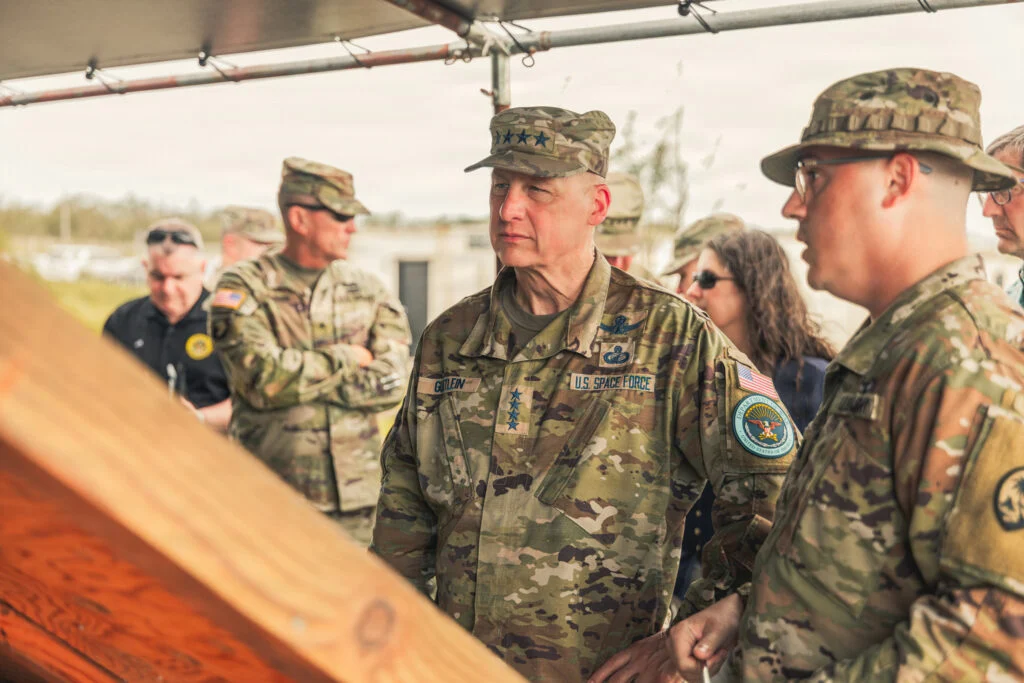
HUNTSVILLE, Ala. – The ambitious "Golden Dome" initiative, the Trump administration’s planned multilayered missile defense shield, has established its "first operational site" at Fort Story, Virginia, according to the Pentagon official overseeing the project. General Michael Guetlein, the program manager for Golden Dome, revealed this significant milestone during his keynote address at the Space and Missile Defense Symposium in Huntsville, Alabama. The declaration signals tangible progress in a defense strategy designed to counter evolving ballistic missile threats.
"We are digging dirt around the homeland," General Guetlein stated at the symposium, underscoring the concrete, on-the-ground development of the defensive architecture. This statement, delivered to an audience of defense industry leaders, military officials, and policymakers, confirms that the program is moving beyond conceptualization and into active construction and deployment phases. The phrase "digging dirt" is a colloquialism that signifies the commencement of physical construction and infrastructure development for the defense system.
President Donald Trump has publicly stated his desire for Golden Dome to be fully operational before the end of his term in early 2029. General Guetlein affirmed that the program remains on schedule to meet this ambitious target, projecting operational readiness by 2028. This timeline indicates a focused effort to accelerate development and deployment, driven by perceived urgency regarding national security threats. The commitment to a 2028 operational date suggests that critical components and initial capabilities are expected to be in place within the next four years.
While General Guetlein provided a key update on the initial site, he remained circumspect regarding the broader network. Speaking to reporters after his address, he stated, "I cannot comment on where the rest of the [Golden Dome] sites are nor how many of them there are." This deliberate withholding of specific location and quantity information is a common practice in military and national security programs, aimed at preserving operational security and preventing potential adversaries from gaining a strategic advantage. The secrecy surrounding the full extent of the Golden Dome network highlights the sensitive nature of strategic defense infrastructure.
Testing and Validation: Building Confidence in Capabilities
The program has already conducted two significant tests, with one notably taking place at the White Sands Missile Range in New Mexico. However, General Guetlein declined to identify the specific equipment or missile types involved in these tests, again citing security concerns. These tests are crucial for validating the effectiveness of the integrated missile defense system, which comprises sensors, command and control systems, and interceptor weapons – collectively referred to as "effectors."
Reflecting on a recent major testing event, Guetlein recounted a challenge he issued to the Missile Defense Agency in January of the current year. He tasked them with executing a critical test in the summer of 2026. "A whole host of other agencies all came together in less than six months, starting from scratch, and delivered what I will argue is the most complex integrated missile defense test that we had pulled off as a nation," he reported. This rapid mobilization and successful execution of a highly complex test underscore the interagency cooperation and the advanced capabilities being developed under the Golden Dome umbrella.
The results of these tests, Guetlein emphasized, have been encouraging. "Both [tests] demonstrated that the capabilities that we are putting together, both command and control, our sensor network and our effectors, are going to be effective against the threats as they are currently designed," he stated. This assessment provides a degree of confidence in the current trajectory of the program. However, he also cautioned that the White Sands test, while successful, "is a fraction of what we’ve got to do to deliver what they’ve asked us to do in ’28." This acknowledgment highlights the immense scale and complexity of the full Golden Dome system and the substantial work remaining to achieve comprehensive operational readiness.
Space-Based Interceptor Layer: A Crucial Component on Track
A vital element of the Golden Dome architecture is its space-based interceptor (SBI) layer. General Guetlein announced that this component has successfully met the first of four planned developmental milestones, known as "gates." Earlier this year, the U.S. Space Force initiated a competitive process, selecting 12 companies to advance SBI technology. These companies are vying for contracts totaling up to $3.2 billion, indicating a significant investment in this advanced defense capability.
"All of the providers that are part of the competition are progressing exceptionally well, and Gate One just came to a closure," Guetlein informed reporters. This positive update on the SBI program suggests that the foundational design and component-level testing phases are progressing as intended.
The competition for the SBI layer is structured around four distinct gates, each representing a significant achievement:
- Gate One: Focuses on establishing the foundational design and conducting component-level testing to verify the integrity and performance of individual parts.
- Gate Two: Requires the development of a functional capability that can be launched into outer space.
- Gate Three: Demands proof that the developed capability operates effectively once deployed in the space environment.
- Gate Four: Mandates the demonstration that the space-based capability integrates and functions as an integral part of the broader Golden Dome architecture.
"Once [competitors] get through all those four gates, four tests, if you will, in a prize-based competition, then we will make a decision" on procurement, Guetlein explained. This structured, gate-based approach allows for incremental validation and risk reduction, ensuring that only mature and effective technologies are ultimately selected for deployment. The prize-based competition model incentivizes innovation and rapid development among the participating companies.
General Guetlein has previously emphasized the fiscal realities of the program, stating that he will not proceed with the SBI layer if it proves to be unaffordable. This pragmatic stance underscores the importance of cost-effectiveness alongside technological superiority in the development of this critical defense system.
Executives from major defense contractors like Lockheed Martin and Northrop Grumman, both selected by the Space Force for SBI development, expressed confidence in their progress. Speaking at separate media roundtables during the symposium, they indicated that their companies are on track to demonstrate their SBI technologies on orbit by the end of 2027. This timeline aligns with the program’s overall schedule, suggesting that the ambitious goals for the space-based component are achievable.
The Digital Backbone: ApexR and Artificial Intelligence
Beyond the physical infrastructure and interceptor technologies, General Guetlein also highlighted the development of a sophisticated digital ecosystem named ApexR. This system is designed to consolidate vast amounts of sensor data, process it using artificial intelligence (AI), and leverage this intelligence during Golden Dome operations.
The creation of ApexR signifies a recognition that modern missile defense requires not only advanced hardware but also cutting-edge software and data analytics. By consolidating sensor data from various sources – potentially including ground-based radar, airborne platforms, and satellites – ApexR aims to provide a comprehensive and real-time picture of the threat landscape. The integration of AI will enable faster threat detection, identification, and tracking, as well as more informed decision-making for defensive responses. This "digital backbone" is expected to be a critical enabler for the effectiveness and efficiency of the multilayered defense shield.
Broader Context and Implications
The development of the Golden Dome missile defense shield comes at a time of increasing global geopolitical tension and advancements in ballistic missile technology by potential adversaries. Nations such as North Korea and Iran continue to develop and test intercontinental ballistic missiles (ICBMs) and other advanced missile systems, posing a significant threat to the United States and its allies. Russia and China also possess advanced missile capabilities that necessitate robust defensive measures.
The "multilayered" aspect of Golden Dome is crucial. It implies a defense system designed to intercept threats at various stages of their flight – from boost phase (shortly after launch) through mid-course (in space) to terminal phase (approaching the target). This layered approach increases the probability of a successful interception and provides redundancy in the defense system. The current U.S. missile defense architecture, while significant, has faced challenges in fully addressing the evolving threat spectrum, particularly with the development of hypersonic missiles and maneuvering warheads.
The successful implementation of Golden Dome could significantly alter the strategic balance by deterring missile attacks and mitigating the consequences of any successful strike. However, the program also faces scrutiny regarding its cost, effectiveness against novel threats, and potential to spur further arms races. The substantial investment in Golden Dome reflects a national security priority to maintain a strategic advantage and protect the homeland.
The Space and Missile Defense Symposium itself serves as a critical platform for dialogue and collaboration within the defense community. It brings together government, industry, and academic stakeholders to discuss the latest advancements, challenges, and future directions in missile defense. General Guetlein’s address at this event underscores the program’s significance and the ongoing efforts to build a comprehensive and effective shield against missile threats. The commitment to operational readiness by 2028, coupled with tangible progress on key components like the first operational site and the SBI layer, indicates a determined push to realize the vision of Golden Dome. The coming years will be critical in demonstrating the program’s ability to deliver on its ambitious objectives.