Scientists poring over data from the venerable Cassini-Huygens mission have unearthed a surprising revelation about Saturn’s magnetosphere, its vast protective magnetic bubble. The analysis has identified an unexpected structural anomaly, strongly suggesting that the magnetospheres of gas giants like Saturn operate on fundamentally different principles than our own terrestrial magnetic shield. This groundbreaking finding, published in the esteemed journal Nature Communications, offers a compelling new perspective on the complex interplay between planetary rotation, solar wind, and the formation of celestial magnetic environments.
The research team, featuring luminaries such as Dr. Licia Ray and Dr. Sarah Badman from Lancaster University, and Dr. Chris Arridge, a former researcher at Lancaster, meticulously examined years of observations. The Cassini mission, a monumental collaborative effort involving NASA, the European Space Agency (ESA), and the Italian Space Agency (ASI), was instrumental in our understanding of the Saturnian system. Orbiting the ringed planet from 2004 to 2017, Cassini provided an unprecedented wealth of data that continues to yield scientific dividends long after its mission concluded.
The Dominance of Rotation: Reshaping Saturn’s Magnetosphere
A central tenet of planetary magnetospheres is their interaction with the solar wind, a continuous stream of charged particles emanating from the Sun. This interaction creates a protective bubble, the magnetosphere, which deflects the majority of these energetic particles. Earth’s magnetosphere, for instance, is largely shaped by the balance between the outward pressure of the solar wind and the inward pressure of its own magnetic field. However, the new findings from Saturn challenge this Earth-centric model, lending robust support to a long-standing theory: for massive, rapidly rotating planets, the planet’s own spin can become a more significant driver of magnetospheric structure than the external solar wind.
The research focused on a specific feature within magnetospheres known as "magnetospheric cusps." These are funnel-shaped openings, typically found near a planet’s poles, where charged solar particles can penetrate the magnetosphere and enter the planet’s atmosphere more directly. By analyzing Cassini observations collected between 2004 and 2010, the scientists aimed to pinpoint the precise location of Saturn’s magnetospheric cusp. Their subsequent comparison with analogous data from Earth revealed a stark divergence.
A Shift Towards Dusk: Saturn’s Afternoon Cusp
Unlike Earth’s magnetospheric cusp, which is generally found close to local high noon, Saturn’s cusp exhibits a significant displacement. The planet’s exceptionally rapid rotation, completing a full rotation in approximately 10.7 hours, appears to "drag" the cusp away from the noon meridian. On average, the analysis indicates that Saturn’s cusp is shifted well into the afternoon, typically observed between 13:00 and 15:00 local time. In some instances, this displacement extends even further, reaching as late as 20:00 local time. This pronounced shift toward dusk provides compelling evidence that a planet’s rotational speed can fundamentally reconfigure its surrounding space environment.
Implications for Auroral Displays and Energetic Particle Dynamics
The unusual location of Saturn’s magnetospheric cusp carries significant implications for our understanding of several key magnetospheric processes. These include the dynamics of magnetic reconnection, the acceleration of high-energy particles, and the generation of Saturn’s spectacular auroral displays.
Dr. Licia Ray of Lancaster University elaborated on the significance of these findings: "This result allows us to move forward with new and improved theories on how planetary magnetospheres interact with the solar wind. For a long time, we’ve seen this discrepancy between models and observations, and this work provides a crucial piece of the puzzle."
A Tale of Two Rotations: Earth vs. Saturn
The contrast between Earth and Saturn in this regard is striking. Earth’s rotation, a leisurely 24 hours, allows for a magnetosphere where the solar wind’s pressure plays a more dominant role in dictating the cusp’s position, keeping it relatively aligned with local noon. Saturn, however, is a different beast entirely. Its rapid rotation is compounded by another unique characteristic: a substantial abundance of ionized material within its magnetosphere, largely supplied by its geologically active moon, Enceladus.
This dual influence—rapid rotation and a plasma-rich environment—creates a different set of forces at play. The pressure exerted by Saturn’s powerful magnetic field, coupled with the outward pressure from its rapidly rotating disk of charged material, must achieve a balance with the incoming pressure of the solar wind. This dynamic equilibrium is the likely driver behind the observed afternoonward shift of Saturn’s magnetospheric cusp.
Unlocking Further Secrets: The Enduring Legacy of Cassini
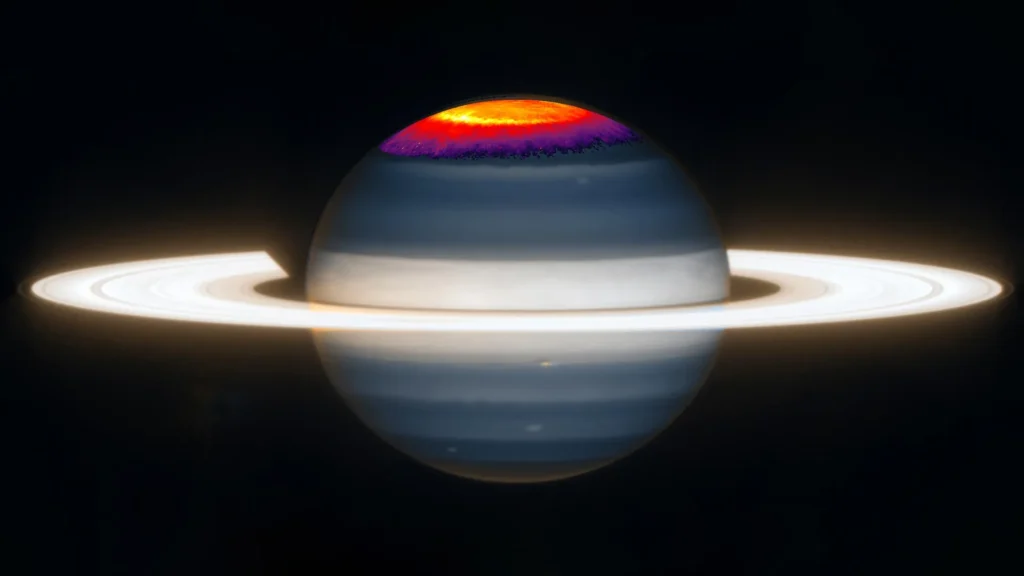
The discovery not only refines our understanding of magnetospheric physics but also promises to enhance our comprehension of Saturn’s dazzling auroras. These celestial light shows are a direct consequence of energetic particles from space interacting with a planet’s atmosphere. The precise location where these particles enter, as dictated by the cusp, therefore has a direct bearing on the patterns and intensity of auroral emissions.
"In particular, the afternoon cusp locations have implications for how we interpret Saturn’s bright aurora and where we expect magnetic reconnection, an explosive process that accelerates particles to very high energies of keV and more, to occur," Dr. Ray further explained. "It also highlights the rich science that can still be done with Cassini data more than eight years after the end of mission. The wealth of information gathered by Cassini is truly extraordinary, and we are still uncovering its profound scientific value."
A Chronology of Discovery: From Mission Launch to Data Analysis
The journey leading to this discovery spans decades. The Cassini-Huygens mission itself was conceived in the late 1980s and approved in 1997, with its launch occurring on October 15, 1997. After a seven-year interplanetary voyage, Cassini entered orbit around Saturn on July 1, 2004. The Huygens probe successfully landed on Saturn’s moon Titan in January 2005.
The primary mission extended for several years, followed by multiple mission enhancements and extensions, including the "Solstice Mission" and the daring "Grand Finale" orbits. During the Grand Finale, which took place in the final months of Cassini’s operational life from April to September 2017, the spacecraft made unprecedented passes through the gap between Saturn’s rings and the planet itself. It was during these final, high-resolution observations, as well as earlier data collected throughout the mission, that the detailed insights into the magnetosphere were meticulously gathered.
The specific data analyzed for the Nature Communications paper was gathered over a six-year period, from 2004 to 2010. This period encompassed a significant portion of Cassini’s orbital tour, allowing researchers to observe Saturn’s magnetosphere under varying solar wind conditions and orbital positions. The subsequent analysis and interpretation of this complex dataset, involving sophisticated modeling and comparative studies with Earth data, took several years to complete, culminating in the recent publication.
Broader Implications: A Universal Principle?
The findings from Saturn raise intriguing questions about the magnetospheres of other gas giants in our solar system and beyond. Jupiter, the largest planet, also rotates rapidly and possesses a colossal magnetosphere. It is highly probable that similar rotational dominance influences Jupiter’s magnetospheric structure. Further investigation into the data from missions like Pioneer 10, Pioneer 11, Voyager 1, Voyager 2, and Galileo, which have provided glimpses into Jupiter’s magnetosphere, may reveal comparable phenomena.
On an exoplanetary scale, this research provides a crucial framework for interpreting observations of distant worlds. As astronomers discover an ever-increasing number of exoplanets, particularly gas giants, understanding the factors that shape their magnetospheres becomes paramount. The Saturnian model suggests that the rotation rate of these exoplanets could be a primary determinant of their magnetic shielding capabilities, influencing their potential habitability by affecting atmospheric retention and protection from stellar radiation.
Expert Reactions and Future Directions
The scientific community has largely welcomed the findings, recognizing their significance in advancing magnetospheric physics. Dr. Arridge, a key contributor to the study, previously commented on the mission’s legacy: "The Cassini-Huygens mission has been an unparalleled success, providing a treasure trove of data that continues to inform our understanding of the Saturnian system. This latest discovery is a testament to the enduring scientific value of the mission’s extensive observations."
Looking ahead, the research team plans to further refine their models of Saturn’s magnetosphere, incorporating the newly identified cusp location. They also aim to investigate the precise mechanisms by which Saturn’s rapid rotation influences the plasma environment and magnetic field topology. The potential for applying these insights to other rapidly rotating planets, both within and beyond our solar system, represents a significant frontier in planetary science and astrophysics. The legacy of the Cassini-Huygens mission, it seems, is far from over, continuing to illuminate the mysteries of our solar system and beyond.