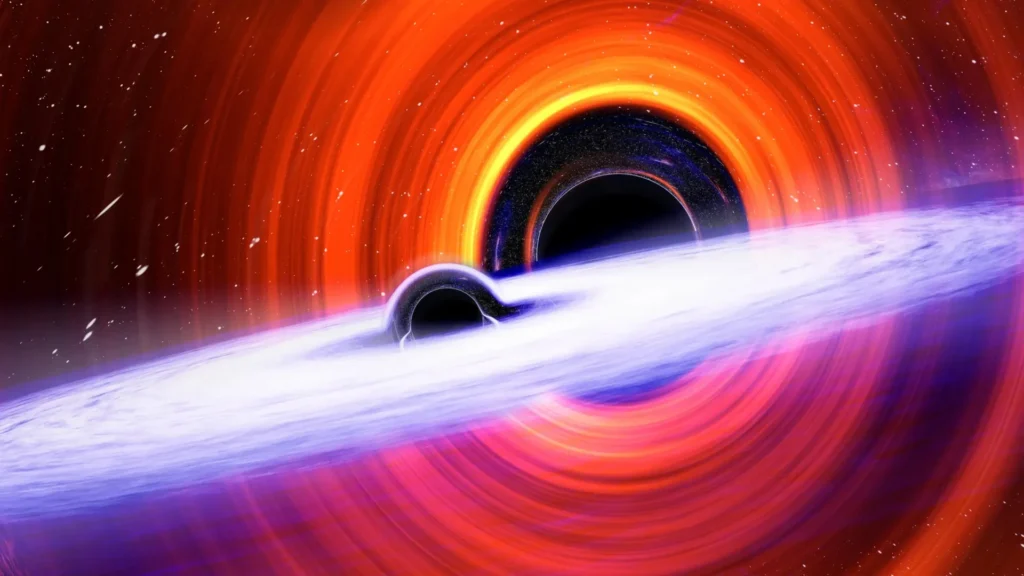
The search for the fundamental building blocks of the universe has taken a significant leap forward as researchers at the University of Miami suggest that a recent, anomalous gravitational wave detection may confirm the existence of primordial black holes. These theoretical objects, which are believed to have formed in the chaotic fraction of a second following the Big Bang, have long been a subject of intense debate within the scientific community. If proven real, they could provide a definitive answer to one of the most enduring mysteries in physics: the nature of dark matter.
For decades, the standard model of cosmology has struggled to account for the "missing" mass of the universe. Observations of galactic rotation and gravitational lensing suggest that roughly 85 percent of all matter in the cosmos is invisible, exerting a gravitational pull but emitting no light. This "dark matter" has remained elusive, with various candidate particles—such as Weakly Interacting Massive Particles (WIMPs) or axions—failing to appear in direct detection experiments. The new research led by Nico Cappelluti, an associate professor in the University of Miami’s Department of Physics, and Ph.D. student Alberto Magaraggia, posits that the answer may not be a new particle at all, but rather a vast population of black holes born at the dawn of time.
The Mystery of the Subsolar Mass Signal
The catalyst for this renewed interest is a specific event recorded by the Laser Interferometer Gravitational-Wave Observatory (LIGO). In late 2023, the observatory’s automated systems flagged a gravitational wave signal that defied conventional explanation. Gravitational waves are ripples in the fabric of spacetime, typically generated by the violent collision of two massive objects, such as neutron stars or stellar-mass black holes.
Most black holes observed to date are the remnants of massive stars that have reached the end of their life cycles. When a star several times more massive than our Sun exhausts its nuclear fuel, it collapses under its own gravity, often resulting in a supernova explosion and leaving behind a black hole. Because of the physics governing stellar evolution, these black holes typically have masses ranging from approximately three times the mass of the Sun to several dozen solar masses.
However, the November alert from LIGO indicated a merger involving at least one object with a mass significantly less than that of our Sun. Such a "subsolar mass" object cannot be explained by traditional stellar death. According to the Chandrasekhar limit—the maximum mass of a stable white dwarf star—and the Tolman-Oppenheimer-Volkoff limit for neutron stars, there is no known mechanism for a star to collapse into a black hole of such low mass. This discrepancy has led researchers to look toward the early universe for answers.
Primordial Black Holes: A Relic of the Big Bang
Unlike stellar black holes, primordial black holes (PBHs) do not require a star to form. Instead, they are hypothesized to have originated from the extreme density fluctuations present in the early universe, specifically during the first millisecond after the Big Bang. In these high-pressure conditions, pockets of space may have become so dense that they collapsed directly into black holes.
Because they formed before the first stars ever flickered to life, PBHs could theoretically exist in a vast range of sizes. They could be as small as a grain of sand or an asteroid, or they could be massive enough to serve as the "seeds" for the supermassive black holes found at the centers of galaxies today.
"We believe our study will aid in confirming that they actually do exist," said Nico Cappelluti. His work with Magaraggia, recently published in The Astrophysical Journal, argues that the detected LIGO signal is most consistent with the signature of a primordial black hole. By estimating the potential density of these objects across the cosmos, the team calculated the frequency at which LIGO should expect to "hear" them colliding. Their findings suggest that subsolar black hole mergers should be rare occurrences—a prediction that aligns perfectly with the current observational data.
A Chronology of Theoretical Development
The concept of primordial black holes is not new; it is a theory with deep roots in 20th-century physics. The idea was first proposed in the late 1960s by Soviet physicists Yakov Zeldovich and Igor Novikov. They theorized that the early universe was sufficiently lumpy that gravity could have overcome the expansion of space in certain regions.
In 1971, Stephen Hawking refined this theory, suggesting that these ancient black holes could be scattered throughout the universe. Hawking famously proposed that if these objects were small enough, they would eventually evaporate through what is now known as Hawking radiation. However, larger PBHs would remain stable over billions of years, potentially clustering in the halos of galaxies. This led to the hypothesis that PBHs could constitute the bulk of dark matter, providing the gravitational "glue" that prevents galaxies from flying apart.
The timeline of discovery took a monumental turn on September 14, 2015, when LIGO made the first-ever direct detection of gravitational waves. This event, known as GW150914, involved the merger of two black holes roughly 30 times the mass of the Sun. While this confirmed Einstein’s General Theory of Relativity, it also sparked a question: were these black holes stellar remnants, or were they primordial? The recent subsolar detection has now pushed this question to the forefront of astrophysical research.
Scientific Skepticism and the Search for the "Smoking Gun"
Despite the excitement surrounding the University of Miami study, the scientific community remains cautious. Detecting gravitational waves is an incredibly delicate process. LIGO’s detectors use laser interferometry to measure changes in distance smaller than the width of a proton. At this level of sensitivity, environmental factors—ranging from seismic activity to distant ocean waves—can create "noise" that mimics a real signal.
Some astrophysicists argue that the subsolar mass signal may simply be an instrumental artifact or an error in data processing. "LIGO picked up what is very strong evidence that these types of black holes exist," Cappelluti acknowledged. "But we’ll need to detect another such signal or even several others to get the smoking-gun confirmation that they are real."
To address these doubts, the international LVK collaboration—comprising LIGO in the United States, Virgo in Italy, and KAGRA in Japan—is undergoing continuous upgrades. By increasing the sensitivity of the detectors and improving the algorithms used to filter out noise, researchers hope to isolate more subsolar events. The goal is to move from a single "candidate" event to a statistically significant population of detections.
Data and Implications: Dark Matter and Beyond
If the University of Miami’s findings are corroborated by future detections, the implications for our understanding of physics would be transformative. The study indicates that primordial black holes could account for a significant portion, if not all, of the dark matter in the universe.
Current cosmological data suggests the following composition of the universe:
- 70% Dark Energy: The force driving the accelerated expansion of the universe.
- 25% Dark Matter: The invisible mass holding galaxies together.
- 5% Normal Matter: Everything we can see, including stars, planets, and people.
If dark matter is composed of primordial black holes, it would eliminate the need for "New Physics" theories that require the existence of undiscovered subatomic particles. Instead, the mystery of dark matter would be solved using the existing framework of General Relativity and the known behavior of gravity.
Furthermore, the existence of PBHs would provide a "window" into the conditions of the early universe. By studying the mass distribution of these black holes, scientists could learn about the temperature, pressure, and density fluctuations that occurred just moments after the Big Bang, offering a clearer picture of how the cosmos evolved from a hot, dense plasma into the structured universe we see today.
The Future of Gravitational Wave Astronomy
While LIGO and its partners have opened the door to this field, the next decade promises even more advanced tools for exploration. LIGO’s current design is optimized for high-frequency waves produced by relatively recent cosmic events. To peer even further back in time, scientists are looking toward space-based and next-generation ground-based observatories.
The European Space Agency’s Laser Interferometer Space Antenna (LISA), set for launch in 2035, will consist of three spacecraft flying in a triangular formation millions of miles apart. Because it will be located in the vacuum of space, free from terrestrial noise, LISA will be able to detect much lower-frequency gravitational waves. This will allow it to capture signals from the very first epochs after the Big Bang, potentially observing the formation of primordial black holes directly.
In the United States, the proposed "Cosmic Explorer" facility aims to build a detector ten times more sensitive than LIGO. With vacuum arms stretching 25 miles in length, it would be capable of detecting every black hole merger in the observable universe, reaching back to the "Cosmic Dawn" when the first stars were born.
As Alberto Magaraggia noted, the results of the Miami study are encouraging because they provide a roadmap for what these future observatories should look for. "We predict that subsolar black holes… should indeed be rare, consistent with how infrequently such events have been seen so far," he said.
The search for primordial black holes is more than just a hunt for an exotic astronomical object; it is a quest to understand the origin and ultimate fate of the universe. Whether these ancient relics are the key to dark matter or a rare cosmic anomaly, the ongoing observations by LIGO and its successors are poised to rewrite the textbooks of modern cosmology. For now, the scientific world waits for the next ripple in spacetime to confirm that the echoes of the Big Bang are still being heard.