Water, the ubiquitous solvent and lifeblood of Earth, occupies over 70% of the planet’s surface, yet its fundamental behavior continues to challenge scientific understanding. Unlike nearly every other known liquid, water exhibits a bewildering array of anomalous properties. Chief among these is its paradoxical expansion upon freezing, a trait that prevents lakes from freezing solid from the bottom up and allows aquatic life to survive harsh winters. For decades, scientists have theorized that these unusual characteristics stem from dynamic changes in water’s microscopic molecular structure, fluctuating with variations in temperature and pressure. However, the lack of a standardized, consistent framework to describe and compare these intricate structural transformations has been a persistent hurdle in fully comprehending H₂O’s unique nature.
Now, a significant breakthrough from researchers at the University of Osaka promises to bridge this long-standing gap. Leveraging the power of artificial intelligence (AI), their newly developed system offers a unified methodology for comparing diverse approaches to characterizing the structure of supercooled water. This innovative AI tool is poised to identify which structural descriptors most effectively capture the critical features responsible for water’s peculiar behaviors, as detailed in their recent publication in the esteemed journal Communications Chemistry. This development marks a pivotal moment, offering new avenues for a more profound understanding of one of the universe’s most vital, yet enigmatic, substances.
The Paradox of Water: A Century of Scientific Inquiry
Water’s anomalies are not merely academic curiosities; they are foundational to life as we know it. While most liquids contract and become denser as they cool, water famously reaches its maximum density at approximately 4 degrees Celsius (39.2 degrees Fahrenheit). Below this temperature, it begins to expand, culminating in a roughly 9% volume increase when it transitions into ice. This phenomenon ensures that ice floats, insulating the water beneath and creating a stable environment for aquatic ecosystems. Without this singular property, Earth’s oceans and freshwater bodies would freeze solid, fundamentally altering planetary habitability. Beyond its density anomaly, water boasts an unusually high specific heat capacity, allowing it to absorb and release large amounts of heat without drastic temperature changes, a crucial factor in climate regulation. It also exhibits high surface tension, exceptional solvent properties, and anomalous viscosity and compressibility, among over 70 known anomalies that defy the typical behavior predicted for a molecule of its size and composition.
The scientific quest to unravel these mysteries spans centuries. Early observations of water’s density anomaly can be traced back to the 17th century, with figures like Niccolò Aggiunti and later Horace Bénédict de Saussure making notable contributions. However, a comprehensive molecular-level explanation remained elusive, primarily due to the limitations of experimental techniques to probe structures at the atomic scale and the complexity of water’s hydrogen bond network. The advent of quantum mechanics and computational chemistry in the 20th century began to offer new tools, allowing scientists to simulate molecular interactions and propose theoretical models for water’s unique phases. Despite these advancements, the sheer dynamism and transient nature of water’s molecular arrangements continued to pose significant challenges.
The Peculiar Realm of Supercooled Water
To transform liquid water into solid ice, water molecules must align themselves into a highly ordered, crystalline lattice. This crystallization process typically commences at a "nucleation site" – a microscopic imperfection or impurity that provides a starting point for ice crystal formation. Even minute particles or microscopic scratches within a container can serve as these critical nucleation points.
However, if these nucleation sites are meticulously absent or minimized, water can defy its normal freezing point and persist in a liquid state even when cooled significantly below 0°C (32°F). This extraordinary, metastable condition is known as supercooled water. It’s a state that is notoriously difficult to maintain in a laboratory setting, often requiring specialized techniques to prevent spontaneous freezing. Under these supercooled conditions, water’s already unusual properties become even more pronounced and amplified, offering scientists a unique window into its underlying molecular mechanics.
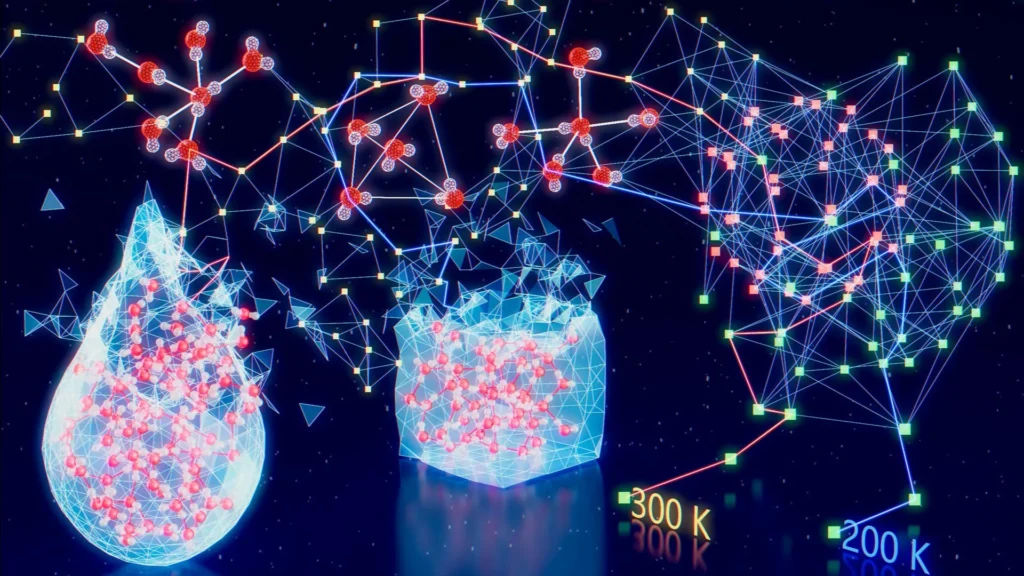
The prevailing scientific hypothesis to explain these exaggerated behaviors in supercooled water centers on a delicate equilibrium between two distinct, competing forms of liquid water: a high-density liquid (HDL) and a low-density liquid (LDL). At the molecular level, water molecules are not static but are constantly forming, breaking, and reforming intricate networks of hydrogen bonds. The LDL state is characterized by more open, tetrahedral-like arrangements of molecules, resembling the structure of ice but without long-range order, contributing to lower density. Conversely, the HDL state involves more compact, disordered arrangements, leading to higher density. As the temperature of supercooled water gradually rises, the more compact HDL structures increasingly gain dominance over the more expansive, open LDL configurations, shifting the balance and influencing macroscopic properties. Understanding this dynamic interplay is crucial for deciphering water’s overall behavior.
The Challenge of Describing Molecular Architecture
Over the years, the scientific community has proposed a multitude of ways to describe the local arrangement and bonding patterns of water molecules. These "structural descriptors" encompass a wide range of measurements, including parameters like tetrahedral bond order, local density, coordination number, and various geometric indices. Each descriptor attempts to quantify a specific aspect of the molecular environment, aiming to provide insight into the prevalence of HDL-like or LDL-like structures.
The independent development of these numerous descriptors, often by different research groups with distinct theoretical frameworks and computational approaches, has inadvertently created a significant obstacle. They frequently utilize different scales, dimensions, and types of information, making direct comparisons and cross-validation inherently difficult. This lack of a unified language has hindered the ability of researchers to definitively determine which descriptors are most accurate, efficient, and truly capture the most important structural information responsible for water’s anomalies. The absence of a common benchmark has made it challenging to build a cohesive, widely accepted model of water’s dynamic structure.
AI’s Role in Unifying Water Models: The Osaka Innovation
Recognizing this critical need for a standardized comparative framework, researchers at the University of Osaka embarked on an ambitious project to apply cutting-edge artificial intelligence to the problem. Their approach leverages the pattern-recognition capabilities of neural networks, a powerful subset of AI, to systematically evaluate the efficacy of various structural descriptors.
"Past studies have shown that using machine learning to classify and understand structural data is remarkably effective," explains corresponding author Kang Kim, highlighting the growing trend of AI in materials science and chemistry. "We specifically wanted to incorporate a neural network model into this study to evaluate how accurate the descriptors were at capturing key structural information, in a way that is like human cognition. The AI can identify subtle patterns that might be overlooked by traditional analytical methods, essentially learning to ‘see’ the differences between LDL and HDL states as a human expert might, but with unparalleled speed and consistency."
To train their AI system, the Osaka team fed the neural network an extensive dataset comprising structural information generated from molecular dynamics simulations of supercooled water. Molecular dynamics (MD) simulations are computational techniques that model the physical movements of atoms and molecules over time, providing detailed insights into their interactions and collective behavior. By simulating water molecules under various supercooled conditions, the researchers could generate a vast library of structural configurations, representing both HDL and LDL tendencies. Through repeated iterations of trial and error, the neural network progressively learned to recognize and differentiate meaningful patterns within these complex molecular structures, effectively developing an intrinsic understanding of what constitutes an HDL state versus an LDL state.
New Clues to Water’s Hidden Structure and Future Implications
Once trained, the AI network was deployed to evaluate the performance of 16 different structural descriptors. "The network used what it had learned to compare how 16 descriptors differentiated between LDL and HDL structures at different temperatures," reports senior author Nobuyuki Matubayasi. "In this way, we determined the most efficient descriptors." The AI’s ability to consistently and objectively assess the discriminatory power of each descriptor, irrespective of its original scale or formulation, provided an unprecedented level of comparative analysis. This rigorous evaluation helped pinpoint which descriptors were most sensitive to the subtle structural variations that characterize the two competing liquid forms of water.
This groundbreaking framework developed by the Osaka researchers holds immense promise for advancing scientists’ understanding of how microscopic structural changes in water are intimately connected to its macroscopic thermodynamic behavior. By identifying the most robust and informative descriptors, the research provides a more precise vocabulary for discussing water’s molecular arrangements. This clarity is expected to accelerate the development of more accurate theoretical models and computational simulations, moving closer to a comprehensive "equation of state" for water that fully accounts for its anomalies.
The findings may also shed new light on the fundamental origin of water’s unusual properties, potentially resolving long-standing debates within condensed matter physics and physical chemistry. Moreover, the methodology itself serves as a powerful new tool, guiding the development of even better, more refined instruments and computational techniques for studying the complex molecular structure of water and other challenging liquids.
The broader implications of this research extend far beyond academic curiosity. A deeper understanding of water at the molecular level could have transformative impacts across various scientific and technological domains:
- Cryopreservation: Improving the ability to preserve biological tissues, organs, and cells by minimizing ice crystal damage, which is crucial for medicine and biotechnology.
- Materials Science: Designing novel materials with tailored properties, such as ice-resistant surfaces or new types of membranes for water purification, by controlling water-material interactions at the molecular scale.
- Drug Discovery: Understanding how water molecules interact with proteins and other biomolecules is fundamental to rational drug design, as these interactions dictate protein folding and ligand binding.
- Climate Science: Enhancing models of cloud formation, precipitation, and ocean dynamics, where the phase transitions and properties of water play critical roles.
- Fundamental Chemistry and Physics: Providing a template for applying AI to unravel the structural complexities of other liquids, glasses, and disordered materials, which are notoriously difficult to characterize.
The scientific community, long grappling with the elusive nature of water’s phases and its many anomalies, is expected to view these findings from the University of Osaka as a significant step forward. This innovative application of AI not only provides a powerful new lens through which to view water’s microscopic world but also exemplifies the growing synergy between artificial intelligence and fundamental scientific discovery. As AI continues to evolve, its capacity to accelerate our understanding of the natural world, particularly in areas of immense complexity like the physics of water, will undoubtedly continue to expand, paving the way for unforeseen breakthroughs and technological advancements.