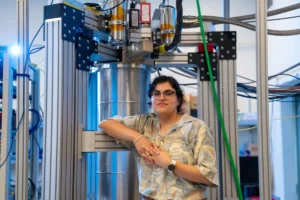
Researchers at Rice University have made a groundbreaking experimental confirmation that extreme, nanoscale wrinkles within sheets of graphene generate localized electric charges, providing definitive evidence of flexoelectricity in single-atom-thick materials. This pivotal discovery heralds a paradigm shift in material science, suggesting that the electrical properties of ultrathin materials can be controlled by altering their physical shape, rather than relying on traditional chemical modifications or doping. This geometry-driven approach promises to unlock new avenues for developing highly sensitive sensors and advanced, ultra-thin electronic devices that could revolutionize various technological sectors.
Unveiling Flexoelectricity in Graphene
The core of this revelation lies in the concept of flexoelectricity, an intrinsic property of materials where an electric polarization is induced by mechanical strain gradients, particularly uneven bending. While piezoelectricity, which involves electric charge generation from uniform strain, is well-understood and widely utilized, flexoelectricity has historically been more challenging to observe and harness, especially in materials that lack an inherent crystal polarity. Graphene, being a non-polar material, was not expected to exhibit strong flexoelectric effects, making this experimental validation particularly significant. The Rice team demonstrated that naturally occurring, sharply curved nanoscale wrinkles in graphene cause electrons to redistribute, shifting towards one side of the bend. This subtle electron migration creates opposite electrical charges across the wrinkle, effectively acting like a microscopic battery.
Pulickel Ajayan, the Benjamin M. and Mary Greenwood Anderson Professor of Engineering and co-corresponding author of the study, emphasized the profound implications of this finding. "Our work shows that even an ordinary wrinkle can become an extraordinary electronic feature when viewed at the atomic scale," Ajayan stated. "By demonstrating that geometry alone can reshape electrical behavior in graphene, we open a new pathway for designing materials whose properties can be controlled through structure rather than chemistry." This statement underscores a fundamental departure from conventional material engineering, where chemical composition and doping are typically the primary levers for tuning electronic characteristics.
The Graphene Phenomenon: A Brief Overview
To appreciate the magnitude of this discovery, it is essential to understand graphene itself. Graphene is a two-dimensional material consisting of a single layer of carbon atoms arranged in a hexagonal lattice. Discovered in 2004 by Andre Geim and Konstantin Novoselov at the University of Manchester, a feat that earned them the Nobel Prize in Physics in 2010, graphene quickly captivated the scientific community due to its extraordinary properties. It is the thinnest material known, yet also incredibly strong—about 200 times stronger than steel by weight. Furthermore, it possesses exceptional electrical conductivity, superior thermal conductivity, and optical transparency. These remarkable attributes have positioned graphene as a "wonder material" with potential applications spanning electronics, energy storage, biomedical devices, and composite materials. However, controlling its electronic properties has often involved chemical functionalization or interaction with other materials. The Rice discovery introduces a new, intrinsic method for manipulating graphene’s electrical behavior through purely mechanical means.
Understanding Flexoelectricity: A Deeper Dive
Flexoelectricity is a phenomenon observed in dielectric materials where an electric polarization is generated in response to a strain gradient. Unlike piezoelectricity, which requires materials to lack inversion symmetry and thus have an inherent dipole moment, flexoelectricity can exist in any dielectric material, regardless of its crystal symmetry. This makes it a more universal effect. However, its magnitude is typically very small and often overshadowed by piezoelectric effects in materials that exhibit both. In bulk materials, the strain gradients required to induce significant flexoelectricity are often extreme, limiting its practical applications. The breakthrough with graphene lies in demonstrating a remarkably strong flexoelectric response at the nanoscale, where atomic-level bending creates exceptionally high strain gradients within the single-atom-thick lattice. This inherent nanoscale curvature provides the ideal conditions for pronounced flexoelectric effects, a phenomenon previously difficult to isolate and quantify.
The "Cold Case" Solved: A Decades-Old Prediction Confirmed
The journey to this discovery has a compelling chronological narrative, akin to solving a scientific cold case. The theoretical foundation for graphene’s flexoelectricity was laid nearly two decades ago. In 2008, theoretical physicist Vincent Meunier, then at the Rensselaer Polytechnic Institute, published a seminal paper predicting that violently curving graphene would force its electrons to realign and generate an electrical charge. Meunier’s mathematical models were robust, but the technology required to experimentally verify such a subtle effect—measuring voltage across a gap only a few atoms wide—simply did not exist at the time. The prediction remained an elegant theoretical construct, awaiting technological advancement.
Years later, the pieces of the puzzle began to fall into place. Sathvik Ajay Iyengar, a former Rice doctoral student and lead author of the current study, along with his colleague Manoj Tripathi, were reviewing old dataset measurements of graphene samples. They noticed peculiar, unexplained electrical signals that spiked specifically at the sharpest folds and wrinkles within their graphene samples. These anomalies sparked their curiosity. Iyengar, recognizing the potential significance, brought this intriguing data to Meunier, who by then had joined Rice University.
The collaboration between Iyengar, Tripathi, and Meunier, coupled with the sophisticated tools available at Rice, finally allowed them to catch the "phantom effect" in action. The team employed a multi-pronged approach: specialized microscopic probes capable of atomic-scale manipulation, laser-based Raman spectroscopy for detailed structural and electronic characterization, and advanced computer simulations to model the electron behavior under extreme curvature. Applying approximately one volt of electricity to the isolated wrinkles caused the bends to react precisely as Meunier’s 18-year-old mathematical predictions had foretold. This convergence of theoretical foresight and experimental validation marks a significant milestone in condensed matter physics and material science.
Experimental Rigor and Quantifiable Results
The experimental methodology employed by the Rice team was crucial for isolating the flexoelectric effect. Earlier studies on graphene often examined gentler bends or relied on external pressure, which made it challenging to distinguish subtle flexoelectric signals from other electrical phenomena. Iyengar elaborated on their approach: "Comparing the sharply curved wrinkles with flat graphene allowed us to clearly identify the role of extreme curvature." This direct comparison provided a control, enabling the researchers to attribute the observed electrical changes specifically to the geometric deformation.
The researchers discovered that graphene’s sharp nanoscale wrinkles function like tiny electrical "speed bumps," altering the local electrical energy landscape and generating a consistent current under roughly one volt of applied electricity. A key finding was that the electrical response relies predominantly on the sharpness of the wrinkle rather than its overall height or size. This characteristic leads to an astonishing charge separation, or polarization, estimated to be between 100,000 to 10 million times stronger than what is typically observed in much larger flexoelectric systems. "The sharpness of the wrinkle turned out to be much more important than its overall size," Iyengar noted. "That tells us we can potentially tune electrical behavior by carefully controlling curvature at the nanoscale." This insight is critical for future engineering applications, as it suggests that even minute, precisely controlled geometric features can yield substantial electrical effects.
Shifting Paradigms: Geometry Over Chemistry
The implications of this "geometry over chemistry" approach extend beyond graphene. Traditionally, modifying the electrical properties of materials involves doping—introducing impurities to alter electron concentrations—or functionalization with chemical groups. These methods often come with limitations, such as stability issues, manufacturing complexity, or unintended changes to other material properties. The ability to control electrical behavior purely through structural deformation offers a clean, intrinsic, and potentially more robust method. This could lead to a new class of "mechano-electronic" materials where mechanical manipulation directly dictates electronic function, opening up possibilities for dynamic, reconfigurable electronic devices.
For example, imagine sensors that respond to minute mechanical changes not through stress-induced resistance changes, but by generating a direct electrical signal from flexoelectricity. Or flexible electronic components whose functions can be tuned by simply bending or creasing them in specific ways. This paradigm shift could simplify fabrication processes, reduce reliance on exotic chemical additives, and enable the creation of truly novel devices.
Statements from the Research Team
The enthusiasm from the Rice University team is palpable, reflecting the profound impact of their findings. Professor Ajayan’s remarks underscore the transformative potential for material design. "This opens up an entirely new dimension for engineering materials. Instead of just thinking about what atoms to put together, we can now also think about how to shape them at the atomic scale to achieve desired electronic functionalities," he explained. "It’s a testament to the power of interdisciplinary research, where theoretical predictions from years ago can finally be validated by experimental ingenuity."
Iyengar, reflecting on the arduous experimental journey, added, "There were many moments where the signals were so subtle, it felt like chasing ghosts. But the consistency of the data, especially when compared with Meunier’s original predictions, gave us the confidence to push forward. It’s incredibly rewarding to see a long-standing theoretical puzzle finally solved with clear experimental evidence." The collaborative spirit, bridging theoretical physics and experimental material science, was a critical factor in this success.
Broader Implications for Next-Generation Technologies
The confirmation of robust flexoelectricity in graphene has far-reaching implications for several technological domains:
-
Highly Sensitive Sensors: The ability of nanoscale wrinkles to generate significant charge separation in response to extreme curvature suggests the development of ultra-sensitive mechanical sensors. These could include strain sensors capable of detecting minute deformations, pressure sensors, or even flow sensors. Moreover, coupling this effect with graphene’s other properties, like its large surface area, could lead to novel chemical and biological sensors that detect target molecules by inducing specific conformational changes in a graphene membrane, thereby generating an electrical signal.
-
Advanced, Ultra-Thin Electronic Devices: The prospect of controlling electrical properties through geometry offers new pathways for designing next-generation electronic components. This could include flexible and transparent electronics that are more durable and adaptable. Imagine self-powered flexible displays or wearable devices that generate electricity from body movements. Furthermore, this effect could be harnessed to create novel transistors or diodes whose characteristics are tuned by mechanical deformation, leading to reconfigurable circuits. The "electrical speed bump" analogy suggests a way to locally modulate electron flow, which is fundamental to transistor operation.
-
Energy Harvesting: While not explicitly stated as an immediate application, the generation of an electric charge from mechanical bending inherently points towards potential for nanoscale energy harvesting. If these flexoelectric effects can be scaled or amplified, graphene-based devices could potentially convert ambient mechanical vibrations or movements into electrical energy, powering small-scale electronics without external batteries.
-
Novel Material Design Principles: Beyond specific applications, this research introduces a fundamental new design principle for materials science. The emphasis on nanoscale architecture and mechanical deformation as a means to engineer electronic properties could be extended to other 2D materials (like boron nitride or molybdenum disulfide) or even carefully structured metamaterials. This opens an entirely new design space for materials with tailored functionalities.
Challenges and Future Directions
Despite the significant breakthrough, challenges remain, and the research opens several new avenues for exploration. One primary challenge is the precise control over the formation and geometry of these nanoscale wrinkles. While naturally occurring wrinkles were studied here, for industrial applications, methods for reliably creating and patterning these sharp bends with atomic precision will be necessary. Advanced nanofabrication techniques, such as focused ion beam milling or controlled growth processes, might be explored.
Further research will likely focus on:
- Controlling Wrinkle Formation: Developing techniques to intentionally induce and control the sharpness, height, and orientation of graphene wrinkles.
- Scaling Up: Investigating whether these effects can be scaled up to macroscopic devices while maintaining their efficiency.
- Integration with Other Materials: Exploring how flexoelectric graphene can be integrated into existing electronic architectures or combined with other functional materials.
- Dynamic Tuning: Studying the dynamic response of these flexoelectric effects to varying mechanical stimuli, which is crucial for sensor and reconfigurable electronics applications.
- Theoretical Refinements: Further refining theoretical models to predict and optimize flexoelectric responses in various 2D material geometries.
Conclusion: A New Era of Material Design
The experimental confirmation of robust flexoelectricity in graphene’s nanoscale wrinkles by researchers at Rice University marks a monumental step forward in materials science. It not only validates a decades-old theoretical prediction but also introduces a powerful new paradigm for controlling material properties: geometry over chemistry. This discovery holds immense promise for the development of next-generation, ultra-thin, flexible, and highly sensitive electronic devices and sensors. As scientists delve deeper into understanding and harnessing this intrinsic property, we stand on the cusp of a new era of material design, where the subtle art of shaping matter at the atomic scale will unlock unprecedented functionalities and drive innovation across countless technological frontiers. The findings, meticulously detailed and rigorously validated, were published in the prestigious journal Advanced Materials, setting a new benchmark for research in two-dimensional materials.