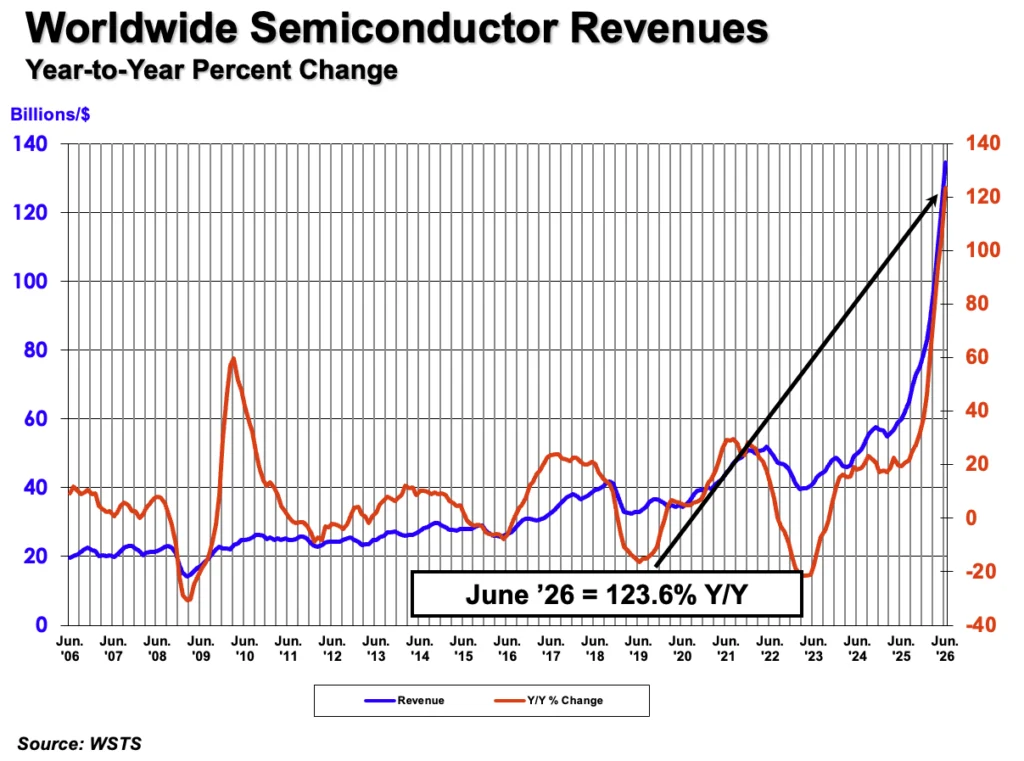
Global semiconductor sales achieved a remarkable $403.3 billion during the second quarter of 2026, marking a substantial 35.1% increase compared to the first quarter, according to the latest figures released by the Semiconductor Industry Association (SIA). This robust performance signals a vigorous recovery and expansion within the crucial chip industry, setting a new benchmark for quarterly growth and fueling optimistic projections for the remainder of the year. The momentum carried strongly into June 2026, with worldwide chip sales reaching $134.5 billion for the month. This figure represents an astounding 123.6% increase over sales recorded in June 2025 and a solid 9.7% uptick from May 2026, underscoring a broad-based and accelerated demand across the global technology landscape. These monthly sales statistics, compiled by the World Semiconductor Trade Statistics (WSTS) organization, are presented as a three-month moving average, providing a smoothed and reliable indicator of market trends.
A Trajectory of Recovery: Chronology of Semiconductor Market Dynamics
The semiconductor industry has navigated a dynamic and often volatile path over the past few years, experiencing periods of unprecedented boom followed by a necessary correction, and now, a resurgence. The initial surge in demand during 2020 and 2021 was largely driven by the rapid acceleration of digital transformation, remote work, and heightened consumer electronics consumption in the wake of the global pandemic. This period saw strained supply chains and record-high sales, culminating in a peak in late 2021 and early 2022.
However, the latter half of 2022 and much of 2023 witnessed a significant downturn. Macroeconomic headwinds, including rising inflation and interest rates, coupled with an inventory correction across various segments, led to a deceleration in demand and a subsequent dip in sales. Companies that had over-ordered during the boom began to deplete their stockpiles, leading to reduced new orders for chip manufacturers. This period was characterized by price erosion, particularly in the memory sector, and a cautious outlook from many industry players.
Signs of stabilization and nascent recovery began to emerge in late 2024, particularly in segments like Artificial Intelligence (AI) and high-performance computing (HPC), which continued to exhibit strong underlying demand. The first quarter of 2026 then solidified this recovery, laying the groundwork for the extraordinary growth seen in Q2. The 35.1% sequential increase from Q1 to Q2 2026 is not merely a rebound but an emphatic statement of renewed market vigor, suggesting that the industry has successfully navigated its inventory challenges and is now responding to a fresh wave of technological demand. This chronological progression highlights the cyclical nature of the industry but also points to the unique drivers behind the current expansion.
Unpacking the Q2 2026 Surge: Key Performance Indicators and Market Depth
The $403.3 billion in Q2 2026 sales underscores the sheer scale of the semiconductor market and its integral role in the global economy. The 35.1% quarter-on-quarter growth is indicative of a robust expansion not merely limited to a few niche segments but reflective of broader market health. To put this into perspective, such a substantial quarterly increase is often associated with periods of aggressive technological adoption cycles and significant capital expenditure across industries.
The monthly data for June 2026 further reinforces this narrative. The $134.5 billion in sales for the single month, representing a 123.6% year-on-year increase from June 2025, illustrates a dramatic shift from the previous year’s conditions. This triple-digit annual growth is particularly telling, suggesting that the industry has not only recovered from any previous slumps but is now operating at a significantly higher output and demand level. The 9.7% month-over-month increase from May 2026 to June 2026 demonstrates sustained momentum, indicating that the strong Q2 performance was not merely a one-off surge but part of a continuous upward trend. The use of a three-month moving average by WSTS helps to smooth out any short-term fluctuations, providing a more reliable picture of the underlying market strength. This methodology ensures that reported figures reflect sustained trends rather than transient spikes, lending greater credibility to the current positive outlook.
Regional Growth: A Broad-Based Expansion Across Global Markets
The latest SIA report highlights that the growth in semiconductor sales is not confined to specific geographical pockets but is a broad-based phenomenon, with every major regional market recording substantial year-on-year growth during June 2026. This widespread growth is a crucial indicator of a healthy global market, suggesting that demand is being driven by diverse economies and technological initiatives.
The Americas region led this impressive growth, reporting an extraordinary 160.9% increase in sales compared to June 2025. This surge in the Americas can be attributed to robust investments in data centers, significant advancements in AI research and deployment, and strong government initiatives aimed at boosting domestic chip manufacturing and R&D. Following closely, Asia Pacific and other markets experienced a 124.4% rise in sales, reflecting the region’s continued dominance in electronics manufacturing, expanding digital economies, and growing adoption of advanced technologies across various sectors.
China, a critical market for semiconductor consumption, saw sales increase by 112.8% year-on-year. Despite ongoing geopolitical complexities and efforts towards domestic self-sufficiency, China’s vast consumer base and industrial demand for chips continue to drive significant market volume. Europe also demonstrated strong growth, with sales climbing by 75.2% compared to June 2025, likely fueled by the automotive sector’s transition to electric vehicles and advanced driver-assistance systems (ADAS), as well as industrial automation initiatives. Japan recorded a 39% increase, showcasing its resilience and continued innovation in specialized semiconductor applications and industrial machinery.
Beyond year-on-year comparisons, month-to-month growth was also recorded across every region, further solidifying the consistent upward trajectory. China led this sequential growth with a 10.4% increase, followed by Asia Pacific and other markets at 9.8%, and the Americas at 9.6%. Japan saw an 8.6% rise, and Europe experienced a 7.7% increase. This uniform monthly growth across all regions underscores a sustained and widespread increase in demand, painting a picture of a globally synchronized market expansion.
Underlying Drivers of Demand: Beyond the Raw Numbers

The impressive sales figures are not merely statistical anomalies but are deeply rooted in profound technological shifts and escalating digital needs across various industries. Several key drivers are propelling this unprecedented demand for semiconductors:
- Artificial Intelligence (AI) and Machine Learning: The most significant catalyst. The explosion of generative AI, large language models, and AI integration across cloud computing, data centers, and edge devices is creating an insatiable demand for high-performance AI accelerators, GPUs, and specialized AI chips. Companies are heavily investing in AI infrastructure, driving substantial orders for advanced semiconductor components.
- Automotive Electrification and Autonomy: The automotive sector continues its transformative journey towards electric vehicles (EVs) and autonomous driving. Modern vehicles are essentially "computers on wheels," requiring an ever-increasing number of sophisticated semiconductors for power management, infotainment, sensor fusion, ADAS, and advanced safety features. Each new generation of vehicles significantly boosts the chip content per car.
- 5G and Connectivity Expansion: The ongoing global rollout of 5G networks and the development of 6G technologies necessitate vast quantities of chips for base stations, mobile devices, IoT endpoints, and network infrastructure. Enhanced connectivity is fundamental to smart cities, industrial IoT, and next-generation consumer applications.
- High-Performance Computing (HPC) and Data Centers: The continuous growth of cloud computing services, big data analytics, and scientific research demands increasingly powerful and efficient processors, memory, and storage solutions for data centers and HPC clusters. The need for faster data processing and storage capacity remains a constant driver.
- Industrial IoT (IIoT) and Automation: The push towards smart factories, automated logistics, and connected industrial systems relies heavily on embedded processors, sensors, and communication chips, driving demand in the industrial sector.
- Memory Market Rebound: After a challenging period of oversupply and price declines in 2022-2023, the DRAM and NAND flash memory markets have begun a strong recovery. Increased demand from data centers (especially for AI applications) and a disciplined approach to supply by manufacturers have led to rising prices and improved profitability, significantly contributing to the overall semiconductor sales figures.
Industry Projections and Expert Outlook
The Semiconductor Industry Association (SIA) has expressed strong confidence in the market’s trajectory, with SIA President and CEO John Neuffer stating, "Global chip sales are expected to exceed $1.5 trillion in 2026, with Q2 sales substantially outpacing sales in Q1 2026." This forecast of surpassing $1.5 trillion would represent a historic milestone for the industry, underscoring the profound impact of current growth drivers.
Industry analysts and market observers largely echo this optimistic outlook. Many believe that the structural demand for semiconductors, particularly from AI and automotive sectors, is robust and sustainable. Reports from major financial institutions suggest that the current investment cycle in AI infrastructure is still in its early to mid-stages, implying sustained demand for high-end chips for several years to come. Capital expenditure plans from leading foundries like TSMC, Samsung, and Intel also point to significant capacity expansion, indicating expectations of continued strong demand.
However, experts also counsel prudence, noting potential challenges that could temper growth. Geopolitical tensions, particularly concerning trade and technology transfer, remain a watch point. Supply chain resilience, while improved since the pandemic, is still a focus area, with concerns about potential bottlenecks in advanced packaging or specialized materials. The global macroeconomic environment, including inflation rates and interest rate policies, could also influence consumer and enterprise spending on technology, although the current momentum appears strong enough to weather minor fluctuations. Despite these considerations, the overwhelming consensus is that the semiconductor market is entering a new era of accelerated growth, driven by fundamental technological advancements.
Supply Chain Resilience and Geopolitical Implications
The current surge in demand places renewed emphasis on the resilience and geographical distribution of the global semiconductor supply chain. Lessons learned from the pandemic-induced chip shortages have spurred significant government and industry efforts to diversify manufacturing capabilities beyond traditional hubs. Initiatives such as the CHIPS and Science Act in the United States, similar programs in the European Union (EU Chips Act), and strategic investments in Japan and India aim to foster regional self-sufficiency and reduce reliance on a single geographic area for critical components, especially advanced logic and memory.
This surge in sales highlights the double-edged sword of these diversification efforts. While it validates the need for more robust and distributed supply chains, it also puts immense pressure on existing manufacturing capacities, particularly for cutting-edge process nodes. The demand for advanced chips, critical for AI and HPC, still heavily relies on a few key players, notably Taiwan’s TSMC and South Korea’s Samsung. The geopolitical significance of these manufacturing powerhouses is amplified during periods of high demand, underscoring their critical role in global technological advancement and economic stability. The increased investment in new fabs and R&D centers globally is a direct response to both the growing demand and the strategic imperative for supply chain security.
Investment and Innovation Fueling Future Growth
The semiconductor industry is inherently capital-intensive and research-driven. The current boom is not merely about increased sales but also about significant investments in future technologies. Leading companies are pouring billions into research and development (R&D) to push the boundaries of transistor density, energy efficiency, and novel architectures. This includes advancements in gate-all-around (GAA) technology, 3D stacking, advanced packaging, and the exploration of new materials beyond silicon.
Capital expenditure (CapEx) by major foundries and integrated device manufacturers (IDMs) is at unprecedented levels, aimed at building new fabrication plants (fabs) and upgrading existing ones to meet the escalating demand for advanced chips. This investment cycle, often lasting several years, creates a ripple effect throughout the entire semiconductor ecosystem, benefiting equipment suppliers, material providers, and software developers. Furthermore, venture capital funding for semiconductor startups is also witnessing a resurgence, driven by the promise of AI hardware innovation and specialized chip designs for emerging applications, ensuring a continuous pipeline of disruptive technologies.
Looking Ahead: Sustainability and Long-Term Trends
The question of whether this current growth trajectory is sustainable beyond 2026 is paramount. While the short-to-medium term outlook appears exceptionally strong, the long-term health of the industry will depend on several enduring trends. Continued innovation in AI, quantum computing, advanced robotics, the metaverse, and ubiquitous connectivity will serve as persistent drivers of semiconductor demand. The increasing digitization of every aspect of human life, from healthcare to education and entertainment, ensures a foundational role for semiconductors.
Moreover, the focus on energy efficiency in chip design is becoming increasingly critical. As the number of connected devices and the complexity of AI models grow, the power consumption of semiconductors becomes a major environmental and operational concern. Innovations in low-power design, specialized accelerators, and sustainable manufacturing processes will be vital for the industry’s long-term sustainability. The semiconductor industry, therefore, is not just riding a wave of demand but is also actively shaping the future of technology and addressing the challenges that come with it.
In conclusion, the second quarter of 2026 marks a pivotal period for the global semiconductor industry. The exceptional sales figures, regional growth, and optimistic forecasts collectively paint a picture of a robust market undergoing a profound expansion. Driven by the relentless march of technological innovation, particularly in AI and automotive, the industry appears well-positioned to achieve a record-breaking year, solidifying its role as the foundational engine of the global digital economy.