For decades, the field of cosmology has been haunted by a fundamental accounting error on a universal scale. While astronomers have become increasingly adept at mapping the sprawling architecture of the cosmos, from the shimmering webs of dark matter to the dense clusters of galaxies, a significant portion of the universe’s ordinary matter has remained stubbornly invisible. This "missing baryon problem" has suggested that nearly 90 percent of the ordinary matter—the protons and neutrons that make up stars, planets, and human beings—is not located within the galaxies where scientists expected to find it. Now, a landmark study led by researchers at the Massachusetts Institute of Technology (MIT), as part of the CHIME/FRB Collaboration, has utilized the ephemeral flashes of fast radio bursts (FRBs) to locate this missing matter, revealing that it exists in vast, diffuse clouds extending far beyond galactic boundaries.
The research, recently published in the journal Physical Review Letters, represents a significant leap forward in our understanding of galactic evolution. By analyzing the "smearing" effect of radio signals traveling across billions of light-years, the team has not only confirmed the existence of this missing matter but has also mapped its distribution. The findings suggest that galaxies are far more "violent" and "messy" than previously theorized, acting as cosmic fountains that spray matter into intergalactic space through the sheer power of supernova explosions and supermassive black hole jets.
The Mystery of the Missing Baryons
To understand the significance of this discovery, one must look back to the conditions of the early universe. Cosmologists have a high degree of confidence in the composition of the universe shortly after the Big Bang. Based on observations of the Cosmic Microwave Background (CMB) and the relative abundance of light elements, scientists have determined that approximately 83 percent of all matter in the universe is "dark matter"—an invisible substance that does not interact with light but exerts gravitational pull. The remaining 17 percent is "baryonic matter," the ordinary matter that constitutes the periodic table.
However, when astronomers tally up all the baryonic matter they can actually see through telescopes—counting every star in every galaxy and every glowing gas cloud—the numbers do not add up. This "observable" matter accounts for only about 10 percent of the expected total. For over thirty years, the central question has been: Where is the other 90 percent?
Theoretical models suggested that this missing matter was likely hiding in the vast, empty spaces between galaxies, known as the intergalactic medium (IGM). However, the density of this matter was predicted to be incredibly low—perhaps only one proton per cubic meter. Detecting such a thin "soup" of particles across the vacuum of space was considered nearly impossible using traditional optical or X-ray astronomy.
Fast Radio Bursts: The Cosmic Measuring Stick
The breakthrough came with the utilization of fast radio bursts. First discovered in 2007, FRBs are millisecond-long pulses of intense radio waves originating from high-energy events in distant galaxies. While their exact origins remain a subject of intense study—with theories ranging from magnetars to merging compact objects—their utility as a cosmological probe is now undisputed.
As an FRB signal travels from its home galaxy to Earth, it must pass through the intergalactic medium. As it encounters electrons associated with the missing baryonic matter, the signal undergoes a process called dispersion. High-frequency radio waves travel slightly faster through a plasma of electrons than low-frequency waves. By the time the burst reaches Earth, the signal has been "smeared" or stretched out in time, with the "blue" high-energy waves arriving milliseconds before the "red" low-energy waves.
The degree of this smearing, known as the Dispersion Measure (DM), is directly proportional to the total number of electrons the signal encountered on its journey. Essentially, every FRB acts as a cosmic scale, weighing all the matter between its point of origin and the telescopes on Earth.
A Synergy of Massive Datasets: CHIME and DESI
The MIT-led team, including lead author Haochen Wang and Associate Professor Kiyoshi Masui, sought to move beyond merely detecting that matter existed; they wanted to map exactly where it was located in relation to galaxies. To do this, they combined data from two of the most powerful astronomical surveys currently in operation.
The first is the Canadian Hydrogen Intensity Mapping Experiment (CHIME), located at the Dominion Radio Astrophysical Observatory in British Columbia. CHIME is a unique stationary telescope with no moving parts, using a massive digital correlator to "steer" its gaze across the entire northern sky. Since its inception, CHIME has revolutionized the study of FRBs, detecting thousands of events and providing the statistical power necessary for large-scale analysis.
The second data source is the Dark Energy Spectroscopic Instrument (DESI), mounted on the Mayall Telescope in Arizona. DESI is currently engaged in a five-year mission to map the 3D positions of 35 million galaxies and 2.4 million quasars. By cross-referencing the locations of 2,870 FRBs detected by CHIME with the positions of over 6 million galaxies mapped by DESI, the researchers could determine how much of an FRB’s smearing was caused by matter specifically associated with those galaxies.
The Discovery of Galactic Fountains
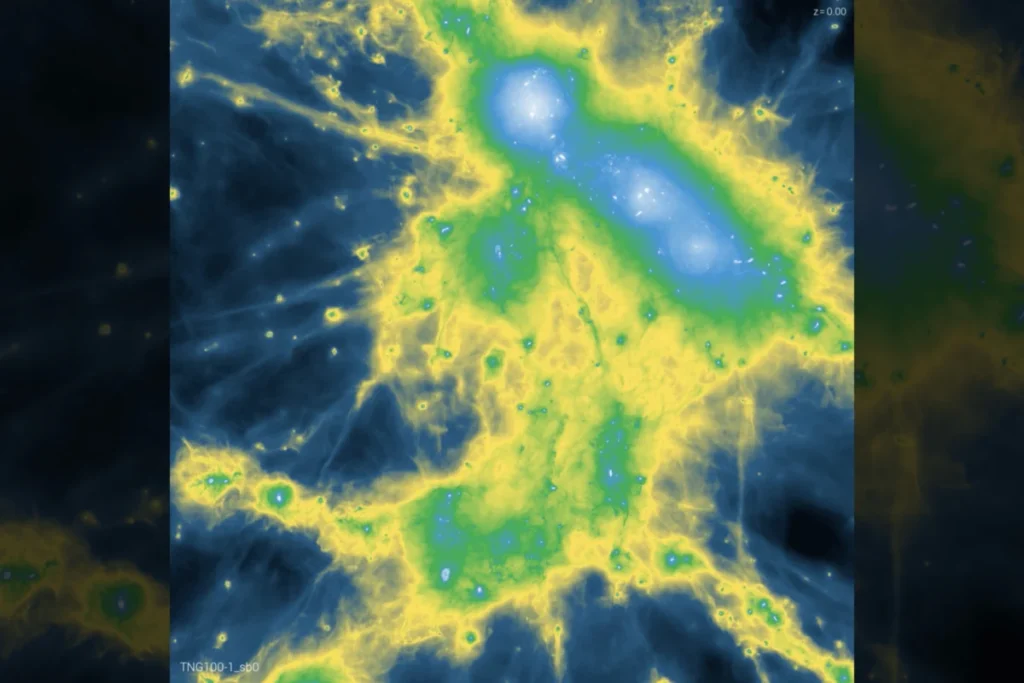
The analysis revealed a clear and startling pattern. The researchers found that while missing matter is indeed associated with galaxies, it is not huddled close to the galactic centers. Instead, it forms enormous, diffuse halos that extend much further than anyone had predicted.
"A galaxy is maybe a few 100,000 light-years across, and we found missing matter out to about 4 million light-years," noted Kiyoshi Masui. For perspective, this means the influence of a galaxy—in terms of its baryonic footprint—extends nearly 40 times further than its visible starlight.
This distribution provides crucial evidence for "galactic feedback." In the standard model of galaxy formation, gravity pulls gas inward to form stars. However, if this process were unchecked, galaxies would be much larger and more massive than what we observe today. Astronomers have long suspected that "feedback" mechanisms—such as the intense radiation from newborn stars, the shockwaves from supernovae, and the powerful relativistic jets from supermassive black holes—push gas back out into space.
The MIT study suggests that these feedback mechanisms are far more violent and effective than previously thought. Galaxies are not closed systems; they are more akin to cosmic fountains, perpetually cycling matter into the intergalactic medium. The fact that the matter is found 4 million light-years away indicates that the energy released by black holes and exploding stars is powerful enough to overcome the massive gravitational pull of the galaxy and its dark matter halo.
Scientific Implications and Future Research
The discovery has profound implications for several branches of astrophysics. First, it provides a solution to the "missing baryon" problem, confirming that the matter predicted by Big Bang nucleosynthesis is indeed present, just far more dispersed than previously detectable.
Second, the findings provide a new benchmark for cosmological simulations. Current computer models of the universe struggle to accurately depict the "messiness" of galactic feedback. By providing a precise map of where the baryons actually end up, this study allows theorists to fine-tune their simulations, leading to a better understanding of how the large-scale structure of the universe evolved.
"We are finding that the activity in galaxies is messier than we thought," said Haochen Wang. "They are really pushing out gas to very large distances."
The research also highlights the burgeoning field of "FRB Cosmology." While FRBs were once viewed as mere curiosities or anomalies, they are now being utilized as precision tools to measure the universe’s expansion rate (the Hubble constant) and the distribution of matter. As the CHIME/FRB collaboration continues to collect data, and as new instruments like the CHIME Outriggers and the Deep Synoptic Array (DSA-2000) come online, the precision of these measurements will only increase.
Conclusion: A New Era of Radio Astronomy
The work of the MIT team and the CHIME/FRB Collaboration marks a turning point in the study of the intergalactic medium. For the first time, scientists can see the "unseen" architecture of the universe, moving beyond the bright islands of stars to the vast, shadowy oceans of gas that connect them.
The discovery that matter is flung to such extreme distances suggests that we live in a much more dynamic and energetic universe than our ancestors could have imagined. The "missing" matter was never truly gone; it was simply waiting for a sufficiently bright flash from the deep past to illuminate its presence. As radio astronomy continues to advance, these millisecond-long bursts will likely continue to provide answers to some of the oldest and most fundamental questions in science, bridging the gap between the chaotic birth of the universe and the complex galactic structures we observe today.