PI (Physik Instrumente), a global leader in high-precision motion and positioning solutions, has formally announced the initiation of a comprehensive low-temperature development program. This ambitious initiative is specifically dedicated to advancing multi-axis nanopositioning systems, engineered to meet the stringent demands of emerging quantum applications and other scientific endeavors requiring extreme cryogenic environments. This strategic move underscores PI’s commitment to providing critical enabling technologies for the burgeoning quantum technology sector, which relies heavily on ultra-precise manipulation at temperatures approaching absolute zero.
The Quantum Imperative: Precision at Extreme Cold
The burgeoning field of quantum technology, encompassing quantum computing, quantum communication, and quantum sensing, represents a paradigm shift in scientific and technological capability. At its core, quantum mechanics harnesses phenomena such as superposition and entanglement to process information or achieve unparalleled sensitivity. However, to observe and manipulate these delicate quantum states, experimental setups often require environments cooled to milliKelvin (mK) temperatures – just fractions of a degree above absolute zero (0 Kelvin or -273.15 °C). This is primarily because thermal noise at higher temperatures can easily disrupt the fragile quantum coherence of qubits, leading to errors and loss of quantum information.
Key quantum platforms, such as superconducting qubits, trapped ions, and quantum dots, necessitate such extreme cooling. Superconducting qubits, for instance, must operate below their critical temperature, typically a few Kelvin, to exhibit zero electrical resistance and maintain coherence. Similarly, experiments involving ultracold atoms or exotic materials often demand cryogenic conditions to slow down atomic motion or reveal novel quantum phases. The challenge is not merely achieving these temperatures but also performing complex, high-precision operations within these confined, thermally sensitive spaces. This is where advanced nanopositioning systems become indispensable, facilitating tasks ranging from optical alignment and fiber coupling to sample manipulation and detector positioning, all while minimizing heat load and maintaining mechanical stability.
Evolution of Cryogenic Motion: From Stacked Stages to Six Degrees of Freedom
Historically, cryogenic motion solutions were often rudimentary, relying on stacked XYZ stages to achieve basic linear movements within a cryostat. These early systems, while functional for simpler experiments, presented significant limitations as quantum and advanced photonic applications grew in complexity. Stacked stages inherently suffer from accumulated errors, where the precision of each subsequent stage adds to the total inaccuracy. Their larger footprint consumes valuable, limited space within cryostats and dilution refrigerators, which are typically designed for maximum cooling efficiency and minimal volume. Furthermore, the sequential nature of stacked movements can be slow and less efficient for intricate alignment tasks.
Modern quantum applications, particularly in quantum photonics and complex qubit architectures, demand significantly more sophisticated control. Researchers now require systems capable of 5- and 6-degree-of-freedom (6DOF) alignment, enabling simultaneous translational (X, Y, Z) and rotational (pitch, roll, yaw) movements. These advanced capabilities are crucial for tasks such as precisely coupling optical fibers to integrated photonic circuits, aligning multiple laser beams onto individual qubits, correcting lens aberrations in cryogenic optical systems, or positioning highly sensitive detectors with nanometer accuracy. The need for robust, compact, and highly precise solutions that can support larger payloads and more complex optical configurations within the confines of a cryostat has become paramount, driving the innovation seen in PI’s latest development program.
PI’s Hexapod Innovation: Engineering for the Quantum Frontier

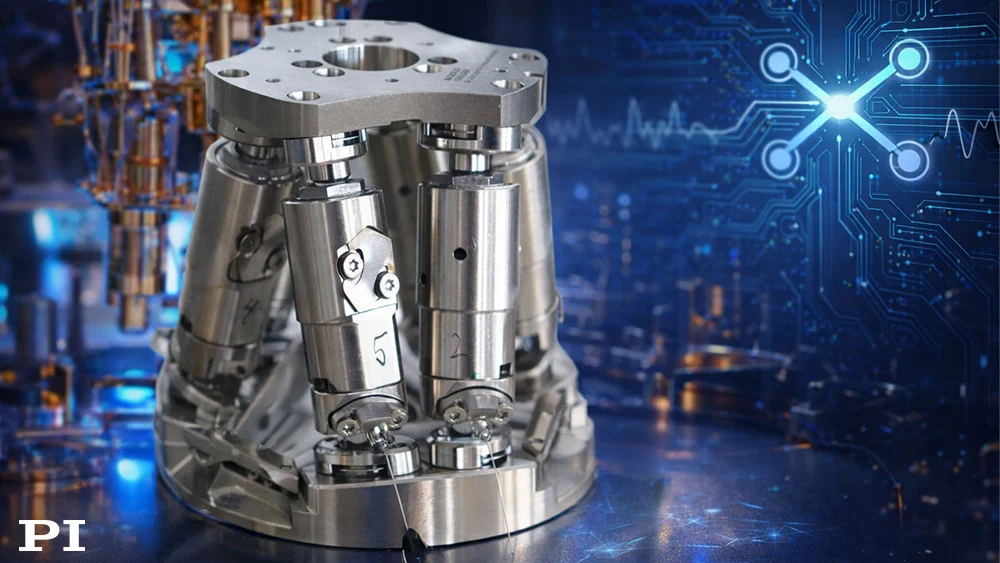
PI’s innovative approach to addressing these challenges is firmly rooted in the company’s extensive expertise in parallel kinematics. The new development program centers on compact 6DOF parallel kinematic systems, specifically Hexapod-type designs, meticulously engineered for seamless integration within the constrained environments of cryostats and dilution refrigerators. This design philosophy represents a significant leap forward from traditional stacked systems, offering a multitude of advantages critical for cutting-edge research.
Hexapods, by their very nature, provide simultaneous and coordinated control over all six degrees of freedom. This inherent design mitigates the error accumulation typically associated with stacked serial kinematics, leading to significantly higher overall precision and repeatability. Each of the six "legs" of a Hexapod is an actuator, working in concert to achieve the desired position and orientation of the top platform. This parallel architecture results in a much stiffer, more compact, and inherently stable system, which is vital when operating under extreme conditions where even minute vibrations can disrupt sensitive experiments. The compact nature of these Hexapod systems is particularly advantageous for the limited space available inside cryostats, allowing researchers to maximize experimental volume while still achieving the necessary precision.
These systems are explicitly designed to operate at temperatures below 4 Kelvin (4K), extending down to milliKelvin regimes, while maintaining their performance characteristics. They are capable of supporting motion of several hundred grams – a substantial payload for cryogenic systems – over millimeter-scale travel ranges, all while delivering exceptional stability and repeatability. This combination of payload capacity, travel range, and precision is crucial for manipulating the increasingly complex and often heavier optical and mechanical components found in advanced quantum setups.
Unpacking the Technical Advantages
The technical prowess of PI’s new cryogenic nanopositioning systems is further underscored by several key design features:
- Piezo-based Architecture: At the heart of these systems are piezoelectric actuators. Piezoelectric materials exhibit a change in shape when an electric field is applied, enabling incredibly fine and fast motion with nanometer precision. Crucially for cryogenic applications, piezo actuators generate very little heat compared to electromagnetic motors. Excessive heat generation within a cryostat can significantly increase the cooling load on the refrigeration system, making it harder and more expensive to maintain ultra-low temperatures. By minimizing heat dissipation, PI’s piezo-based architecture ensures the thermal stability of the cryogenic environment, a non-negotiable requirement for maintaining qubit coherence.
- Self-Locking Operation: Another significant advantage of the piezo-based design is the ability to achieve self-locking operation when power is switched off. This means that once a position is reached, the system can hold that position without continuous power input. In thermally sensitive low-temperature environments, this feature is invaluable. It not only conserves power but also eliminates any potential for residual heat generation from continuously powered actuators, further contributing to the stability of the cryogenic environment.
- Non-Magnetic Materials: The selection of materials is paramount in quantum experiments. Many quantum devices, particularly those involving superconducting circuits or spin qubits, are extremely sensitive to magnetic fields. Even minute magnetic impurities in nearby components can introduce noise or interfere with quantum states. PI’s commitment to using non-magnetic materials throughout the design ensures that the nanopositioning system does not perturb the delicate magnetic environment required by sensitive quantum devices, allowing for seamless integration without compromising experimental integrity.
- UHV Compatibility: Ultra-High Vacuum (UHV) compatibility is another critical feature. Many cryogenic systems operate under UHV conditions to prevent contamination and ensure the purity of the experimental environment. The materials and construction methods used in PI’s new systems are carefully chosen to meet UHV standards, minimizing outgassing and ensuring a clean environment for sensitive quantum components.
- Open Aperture: For optical applications within cryostats, an open aperture through the center of the Hexapod is often essential. This design feature allows for the passage of laser beams, optical fibers, or other components directly through the positioning stage, simplifying complex optical layouts and maximizing the utility of the system for beam steering, fiber alignment, and other photonics-intensive tasks.
- Programmable Pivot Point: The ability to program the pivot point for rotational alignment significantly enhances the system’s flexibility and ease of use. Instead of having a fixed point of rotation, researchers can define a virtual pivot point anywhere in space, allowing for precise alignment about a specific point of interest, such as a qubit or an optical component, without requiring complex external mechanical adjustments. This feature dramatically simplifies complex multi-axis alignment procedures, saving valuable experimental time.
Broadening the Scope: Applications Across Key Industries
The impact of PI’s advanced cryogenic nanopositioning solutions extends far beyond a singular application, offering transformative capabilities across several critical industries:
- Quantum Technology: This is the primary driver for the new development program. Within quantum computing, these systems are vital for precisely positioning optical elements for qubit manipulation and readout, fiber-to-chip coupling in integrated quantum photonics, and alignment of superconducting circuits. In quantum sensing, they enable the precise positioning of cold atom traps, NV-center diamonds, or other quantum sensors relative to target samples, enhancing resolution and sensitivity. They are also crucial for cryogenic microscopy and spectroscopy setups designed to probe quantum materials at the atomic scale.
- Photonics: Beyond quantum applications, the broader field of photonics benefits immensely. Researchers working with cryogenic optical setups, such as those studying novel light-matter interactions at low temperatures, require precise beam steering, lens aberration correction, and polarization control. The ability to accurately position dispersive elements like gratings and prisms within a cryostat opens new avenues for cryogenic spectroscopy and quantum optics experiments. High-precision fiber alignment, particularly for single-mode fibers, is a perennial challenge that these systems can address with unprecedented accuracy at low temperatures.
- Semiconductor Industry: While quantum applications often grab headlines, the semiconductor industry also has a vested interest in cryogenic precision. As chip architectures shrink and become more complex, cryogenic testing is becoming increasingly important for characterizing advanced semiconductor devices, identifying defects, and understanding material properties at extreme low temperatures. These nanopositioning systems can facilitate precise probing of individual transistors or nanoscale features on a chip, enabling detailed analysis of next-generation electronics and quantum materials. Material science research, particularly for superconductors, topological insulators, and other exotic materials, also relies on such precise manipulation in cryogenic environments.
Industry Voice: A Commitment to Advancing Science

"The launch of our cryogenic nanopositioning development program represents a pivotal moment for PI and for the broader quantum technology ecosystem," stated a spokesperson for PI, emphasizing the strategic importance of this initiative. "For years, PI has been at the forefront of precision motion, and we recognize the immense potential and unique challenges presented by quantum applications. Our new Hexapod-based systems are not merely incremental improvements; they are purpose-built solutions designed from the ground up to meet the exacting requirements of operating at milliKelvin temperatures, providing the stability, precision, and multi-axis control that researchers critically need. We believe this technology will significantly accelerate breakthroughs in quantum computing, quantum communication, and advanced material science, enabling our partners to push the boundaries of scientific discovery." This statement underscores PI’s dedication to supporting fundamental research and fostering innovation in high-growth, high-impact technological domains.
Market Dynamics and Strategic Outlook
The market for cryogenic equipment and precision motion solutions is experiencing robust growth, driven primarily by escalating global investment in quantum research and development. Governments and private entities worldwide are pouring billions into quantum initiatives, recognizing its potential to revolutionize computing, medicine, materials science, and national security. This surge in investment directly translates into a demand for sophisticated enabling technologies, with nanopositioning systems being a crucial component.
PI’s expansion into advanced cryogenic nanopositioning is a strategic move to solidify its leadership position in the precision motion market and capture a significant share of the rapidly expanding quantum technology sector. By offering highly specialized, high-performance solutions tailored to the unique demands of cryogenic environments, PI is positioning itself as an indispensable partner for quantum researchers and industrial developers. This development program is not an isolated effort but an expansion of PI’s existing, extensive work in motion technology for quantum research and cryogenic photonic systems, leveraging years of accumulated expertise in high-precision engineering.
The broader implications of this technology are profound. By providing more reliable, precise, and compact motion control within cryostats, PI’s solutions will facilitate the construction of more complex and robust quantum experimental setups. This, in turn, will accelerate the pace of quantum research, enabling faster development cycles for quantum processors, more sophisticated quantum sensors, and more efficient quantum communication networks. Ultimately, such advancements are critical for the eventual commercialization of quantum devices, transitioning them from laboratory curiosities to practical, impactful technologies that can solve some of humanity’s most complex challenges. The ability to precisely control components at the nanoscale in extreme cold is not just an engineering feat; it is a fundamental enabler for the quantum revolution.
For further details on PI’s range of high-precision positioning solutions and its commitment to advancing quantum technologies, interested parties are encouraged to visit pi-usa.us.