The Duster nameplate, a familiar moniker in American automotive history, graced a quartet of Plymouth models spanning from the early 1970s to the mid-1990s. While the inaugural iteration remains a celebrated icon, its subsequent iterations have largely faded from public memory, with the final Duster variant still occasionally encountered in automotive graveyards. This article delves into the rich, albeit uneven, history of the Duster, culminating in the discovery of a 1992 Plymouth Sundance Duster in a Denver-area salvage yard, offering a tangible link to a bygone era of American car manufacturing.
The Genesis of an Icon: The Original Plymouth Duster (1970-1976)
The story of the Duster begins with its debut in 1970 as a submodel of the Plymouth Valiant. Initially, only the 1970 models bore the explicit Valiant badging, establishing a direct lineage. The Duster was conceived as an affordable, sporty-looking commuter car, a strategy that proved highly successful. Its appeal was amplified by a range of clever variations, including the fuel-efficient Feather Duster, the upscale Gold Duster, and the practical Space Duster, catering to diverse consumer needs and desires.
The performance variants, the Duster 340 (1970-1973) and the Duster 360 (1974-1976), represented the Duster’s most potent offerings. These models boasted impressive power-to-weight ratios, particularly for their time, solidifying their status as factory-tuned performers. While the later P-Body Duster would eventually offer superior handling and braking, the original Duster 340 and 360 laid the groundwork for the nameplate’s association with spirited driving, albeit within the context of muscle car era constraints. The success of these early Dusters set a high bar, making the subsequent reintroductions of the nameplate a challenge to live up to the original’s legacy.
The Malaise Era and a Nameplate Revival: The Volaré Duster (1979-1980)
Following a hiatus, the Duster name resurfaced for the 1979-1980 model years, this time adorning an appearance trim package on the two-door Plymouth Volaré. This revival occurred during the so-called "Malaise Era" of automotive design, a period characterized by declining performance and increasingly stringent emissions regulations. Despite these limitations, the Volaré Duster, especially when equipped with the optional 360 cubic inch V8 engine, offered reasonable acceleration by the lenient standards of the time. This iteration, however, marked a departure from the Duster’s original sporty identity, functioning more as an aesthetic enhancement to an existing platform. The Volaré itself was a product of Chrysler’s F-body platform, which also underpinned the Dodge Aspen, and represented an attempt to maintain market presence during a challenging economic and regulatory climate for American automakers.
A Brief, Forgettable Interlude: The Turismo Duster (1985-1987)
The Duster name experienced another, less celebrated, revival between the 1985 and 1987 model years. This iteration was a "Duster-ized" version of the Plymouth Turismo, a car built on the front-wheel-drive L-body platform, which was an evolution of the K-Car architecture. This particular Duster is primarily remembered today for its infamous and controversial "Cocaine Factory" television commercial, starring Finola Hughes. The advertisement, aired only once during the 1984 MTV Music Video Awards, became a notorious piece of automotive marketing. Performance-wise, this Duster was by far the slowest of all its predecessors and successors, typically equipped with a 96-horsepower engine, a stark contrast to the performance aspirations evoked by the original Duster’s name. The Turismo itself was a derivative of the Dodge Omni and Plymouth Horizon, and the Duster branding did little to elevate its profile or performance credentials.
The Final Act: The Sundance Duster (1992-1993)
The fourth and final Duster variant, the 1992 Plymouth Sundance Duster, represents a significant chapter in the nameplate’s history, bridging the gap between the K-Car family and Chrysler’s more modern offerings. The Sundance and its Dodge Shadow twin were members of the extended K-Car family, succeeding the Plymouth Horizon and Omni. In turn, they were eventually replaced by the groundbreaking Plymouth Neon.
The Sundance Duster, though not as potent as the legendary Shelby CSX (a high-performance variant of the Dodge Shadow), offered an excellent performance-per-dollar ratio for its era. It was produced for a limited run, only during the 1992 and 1993 model years, making it a relatively rare find today.
A Junkyard Discovery: The 1992 Plymouth Sundance Duster
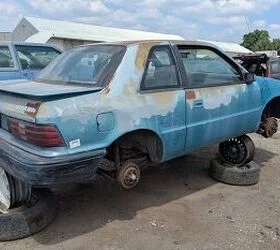
The junkyard find in a Denver-area salvage yard last year provides a tangible connection to this final Duster iteration. This particular 1992 Plymouth Sundance Duster was manufactured at Chrysler’s Toluca Car Assembly plant in Mexico, a facility that has historically produced a variety of Chrysler and Dodge vehicles for North American markets.
Powertrain and Specifications:
Under the hood of this Sundance Duster resided one of Chrysler’s workhorse engines: the Mitsubishi 6G72 3.0-liter V6. In this naturally aspirated, single overhead cam configuration, it was rated at 141 horsepower and 171 lb-ft of torque. This versatile V6 engine found its way into a wide array of Chrysler, Dodge, and Plymouth vehicles throughout the 1990s and early 2000s.
The transmission in this specific junkyard find was the base five-speed manual. A three-speed automatic transmission was available as an option for $557, which would equate to approximately $1,346 in 2026 dollars, reflecting the cost of convenience for consumers.
Pricing and Options:
The base price of the 1992 Plymouth Sundance Duster two-door was $9,849. However, the presence of optional features on this particular vehicle would have significantly increased its final price. Air conditioning, a sought-after comfort feature, added $900 ($2,176 in 2026 dollars), while an AM/FM/cassette radio system cost an additional $205 ($496 today). These figures highlight the incremental cost of amenities that were becoming increasingly standard but still represented a substantial investment for many buyers.
Inflationary Context:
When considering the pricing of the Sundance Duster, it’s crucial to place it within an inflationary context. The base 1992 Sundance, when adjusted for inflation to 2026 dollars, cost approximately $19,304. This figure is comparable to the adjusted prices of its predecessors: the cheapest possible version of the 1973 Valiant started at $18,389, the 1979 Volaré cost $19,488, and the 1985 Horizon was priced at $17,088. This demonstrates that despite evolving platforms and technologies, Chrysler maintained a consistent strategy of offering affordable entry-level transportation across different eras.
Safety Advancements:
A significant development in automotive safety during this period was the introduction of airbags. While most of the Duster’s predecessors lacked this feature (with the exception of the 1990 Horizon), the 1992 Sundance came standard with a driver-side airbag. This was a major selling point for Chrysler, as the company was actively promoting its commitment to occupant safety in the early 1990s.
Design and Practicality:
The P-Body platform, which underpinned the Shadow and Sundance, was characterized by its hatchback design, cleverly disguised to resemble a sedan. This offered a practical compromise between traditional styling and the versatility of a hatchback, providing easier access to cargo space.
Condition and End of Life:
The odometer on this 1992 Sundance Duster indicated just over 150,000 miles, a testament to its enduring service life. The paint, unfortunately, exhibits the characteristic peeling and clear-coat degradation common to vehicles from the early 1990s, a known issue with Chrysler’s paint technology of that era. The interior, however, appears to be in remarkably good condition for its age, suggesting careful ownership or a life spent in less harsh environments. The presence of the keys still in the ignition upon discovery adds a poignant touch, signifying its final resting place in the junkyard.
The "Flirtatious Talking Car" Phenomenon:
The Sundance and Shadow were also known for their "talking car" features, a novelty that often proved to be more of an annoyance than a helpful assistant. This feature, often voiced by a female persona, offered reminders and alerts, but its repetitive and sometimes intrusive nature could quickly become tiresome for drivers. This technological quirk, while innovative for its time, ultimately contributed to the cars’ reputation for being somewhat cheap and quirky.
The Shelby CSX: A Performance Apex
While the Sundance Duster offered value, the performance pinnacle of the P-Body platform was undoubtedly the Dodge Shelby CSX. Developed under the guidance of legendary performance engineer Carroll Shelby, the CSX was a potent iteration of the Dodge Shadow, boasting enhanced suspension, more powerful engines, and distinctive styling cues. The author’s prior discovery of a junked Shelby CSX underscores the varied fates of these K-Car derivatives, from the utilitarian to the enthusiast-focused. The CSX represented the performance potential that could be unlocked from the P-Body platform, a stark contrast to the more modest offerings of the Sundance Duster.
Legacy and Conclusion
The Plymouth Duster nameplate has traversed a varied landscape of automotive history. From the iconic muscle of the early Valiant Duster to the functional affordability of the Sundance Duster, each iteration represents a distinct chapter in Chrysler’s product development and marketing strategies. The 1992 Sundance Duster, found languishing in a Colorado junkyard, serves as a physical reminder of an era of automotive design that prioritized value and practicality, albeit with the occasional quirky innovation. While the days of the Duster as a new car are long past, its history, from celebrated performance icon to affordable commuter, continues to offer a fascinating glimpse into the evolution of the American automobile. The enduring presence of these vehicles, even in their final resting places, speaks to their ubiquity and the role they played in the lives of countless drivers. As the automotive industry continues its rapid transformation, the legacy of nameplates like the Duster serves as a valuable historical reference point, reminding us of the engineering, design, and market forces that shaped the vehicles we once drove. The call to "MOPAR OR NO CAR" may resonate with enthusiasts, but the broader story of the Duster is one of accessibility, evolution, and ultimately, the inevitable cycle of automotive lifecycles.