Few ideas in modern science have reshaped our understanding of reality more profoundly than space-time – the interwoven fabric of space and time at the heart of Albert Einstein’s theory of relativity. This revolutionary concept, first mathematically formulated by Hermann Minkowski in 1908 and later integrated into Einstein’s General Theory of Relativity in 1915, posits that space and time are not distinct entities but rather components of a unified, four-dimensional continuum. While immensely successful in describing the universe at macroscopic scales, the precise nature of space-time continues to be a subject of intense debate, blurring the lines between physics and philosophy and challenging our fundamental grasp of existence, occurrence, and the very structure of reality.
The Genesis of a Unified Reality: From Newton to Einstein
To fully appreciate the conceptual complexities of space-time, it is crucial to understand its historical trajectory. For centuries, Western scientific thought was dominated by Isaac Newton’s classical mechanics, which posited an absolute, immutable space and a separate, uniformly flowing absolute time. In this framework, space was a fixed, three-dimensional stage upon which events unfolded, and time was a universal clock, ticking away independently of any observer or event. This Newtonian paradigm, while remarkably successful in explaining terrestrial and celestial mechanics for over two centuries, began to show cracks with the advent of electromagnetism and the peculiar constancy of the speed of light.
It was Albert Einstein’s Special Theory of Relativity (1905) that fundamentally challenged this separation. Einstein demonstrated that measurements of space and time are relative to the observer’s motion. Events that appear simultaneous to one observer might occur at different times for another, and distances and durations could contract or dilate depending on relative velocity. While Einstein himself initially focused on the relativity of measurements, it was his former mathematics professor, Hermann Minkowski, who provided the profound geometric interpretation in 1908. Minkowski famously declared, "Henceforth, space by itself, and time by itself, are doomed to fade away into mere shadows, and only a kind of union of the two will preserve an independent reality." He introduced the concept of a four-dimensional "space-time continuum," where events are points (called "world-points") and the path of an object through this continuum is its "world-line." This framework allowed for a unified description of space and time, where the "interval" between two events, combining both their spatial and temporal separation, remained invariant across different inertial frames of reference.
A decade later, Einstein’s General Theory of Relativity (1915) deepened this revolution. General Relativity extended the principles of special relativity to include gravity, reinterpreting gravity not as a force acting across space, but as a manifestation of the curvature of space-time itself caused by the presence of mass and energy. Planets orbit the sun not because the sun exerts a pull, but because the sun’s mass warps the space-time around it, and the planets follow the geodesics (the "straightest possible paths") in this curved geometry. This dynamic view of space-time, where the fabric of reality itself responds to and influences matter and energy, forms the bedrock of modern cosmology and has been rigorously confirmed by numerous experimental observations, including the bending of starlight around the sun, the precise operation of GPS satellites (which must account for relativistic effects), and the direct detection of gravitational waves by observatories like LIGO.
The "Fabric of Reality": Metaphor, Structure, or Substance?
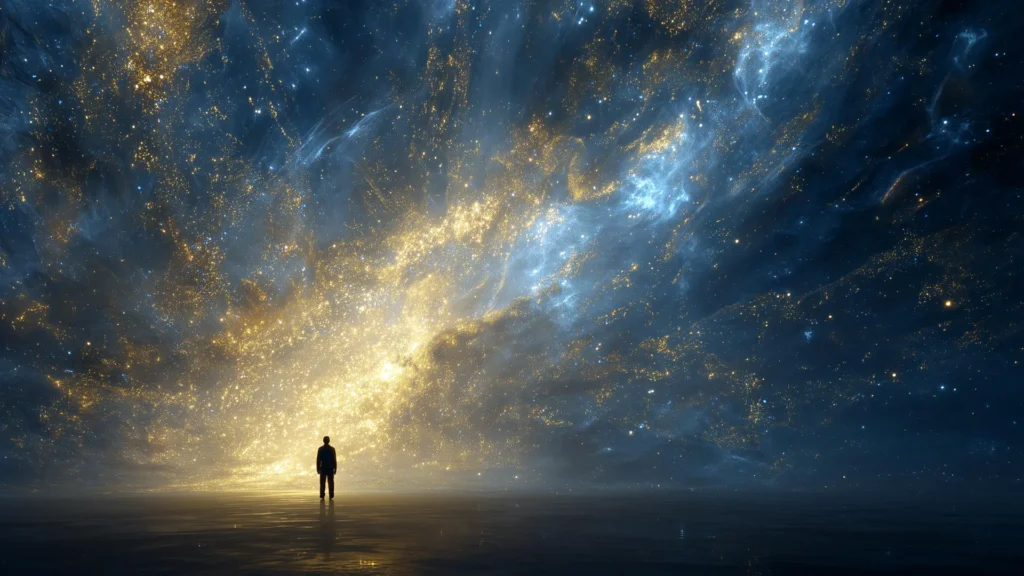
Despite its empirical success, the ontological status of space-time remains a subject of intense philosophical inquiry. It is frequently described as the "fabric of reality," a vivid metaphor that aids intuition but can obscure deeper questions. Is this "fabric" a fixed, four-dimensional "block universe" – a complete map of all events, past, present, and future, laid out eternally? Or is it a dynamic field that bends and curves, actively participating in the universe’s evolution? The distinctions are profound, shaping everything from how we understand gravity and quantum mechanics to our imaginings of time travel and the universe’s ultimate origins.
Physicists and philosophers grapple with fundamental questions: What does it truly mean to say that space-time "exists"? What kind of entity is it? Is it a fundamental structure, an emergent property, a physical substance, or merely a sophisticated mathematical metaphor for the relationships between events? These aren’t idle academic musings; they sit at the heart of how we interpret modern physics and quietly influence our understanding of general relativity, the possibility of multiverses, and even the radical proposals suggesting space-time itself might possess a form of cosmic memory.
The Linguistic Labyrinth: When Language "Goes on Holiday"
Part of the confusion stems from the language used to describe space-time. As Austrian-British philosopher Ludwig Wittgenstein once warned, philosophical problems often arise when "language goes on holiday" – when words are removed from their everyday context and applied in technical or abstract ways without a thorough examination of their inherent baggage. Over the last century, familiar terms like "time," "exist," and "timeless" have been repurposed in physics, leading to widespread conceptual ambiguity.
Consider "eternalism," a prominent view in the philosophy of physics. Eternalism posits that time does not "flow" or "pass" in any objective sense. Instead, all events across all time – past, present, and future – are equally real and coexist within a four-dimensional block universe. In this context, "timeless" is used literally: the universe itself does not endure or unfold; there is no becoming, no genuine change, only a static, pre-existing block where all of eternity exists atemporally. The passage of time, from this perspective, is often considered an illusion generated by our consciousness moving through the fixed continuum.
However, this literal interpretation of "timeless" and the notion of a block universe raise a deeper conceptual problem: If everything that ever happens throughout eternity is equally real and already "there," what does it actually mean to say that space-time itself "exists"?
Existence Versus Occurrence: The Elephant in the Room
To clarify this, one must distinguish between "existence" and "occurrence." One denotes a mode of being, the other a mode of happening. Imagine an elephant standing beside you. You would naturally say, "This elephant exists." It is a three-dimensional object that endures through time; its existence is a continuous process. Now, imagine a purely three-dimensional elephant that flashes into the room for an instant – a cross-sectional moment in the life of an existing elephant, appearing and disappearing like a phantom. This transient entity doesn’t "exist" in the ordinary sense; it merely "occurs."
An existing elephant traces a four-dimensional "world line" through space-time – a continuous path representing its presence across spatial dimensions and throughout its temporal duration. The imaginary "occurring elephant" is merely one three-dimensional, spacelike slice of that world line, a momentary snapshot.
Applying this distinction to space-time itself reveals the core of the problem. What does it mean for four-dimensional space-time to "exist" in the same way the enduring elephant exists? Does space-time itself endure? Does it have its own series of "now" moments? Or is space-time – the manifold of all events that happen throughout eternity – merely something that occurs? Is it simply a descriptive framework for relating those events, a sophisticated map rather than a territory?
Eternalism, by treating all of eternity (i.e., all of space-time) as an existing, static structure, tends to muddy this crucial distinction. It asserts the passage of time is an illusion, yet for that illusion to arise, the four-dimensional space-time block must "exist" in a manner analogous to the three-dimensional, existing elephant whose continuous presence across time gives rise to its four-dimensional world-line.
The Implicit Fifth Dimension and the Limits of Physics
This line of reasoning pushes us to a conceptual precipice. If we consider every event within the block universe to "exist," then when does the block itself exist? If it doesn’t unfold or change, does it exist timelessly? To say something exists "timelessly" implies a meta-temporal dimension outside of the time it contains. We are, in effect, layering another dimension of time onto something that was explicitly supposed to be timeless in the literal sense.
To resolve this, one might construct a hypothetical five-dimensional framework: three spatial dimensions, and two time dimensions. This second temporal axis would allow us to state that four-dimensional space-time "exists" in precisely the same way we commonly understand an elephant to exist within the three spatial dimensions surrounding us, the events of which we catalogue as four-dimensional space-time.
However, such a construct steps outside established physics, which describes space-time solely through four dimensions. This thought experiment highlights a deep conceptual problem: we currently lack a coherent way to articulate what it means for space-time to "exist" without inadvertently reintroducing a hidden dimension of time that is not accounted for in the physical equations. It’s akin to trying to describe a song that exists as a complete entity, all at once, without ever being performed, heard, or unfolding through a temporal sequence.
Implications for Modern Physics and Cosmology
The precise definition of space-time’s existence is not merely a semantic quibble; it carries profound implications for the most pressing challenges in theoretical physics. Foremost among these is the quest to reconcile general relativity with quantum theory, the two pillars of modern physics that remain stubbornly incompatible. General relativity describes gravity and the large-scale structure of the universe as continuous curvature of space-time, while quantum mechanics describes the discrete, probabilistic behavior of matter and energy at the subatomic level.
Many approaches to quantum gravity, such as string theory and loop quantum gravity, propose that space-time itself might be emergent, quantized, or possess a fundamentally different structure at the Planck scale (the smallest theoretical length). If space-time is not a fundamental, continuously existing entity, but rather arises from more basic constituents or relationships, then our interpretation of its "existence" becomes paramount. Concepts like "space-time foam" or the idea that space-time itself is a thermodynamic phenomenon (as explored in emergent gravity theories) directly confront these ontological questions. The idea that space-time could "remember" events, as some radical new proposals suggest, further complicates its status as a mere background stage.
Furthermore, these philosophical distinctions directly influence how we conceptualize cosmic origins and the very possibility of phenomena like time travel. In a block universe where all moments are equally real, time travel becomes a journey to a pre-existing point on the universal timeline, not a means to alter a dynamic past. This is reflected in popular culture: films like James Cameron’s The Terminator (1984) depict a fixed timeline where alterations are impossible, as all events already exist in a predetermined state. In contrast, films like Avengers: Endgame (2019) portray time travel as a mechanism to alter past events and reshape the timeline, implying a block universe that is both existent and capable of change – a logical inconsistency if time does not genuinely pass. Both scenarios, however, assume the past and future are "there" and accessible, yet neither fully grapples with the profound implications for the nature of space-time’s existence.
The Path Forward: Precision in the Pursuit of Reality
When physicists declare that space-time "exists," they are often operating within a framework that has subtly blurred the distinction between existence and occurrence. The outcome is a metaphysical model that, at best, lacks clarity, and at worst, obscures the very nature of reality we strive to understand.
It is crucial to emphasize that none of this debate invalidates the mathematical elegance or empirical triumph of Einstein’s theories. General relativity’s equations continue to work, providing an incredibly accurate description of gravitational phenomena. However, how we interpret those equations, and the underlying conceptual framework we employ, profoundly matters. It shapes how we articulate our understanding of reality and guides our approach to resolving the deeper, more intractable problems in physics, particularly the grand unification challenge of reconciling gravity with quantum mechanics.
Defining space-time is far more than a technical or philosophical exercise; it is about clarifying the fundamental nature of the world we inhabit. By bringing greater linguistic precision and conceptual rigor to these foundational terms, we can illuminate the path towards a more profound and coherent understanding of the universe, moving beyond mere metaphor to grasp the essence of reality itself.