A collaborative research team from Seoul National University, the Korea Advanced Institute of Science and Technology (KAIST), and the Korea Basic Science Institute (KBSI) has announced a breakthrough in renewable energy technology by identifying that silver (Ag) nanocatalysts fundamentally change their reaction sites based on the operating mode of solid oxide cells. This discovery, published in the prestigious journal Energy & Environmental Science, challenges long-held assumptions in materials science and provides a precise roadmap for engineering the next generation of high-efficiency energy conversion devices. By demonstrating that the same catalyst behaves differently when generating electricity versus producing hydrogen, the researchers have opened a new door for the optimization of reversible solid oxide cells (RSOCs), which are essential for a stable, carbon-neutral energy grid.
The study was spearheaded by Professor WooChul Jung and Professor Jeong Woo Han of Seoul National University’s Department of Materials Science and Engineering, alongside Professor Sang Ouk Kim of KAIST and Dr. Beomgyun Jeong of KBSI. Their findings were significant enough to be featured as the Outside Back Cover article of the journal, highlighting the transformative potential of their work in the field of electrochemical energy conversion.
The Dual Nature of Solid Oxide Cells
To appreciate the significance of this discovery, it is necessary to understand the dual functionality of solid oxide cells (SOCs). These devices are among the most efficient energy conversion technologies available today because they operate at high temperatures, typically between 500 and 1,000 degrees Celsius. This thermal environment allows for faster chemical kinetics and the use of non-precious or less-precious metal catalysts compared to low-temperature fuel cells.
Solid oxide cells operate in two primary modes:
- Solid Oxide Fuel Cell (SOFC) Mode: In this mode, the cell generates electricity by reacting a fuel, such as hydrogen or natural gas, with oxygen from the air. This process involves the Oxygen Reduction Reaction (ORR) at the air electrode.
- Solid Oxide Electrolysis Cell (SOEC) Mode: In this mode, the process is reversed. External electricity—ideally from renewable sources like wind or solar—is used to split water molecules into hydrogen and oxygen. This involves the Oxygen Evolution Reaction (OER) at the air electrode.
The versatility of SOCs makes them a cornerstone of the proposed "hydrogen economy." They can be deployed in distributed power systems for buildings and factories, where they provide both electricity and usable high-temperature heat. Conversely, they can act as large-scale energy storage systems by converting excess renewable power into "green hydrogen," which can be stored and transported for industrial use.
The Challenge of Catalyst Localization
Despite the promise of SOC technology, the industry has long struggled with the "black box" nature of the air electrode. While it was well-established that adding metal nanocatalysts to the electrode surface could significantly boost performance, the exact mechanism of this improvement remained a subject of intense debate.
The primary difficulty lies in the complex, porous structure of conventional electrodes. In a standard commercial electrode, the arrangement of materials is often random, making it nearly impossible to determine whether the chemical reactions are occurring on the surface of the catalyst, at the boundary where the catalyst meets the electrode (known as the triple-phase boundary), or on the electrode surface itself. Without knowing where the reaction happens, engineers are forced to use a trial-and-error approach to catalyst design, which is both time-consuming and inefficient.
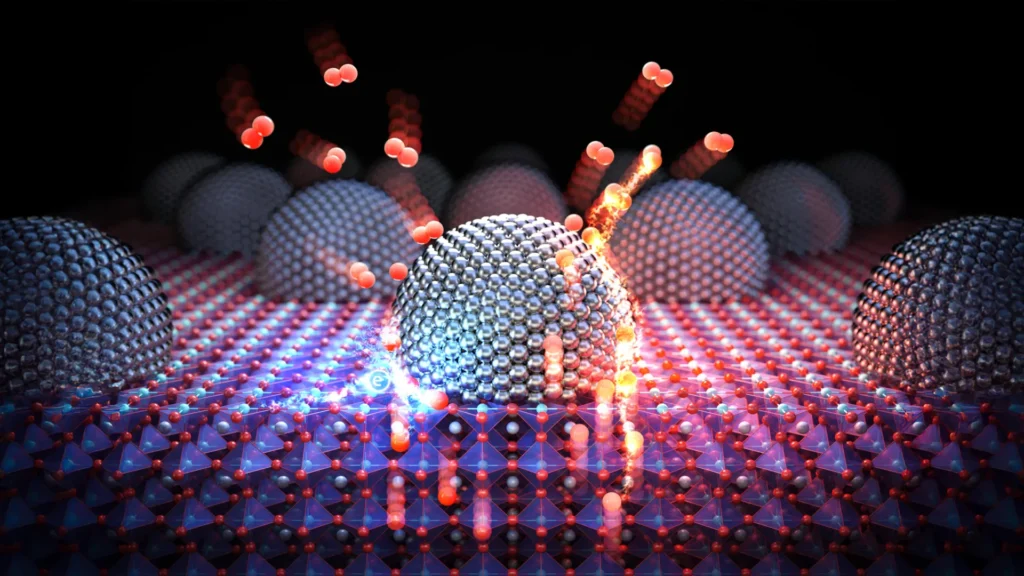
To solve this, the research team moved away from traditional, messy electrode architectures. Instead, they developed a "model electrode" system. Using advanced nanofabrication techniques, they arranged silver nanoparticles of uniform size and spacing onto a thin-film perovskite oxide electrode. This highly controlled environment allowed the scientists to isolate variables and observe exactly how changes in catalyst surface area or interface length affected the overall reaction rate.
A Discovery of Shifting Reaction Sites
The core of the team’s finding is that the silver nanocatalyst is a "chameleon" of sorts, shifting its primary area of activity depending on the direction of the oxygen flow.
During the electricity generation phase (ORR), the researchers found that the reaction rate was directly proportional to the length of the interface—the "edge" where the silver nanoparticle touches the perovskite electrode. This indicates that the interface acts as a critical gateway for electron transfer and oxygen ion incorporation. In this mode, the silver serves primarily to lower the energy barrier for oxygen molecules to be reduced and moved into the solid electrolyte.
However, when the cell was switched to hydrogen production mode (OER), the results shifted entirely. The reaction rate no longer correlated with the interface length but instead grew in proportion to the total surface area of the silver nanoparticles. This suggests that during water splitting, the entire surface of the silver becomes a platform for oxygen atoms to recombine into oxygen molecules before being released into the air.
This "site-switching" phenomenon is a paradigm shift. It means that a catalyst designed perfectly for a fuel cell might be sub-optimal for an electrolyzer, and vice versa. For reversible systems that must perform both tasks, a balanced design that optimizes both the interface and the surface area is required.
Comparative Analysis and Atomic Insights
Before focusing on silver, the research team conducted a comparative analysis of several potential nanocatalysts, including cobalt (Co), palladium (Pd), and platinum (Pt). While all these metals provided some level of catalytic boost, silver emerged as the superior choice for this specific application. Silver is not only more cost-effective than platinum or palladium, but it also demonstrated the most significant enhancement in reaction kinetics under the high-temperature conditions of solid oxide cells.
To understand why silver was so effective and how it managed to switch reaction sites, the team utilized synchrotron-based analysis at the Pohang Accelerator Laboratory (PAL). Specifically, they used Ambient Pressure X-ray Photoelectron Spectroscopy (AP-XPS) at the KBSI-PAL 8A2 beamline. This advanced technique allowed the researchers to observe the electronic state of the atoms on the electrode surface in real-time while the cell was operating.
These observations, combined with atomic-scale theoretical calculations, revealed that silver nanocatalysts actually modify the electronic structure of the underlying perovskite electrode. During oxygen reduction, the presence of silver makes it easier for the electrode to donate electrons to oxygen molecules. During oxygen evolution, the silver surface facilitates the "recombination" step, where individual oxygen atoms join together to form the gas that is eventually released.
Implications for the Green Energy Transition
The practical implications of this research are far-reaching. By providing a clear "design principle" for air electrodes, the study enables engineers to move beyond empirical testing toward precision engineering.
- Efficiency in Distributed Power: For buildings and industrial parks that use SOFCs for combined heat and power, these findings could lead to electrodes that generate more electricity with less fuel, reducing operating costs and carbon footprints.
- Lowering the Cost of Green Hydrogen: One of the biggest hurdles to green hydrogen adoption is the cost of the electricity required for electrolysis. By improving the efficiency of the OER process through surface-optimized silver catalysts, the energy required to split water can be reduced, making green hydrogen more competitive with fossil-fuel-based "gray hydrogen."
- Advancing Reversible Systems: The most exciting application is in Reversible Solid Oxide Cells (RSOCs). These systems can act as a massive battery for the grid—absorbing excess solar power during the day to make hydrogen and then burning that hydrogen at night to provide electricity. Understanding the dual-site mechanism allows for the creation of "bifunctional" electrodes that excel in both directions.
Official Responses and Next Steps
Professor WooChul Jung, the lead author of the study, emphasized the methodological breakthrough his team achieved. "This research is significant because it quantitatively evaluates the performance of nanocatalysts while also identifying their actual reaction sites and operating mechanisms," Jung stated. "We have moved from simply knowing that catalysts work to knowing how and where they work."
He further noted that the team intends to expand this platform to study other catalytic systems. "We plan to further establish this as a new design principle that can be applied to various energy conversion materials and catalytic systems, including oxygen separation membranes and other types of electrochemical cells."
Dr. Jinwook Kim, who played a leading role in the research as a doctoral student and is now a postdoctoral researcher at Northwestern University, will soon bring this expertise to the University of Seoul as an assistant professor. His upcoming work will focus on scaling these laboratory findings into practical, high-efficiency energy devices that can withstand the rigors of industrial use.
The research was a multi-institutional effort supported by the Ministry of Science and ICT and the National Research Foundation of Korea. The collaboration between SNU’s materials expertise, KAIST’s nanofabrication capabilities, and KBSI’s advanced analytical tools was cited as the key factor in unraveling a mystery that had persisted in the field for decades.
As the global community seeks to meet net-zero targets by 2050, the ability to precisely engineer the catalysts that drive the hydrogen economy will be vital. The discovery of the dynamic nature of silver nanocatalysts provides a crucial piece of the puzzle, ensuring that the transition to clean energy is supported by the most efficient technology possible.