DigiKey, a prominent global distributor of electronic components, has announced a collaborative initiative with renowned engineering instructor and content creator Shawn Hymel to present a complimentary 90-minute virtual workshop. Titled “Train a Balance Bot with Reinforcement Learning,” the webinar is scheduled for Thursday, August 13, 2026, at 10 am CDT. This educational event is designed to guide engineers through the intricate process of utilizing reinforcement learning (RL) to train a self-balancing robot within a simulated environment before deploying the resultant control policy onto physical hardware, offering a practical introduction to the crucial "sim-to-real" pipeline in robotics development. The webinar is further complemented by a comprehensive six-part educational video series, providing a multi-faceted approach to mastering reinforcement learning for robotics, from conceptual understanding to practical hardware deployment.
The Ascendance of Reinforcement Learning in Modern Robotics
Reinforcement learning, a sophisticated branch of machine learning, has emerged as a pivotal technology in the advancement of autonomous systems and robotics. At its core, RL involves an agent learning optimal behaviors by interacting with an environment, executing actions, and receiving feedback in the form of reward or penalty signals. Unlike supervised learning, which relies on labeled datasets, or unsupervised learning, which seeks patterns in data, RL thrives on experiential learning, allowing systems to discover complex strategies autonomously. This trial-and-error methodology is particularly well-suited for robotics, where defining explicit rules for every possible scenario can be prohibitively complex or even impossible.
In the context of robotics, RL enables the development of highly adaptive and robust control behaviors, such as maintaining balance, executing dynamic locomotion, navigating intricate terrains, and recovering gracefully from unexpected disturbances or falls. Leading robotics research institutions and commercial entities, including Boston Dynamics, Google DeepMind, and OpenAI, have extensively leveraged RL to achieve groundbreaking feats in quadrupedal and bipedal robot locomotion, manipulation, and decision-making. The ability to learn intricate motor skills and high-level strategies directly from interaction has positioned RL as a cornerstone for the next generation of intelligent robots.
Webinar Focus: Bridging the Sim-to-Real Gap
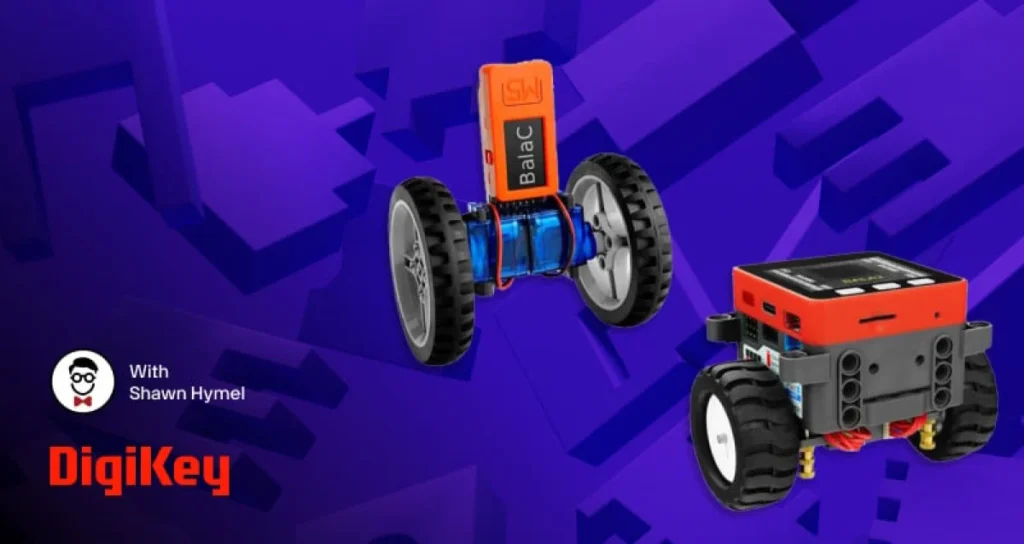
The upcoming DigiKey workshop will delve into the practical application of these principles, focusing specifically on the development of a self-balancing robot. Shawn Hymel will lead attendees through a detailed demonstration, showcasing how a 3D model of the M5Stack Bala-C self-balancing robot is imported into the MuJoCo physics simulator. MuJoCo, known for its high-performance and accurate physics engine, provides a realistic virtual environment for training, minimizing the risks and costs associated with real-world experimentation.
Following the simulation setup, the workshop will illustrate the training of a neural network policy using a multi-phase Proximal Policy Optimization (PPO) curriculum. PPO is a widely adopted and robust reinforcement learning algorithm, celebrated for its stability and sample efficiency, making it an excellent choice for complex control tasks like robot balancing. Curriculum learning, a technique that gradually increases the complexity of the task during training, will be employed to facilitate more effective and stable learning for the robot, starting with simpler balancing scenarios and progressively moving towards more challenging conditions.
A critical aspect of the webinar will be the demonstration of deploying the trained "actor network"—the neural network responsible for generating control commands—onto an ESP32 microcontroller using the Arduino integrated development environment. This segment offers a tangible introduction to the "sim-to-real" pipeline, a fundamental process in modern robotics research where models trained in high-fidelity simulations are transferred and adapted for operation on physical hardware. The successful transfer of learned policies from simulation to reality remains a significant challenge in robotics, often requiring careful calibration, domain randomization techniques, and robust policy design to account for discrepancies between the virtual and physical worlds. This workshop aims to demystify this critical transition, providing attendees with actionable insights and practical experience.
Expert Perspective on RL’s Potentials and Hurdles
Shawn Hymel, a respected voice in the engineering community, underscored the transformative impact of reinforcement learning on the field. "Almost every major robotics lab has turned to reinforcement learning to build robust, AI-powered control and decision-making for their robots, from quadrupeds to bipeds," Hymel stated. This observation highlights the pervasive adoption of RL across diverse robotic platforms, from agile legged robots navigating complex terrains to humanoid robots performing dexterous manipulation tasks. The adaptive nature of RL allows these robots to exhibit behaviors that are difficult to program explicitly, fostering greater autonomy and versatility.
However, Hymel also acknowledged the inherent complexities that can make reinforcement learning daunting for newcomers. He noted that "reinforcement learning can remain difficult to approach, with policy training potentially requiring millions of simulation steps and careful development of the reward function." This candid assessment points to two significant hurdles: the computational intensity of training, which often demands substantial processing power and extended training periods, and the art of designing an effective reward function. A well-designed reward function is crucial for guiding the agent towards desired behaviors, while a poorly designed one can lead to suboptimal policies or unintended behaviors. The webinar is specifically structured to address these challenges, offering a guided, practical pathway to navigate the intricacies of RL development.
DigiKey’s Strategic Investment in Engineering Empowerment
DigiKey’s involvement in initiatives like this webinar underscores its deep commitment to fostering innovation and supporting the global engineering community. As a leading authorized distributor of electronic components, DigiKey plays a vital role in connecting engineers, makers, and product developers with the latest technologies. Beyond transactional services, the company has strategically invested in educational platforms and resources, such as its Maker.io platform, which provides tutorials, articles, and project ideas to empower hobbyists and professionals alike.
A representative from DigiKey’s technical content or education initiatives department, while not directly quoted in the original brief, would likely emphasize the company’s dedication to democratizing access to cutting-edge technological knowledge. "At DigiKey, we believe that empowering engineers with the skills and tools for tomorrow’s challenges is paramount," an inferred statement might read. "Reinforcement learning is rapidly reshaping the landscape of robotics and AI, and our partnership with experts like Shawn Hymel ensures that our community has direct access to the practical insights needed to innovate. This webinar, coupled with our comprehensive video series, represents our commitment to lowering the entry barrier for complex topics and accelerating the development cycle for next-generation intelligent systems." This strategic focus aligns with DigiKey’s broader mission to serve as an indispensable resource for technological advancement.
Technical Deep Dive: Tools and Methodologies
The workshop’s curriculum is built upon a foundation of industry-standard tools and advanced machine learning techniques, providing attendees with a robust understanding of the modern robotics development pipeline.

Proximal Policy Optimization (PPO): As the chosen algorithm for policy training, PPO is a powerful, on-policy algorithm that strikes a balance between ease of implementation, sample efficiency, and performance. Developed by OpenAI, PPO algorithms are known for their ability to achieve high-quality policies while maintaining stability during training. Unlike earlier algorithms that could suffer from large policy updates leading to instability, PPO introduces a "clipping" mechanism to constrain policy updates, ensuring that new policies do not deviate too far from old ones. This characteristic makes it particularly suitable for robotic control tasks where continuous and stable learning is essential.
MuJoCo Physics Simulator: The Multi-Joint Dynamics with Contact (MuJoCo) physics engine is a sophisticated simulator renowned for its speed, accuracy, and robust handling of contact dynamics, which are critical for realistic robot interactions with the environment. Its deterministic nature and ability to perform fast simulations make it an ideal platform for training reinforcement learning agents, where millions of simulation steps are often required. While other simulators like Gazebo, PyBullet, and NVIDIA’s Isaac Gym exist, MuJoCo’s balance of fidelity and performance has made it a preferred choice for many advanced robotics research groups.
M5Stack Bala-C/Bala2 Fire Robots: The selection of M5Stack’s self-balancing robots highlights the accessibility of modern embedded systems for AI applications. The M5Stack ecosystem, often featuring ESP32 microcontrollers, offers an integrated and user-friendly platform for development. The ESP32 is a versatile, low-cost, and powerful system-on-a-chip (SoC) that combines Wi-Fi and Bluetooth capabilities with dual-core processing power, making it an excellent choice for IoT devices, embedded AI, and small-scale robotics projects. Its compatibility with the Arduino IDE further simplifies programming and deployment, allowing engineers to focus more on the RL logic rather than complex hardware-software integration.
Curriculum Learning: The concept of a "multi-phase PPO curriculum" is key to efficient training. Curriculum learning mimics how humans learn complex tasks by gradually increasing difficulty. Instead of immediately exposing the robot to the most challenging balancing scenarios, the training starts with simpler tasks (e.g., balancing on a flat surface) and progressively introduces more complex elements (e.g., recovering from larger disturbances, navigating uneven terrain). This structured approach helps the agent build foundational skills and avoid premature convergence to suboptimal policies, ultimately leading to more robust and generalized behaviors.
A Comprehensive Learning Pathway: Webinar and YouTube Series
Recognizing the depth and breadth of reinforcement learning, DigiKey and Shawn Hymel have designed a multi-pronged educational approach. In parallel with the live webinar, a six-part YouTube series has been launched, providing an even more detailed introduction to robotics and reinforcement learning. This series meticulously follows the complete development process, from initial simulation setup and environment design through reinforcement learning algorithm implementation and, finally, deployment to real hardware.
The first episode of this insightful series is already available, offering immediate access to foundational knowledge. For those who prefer written documentation, a comprehensive version of the tutorial is also published on DigiKey’s acclaimed Maker.io platform. This combination of live interactive sessions, on-demand video tutorials, and detailed written guides ensures that learners with diverse preferences and schedules can fully engage with the material and build a remote-controlled balance bot, guided by a control policy learned through simulated trial and error. This layered approach maximizes the learning potential, allowing participants to revisit concepts, explore deeper nuances, and troubleshoot at their own pace.
Broader Implications for Robotics and AI Development
This initiative carries significant implications for the broader landscape of robotics and AI development. Firstly, it actively contributes to the democratization of advanced robotics skills. By making sophisticated topics like reinforcement learning accessible through free webinars and comprehensive educational series, DigiKey and Shawn Hymel are lowering the barrier to entry for engineers, students, and hobbyists who might otherwise find these fields intimidating. This accessibility fosters a wider pool of talent capable of innovating in cutting-edge areas.
Secondly, the focus on the sim-to-real pipeline addresses a critical bottleneck in robotics research and development. Traditionally, transferring algorithms from simulation to physical robots has been a time-consuming and challenging endeavor. By providing practical guidance and demonstrating effective techniques, the webinar helps to accelerate the research and development cycles for autonomous systems. This means faster prototyping, more efficient testing, and ultimately, quicker deployment of intelligent robots into various applications, from industrial automation to service robotics and consumer electronics.
Furthermore, the emphasis on embedded AI and robust control through platforms like the ESP32 highlights the growing trend of bringing complex AI capabilities to resource-constrained devices. This is crucial for the proliferation of smart devices, IoT applications, and edge AI, where real-time decision-making without constant cloud connectivity is essential. The lessons learned from training a self-balancing robot are directly transferable to a myriad of other embedded AI challenges, such as drone control, autonomous vehicles, and smart home automation.
Finally, this collaboration exemplifies the evolving role of content creators and distributors in shaping the future of engineering education. By partnering with experts to deliver high-quality, practical content, companies like DigiKey are not just selling components but are actively cultivating an ecosystem of knowledge and innovation, ensuring that the engineering community remains at the forefront of technological advancement.
Registration and Future Outlook
Registration for the "Train a Balance Bot with Reinforcement Learning" webinar is entirely free and can be completed through DigiKey’s event portal. While live attendance on August 13, 2026, at 10 am CDT is encouraged for real-time interaction, registrants who are unable to attend will still receive access to the full webinar recording after the event, ensuring that no one misses out on this valuable learning opportunity. Engineers who wish to actively follow along with the workshop are advised to acquire either the M5Stack Bala-C Balance Bot or the M5Stack Bala2 Fire Self-Balancing Robot to maximize their hands-on experience.
As reinforcement learning continues to mature and integrate more deeply with various engineering disciplines, initiatives like this webinar will play a pivotal role in equipping the next generation of innovators. The ability to harness AI for complex physical control tasks is no longer confined to specialized research labs but is becoming an essential skill for engineers aiming to build the intelligent systems of tomorrow.