A team of researchers at the Massachusetts Institute of Technology (MIT), supported by the MIT Climate and Sustainability Consortium (MCSC), has unveiled a groundbreaking advancement in carbon capture technology, signaling a significant step towards more energy-efficient and scalable solutions for mitigating climate change. Published recently in the esteemed journal Nature Energy, their work details the exploration of N-heterocyclic imines (NHIs) as a novel class of sorbent for electrochemically mediated CO2 capture (EMCC), an alternative method poised to overcome the substantial limitations of conventional carbon dioxide removal processes. This innovative approach promises to electrify CO2 separation, ideally driven by renewable energy sources, thereby enhancing both efficiency and environmental compatibility.
The Global Imperative for Carbon Capture: Addressing the Climate Crisis
The urgency of reducing atmospheric carbon dioxide concentrations cannot be overstated. Global average temperatures have already risen by approximately 1.1 degrees Celsius above pre-industrial levels, leading to increasingly severe and frequent extreme weather events, sea-level rise, and ecosystem disruption. Scientific consensus, as articulated by the Intergovernmental Panel on Climate Change (IPCC), unequivocally states that deep, rapid, and sustained reductions in greenhouse gas emissions are essential to limit global warming to 1.5 degrees Celsius, a critical threshold for avoiding the most catastrophic impacts of climate change. While transitioning to renewable energy sources and improving energy efficiency are paramount, the sheer volume of historical and ongoing emissions necessitates complementary strategies. Carbon Capture, Utilization, and Storage (CCUS) technologies have emerged as a crucial component of comprehensive climate mitigation portfolios, offering a means to decarbonize hard-to-abate sectors such as heavy industry (cement, steel, chemicals) and to manage emissions from existing fossil fuel infrastructure during the energy transition.
However, the widespread deployment of CCUS has been hampered by significant technological, economic, and energy-related hurdles. The current standard for CO2 capture, amine scrubbing, involves bubbling flue gas through a chemical solvent (typically an amine solution) that selectively absorbs CO2. This process, while effective, is notoriously energy-intensive, requiring substantial thermal energy to regenerate the solvent and release the captured CO2 for storage or utilization. This "energy penalty" can consume 20-30% of a power plant’s generated electricity, making it economically challenging and sometimes negating a portion of the environmental benefit. Furthermore, amine-based systems are complex to scale, prone to solvent degradation, and can produce hazardous byproducts, limiting their overall impact despite the urgent global need to reduce carbon emissions and potentially upgrade captured CO2 into valuable products. Globally, current operational CCUS projects capture approximately 40-50 million metric tons of CO2 per year, a fraction of the gigatons needed annually by mid-century to meet climate targets. Projections from organizations like the International Energy Agency (IEA) suggest that to achieve net-zero emissions by 2050, CCUS capacity must expand by more than 100-fold, underscoring the critical need for breakthrough technologies that are more efficient, cost-effective, and scalable.
A Chronology of Carbon Capture Evolution: From Industrial Necessity to Climate Solution
The concept of carbon capture is not entirely new, though its primary driver has shifted dramatically over time.
- Early 20th Century (1930s-1970s): Initial industrial applications of CO2 separation focused on processes like natural gas sweetening (removing CO2 and H2S from natural gas to prevent corrosion and improve caloric value) and the production of CO2 for commercial uses (e.g., carbonated beverages, urea synthesis). These early methods often employed chemical absorption techniques, laying the groundwork for later developments.
- Late 20th Century (1980s-1990s): With growing awareness of anthropogenic climate change, scientific interest in large-scale CO2 capture from power plants and industrial sources began to intensify. The first significant demonstration of geological CO2 storage occurred in 1996 with the Sleipner project in the North Sea, where CO2 separated from natural gas was reinjected into a deep saline aquifer. This marked a pivotal moment, proving the feasibility of long-term geological sequestration.
- Early 21st Century (2000s-2010s): Investment and research into CCUS accelerated. Projects like Weyburn-Midale in Canada demonstrated enhanced oil recovery (EOR) using captured CO2, providing an economic incentive for capture. Amine scrubbing solidified its position as the leading post-combustion capture technology due to its maturity and effectiveness, despite its inherent energy penalties. Research also diversified into other capture methods, including physical absorption, adsorption onto solid sorbents, membrane separation, and cryogenic distillation, each with its own advantages and drawbacks.
- Mid-2010s to Present: The Rise of Electrochemical Methods: As the limitations of conventional thermal-swing processes became increasingly apparent, researchers began exploring novel approaches that could leverage electricity rather than heat. Electrochemically mediated CO2 capture (EMCC) emerged as a particularly promising avenue. The theoretical advantages of EMCC are compelling: it can be driven by renewable electricity, offers modularity for scalable deployment, and potentially allows for more precise control over the capture and release cycles. Early EMCC systems typically relied on redox-active organic molecules or ionic liquids that undergo electrochemical transformations to bind and release CO2. However, these early iterations faced their own set of challenges, notably requiring highly reducing potentials. These extreme potentials often lead to significant oxygen reduction side reactions, which not only compromise the efficiency of CO2 capture but also contribute to the degradation of the sorbent and electrode materials, thereby limiting the long-term performance and economic viability of the system. It is precisely these challenges that the MIT team sought to address.
The MIT Breakthrough: N-Heterocyclic Imines (NHIs) Redefining EMCC
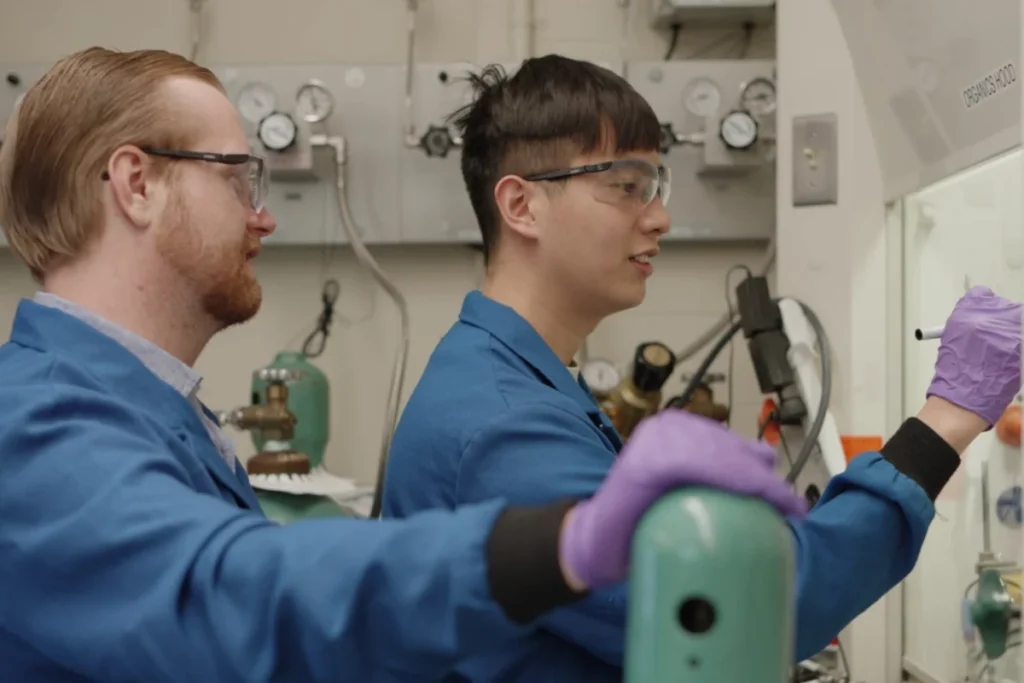
The MIT research team, comprising graduate students Fang-Yu Kuo of the Department of Chemical Engineering and Gi Hyun Byun of the Department of Mechanical Engineering (MechE), Professor Betar Gallant of MechE, and former MCSC postdoctoral Impact Fellows Glen Junor and Akachukwu Obi, tackled the core shortcomings of existing EMCC systems. Their investigation into NHIs represents a critical pivot in the design of electrochemical sorbents.
The fundamental problem with many EMCC sorbents lies in their requirement for highly negative (reducing) potentials to activate the CO2 binding mechanism. At these potentials, ambient oxygen, even in trace amounts, can be reduced at the electrode surface, competing with the intended CO2 reaction. This parasitic oxygen reduction consumes electrical energy without capturing CO2, drastically reducing the overall efficiency and acting as a major pathway for sorbent and electrode degradation. The MIT team hypothesized that a new class of sorbents could operate at less extreme potentials, thus sidestepping the oxygen interference issue.
Their solution centered on N-heterocyclic imines (NHIs). As Fang-Yu Kuo explains, "NHIs have shown promise in recent years as CO2 sorbents because of the ease of NHI molecular modifications for tuning basicity." This inherent tunability is a key advantage, allowing researchers to rationally design molecules with specific properties. The pivotal contribution of the MIT study is the successful translation of these NHIs into the EMCC application space for the first time. Kuo elaborates, "Our work translates these NHIs for the first time into the EMCC application space, and demonstrates that NHI-based sorbents can be modulated electrochemically for CO2 separation by a unique separation mechanism that avoids the need of applying highly reducing potentials."
This "unique separation mechanism" is central to the breakthrough. Unlike traditional EMCC sorbents that rely on a single electron transfer to activate CO2 binding, the MIT team’s novel bis(NHI) structure enables a theoretical CO2 modulation of two molecules per electron during cell operation. This "two molecules per electron" mechanism represents a significant leap in electron efficiency, essentially doubling the CO2 captured per unit of electrical input compared to single-electron processes. By operating at potentials where oxygen reduction is minimized or avoided entirely, the NHI-based system promises enhanced efficiency, improved long-term stability, and reduced sorbent degradation.
The initial findings published in Nature Energy are highly encouraging. The discovery of the novel bis(NHI) structure and its two-electron, two-CO2 binding mechanism establishes a strong foundation. Furthermore, the research indicates that through further molecular engineering of these bis(NHI) structures to strengthen CO2 binding affinity, the system could operate effectively in a wider array of electrolyte environments. This expanded operational flexibility opens new avenues for optimizing overall system performance in critical areas: electron efficiency (how much CO2 is captured per electron), energy efficiency (the total energy input per unit of CO2 captured), and operational flexibility (the ability to adapt to varying CO2 concentrations and operating conditions).
Supporting Data and Potential Technical Advantages
While the Nature Energy publication focuses on fundamental proof-of-concept, the implications for energy efficiency are profound. Conventional amine scrubbing typically requires approximately 3-4 Gigajoules (GJ) of thermal energy per tonne of CO2 captured (equivalent to 830-1110 kWh/tonne CO2). Advanced amine processes aim for around 2.5 GJ/tonne CO2. EMCC, by leveraging electricity, fundamentally changes the energy input profile. If driven by renewable electricity, the carbon footprint of the capture process itself can be dramatically reduced. The MIT team’s innovation in achieving a "two molecules per electron" modulation for CO2 capture directly translates to higher electron efficiency, which is a critical step towards significantly lowering the electrical energy consumption for CO2 separation. While specific GJ/tonne CO2 figures for this nascent NHI-EMCC technology are yet to be fully established and optimized, the theoretical underpinning suggests a pathway to achieve energy requirements substantially lower than current thermal-based systems, potentially falling below 1 GJ/tonne CO2 for the separation process alone.
Moreover, the modular nature of electrochemical systems allows for greater scalability and flexibility in deployment. Unlike large, centralized amine scrubbing plants that require significant infrastructure and land area, EMCC units could be designed as smaller, modular components, making them adaptable to a wider range of industrial emission sources or even distributed direct air capture applications. This adaptability could accelerate deployment in diverse geographical and industrial contexts. The reduced reliance on high-temperature thermal processes also minimizes the generation of chemical waste and the need for large-scale heat exchange equipment, simplifying the overall process footprint and potentially reducing capital costs.
Official Responses and the Path Forward
The support from the MIT Climate and Sustainability Consortium (MCSC) underscores the strategic importance of this research. The MCSC was established with the explicit mission to accelerate the development and deployment of climate solutions through interdisciplinary research and collaboration. Their backing of projects like the NHI-EMCC work highlights a commitment to fostering high-risk, high-reward innovations that can truly move the needle on decarbonization. While Professor Gallant’s direct statement wasn’t provided, her involvement as a lead researcher signifies the academic rigor and the strategic importance of developing energy-efficient alternatives to current industrial processes.
Looking ahead, Fang-Yu Kuo outlines the critical next steps for the research: "A critical future direction of our work involves gaining deeper mechanistic insight into the stability and degradation pathways of the bis(NHI) radical cation… Understanding these pathways will inform the rational design of next-generation bis(NHI) molecules, enabling longer operational lifetimes and enhanced cycling durability for practical deployment." This emphasis on understanding long-term stability and degradation is crucial for any technology transitioning from laboratory proof-of-concept to industrial application. Practical deployment hinges not just on initial efficiency but also on robust, durable operation over thousands of capture-release cycles without significant loss of performance or expensive material replacement. This meticulous approach to understanding fundamental chemical processes is characteristic of world-class scientific research, ensuring that future designs are not only more efficient but also inherently more resilient.
Broader Impact and Implications: A Decarbonized Future?
The implications of this MIT research extend far beyond the laboratory. If successfully scaled and commercialized, NHI-based EMCC could have transformative effects across several domains:
- Technological Advancement: This work pushes the boundaries of electrochemical engineering and materials science, offering a new paradigm for CO2 separation. It could inspire further research into other novel sorbent materials and electrochemical mechanisms, accelerating innovation across the CCUS landscape.
- Economic Implications: Lowering the energy penalty and operational costs associated with carbon capture could make CCUS economically viable for a much broader range of industries, particularly those with marginal profit structures. This could unlock significant investment in CCUS infrastructure, foster job creation in green technology sectors, and potentially create new markets for CO2 utilization (e.g., converting captured CO2 into sustainable fuels, plastics, or building materials), transforming CO2 from a waste product into a valuable feedstock.
- Environmental Impact: Widespread adoption of such efficient capture technologies would significantly accelerate the decarbonization of industrial processes and power generation, making substantial contributions to global emissions reduction targets. By making carbon capture more accessible and sustainable, it enhances the chances of achieving the 1.5°C climate goal and mitigating the most severe consequences of global warming. The reduced environmental footprint of the capture process itself, with less chemical waste and lower energy consumption, also contributes to overall sustainability.
- Policy and Investment: Demonstrated breakthroughs in efficiency and cost-effectiveness could galvanize government policy support, leading to more robust incentives, funding for pilot projects, and regulatory frameworks that encourage CCUS deployment. This research strengthens the scientific basis for advocating for CCUS as a viable and essential climate solution.
While the research is still in its foundational stages, requiring further development, optimization, and scaling, the findings from the MIT team represent a critical stride forward. By tackling the core limitations of existing electrochemical carbon capture methods with an ingenious molecular design, they have illuminated a promising pathway towards a future where carbon capture is not only effective but also truly sustainable and economically competitive. The journey from fundamental research to widespread industrial application is long and challenging, but discoveries like this provide the vital scientific bedrock upon which a decarbonized global economy can be built.