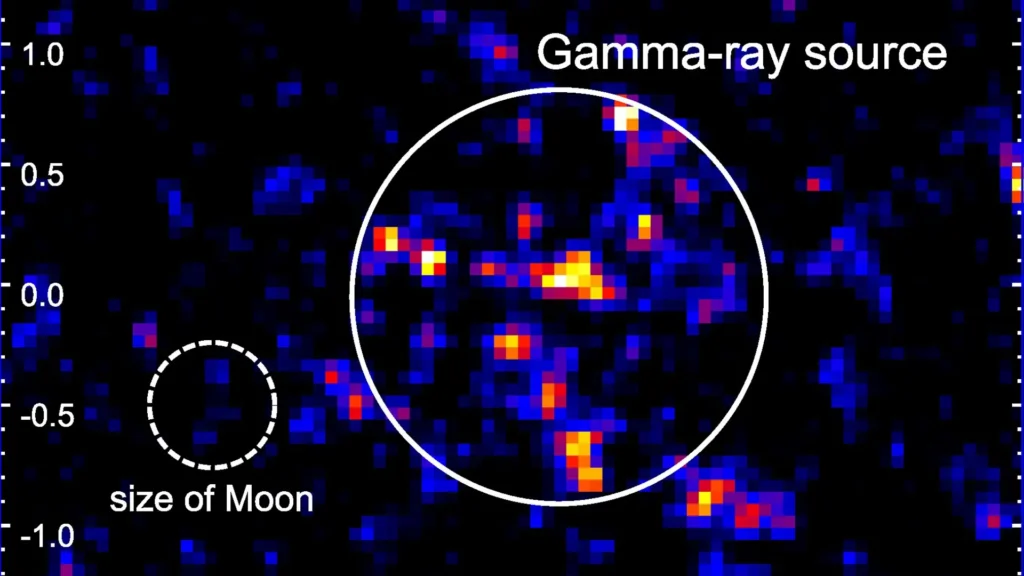
In a landmark achievement for high-energy astrophysics, an international research consortium has conclusively identified a specific source within our own Milky Way galaxy capable of accelerating protons to the highest energy levels ever recorded in a galactic environment. This discovery, centered on the object known as LHAASO J1912+1014u, provides the "smoking gun" evidence that scientists have sought for decades to explain the origin of cosmic rays—the mysterious, ultra-fast particles that permeate the cosmos and constantly bombard the Earth’s atmosphere.
The research, led by a team from Hiroshima University and published in The Astrophysical Journal on July 16, 2026, marks a turning point in our understanding of the Milky Way’s "natural particle accelerators." By synthesizing data from multiple ground-based and space-borne observatories, the team has confirmed that LHAASO J1912+1014u is a "proton PeVatron," a cosmic engine capable of pushing protons to energies exceeding one quadrillion (10^15) electron volts, or one peta-electron volt (PeV).
The Enigma of Cosmic Rays and the PeV Threshold
Cosmic rays are not actually rays in the traditional sense, but rather subatomic particles—primarily protons—traveling at nearly the speed of light. Since their discovery over a century ago, these particles have fascinated and baffled scientists. While the sun and other standard stellar processes produce low-energy cosmic rays, the origin of high-energy cosmic rays has remained one of the most enduring mysteries in astronomy.
To put the energy of these particles into perspective, one must look at the Large Hadron Collider (LHC) on the border of Switzerland and France. The LHC, the most powerful man-made particle accelerator on Earth, can propel protons to energies of several tera-electron volts (TeV). However, the Milky Way contains natural accelerators that are significantly more powerful, reaching the PeV scale—roughly 100 to 1,000 times more energetic than anything humans can currently produce.
"This immense energy makes cosmic rays important in astronomy and astrophysics," explained Tsunefumi Mizuno, an associate professor at Hiroshima University’s Hiroshima Astrophysical Science Center and the study’s lead author. "Finding a cosmic-ray proton accelerator above that PeV level, called a proton PeVatron, is one of the most exciting topics in modern astrophysics."
Identifying the Culprit: LHAASO J1912+1014u
The object at the heart of this discovery, LHAASO J1912+1014u, is located in the constellation Aquila, near the bright star Altair, which serves as one of the vertices of the famous Summer Triangle. Initially discovered in 2024, the source was first detected by the Large High Altitude Air Shower Observatory (LHAASO) in China.
For years, the scientific community struggled to distinguish whether such high-energy signals were the result of accelerated protons (the primary component of cosmic rays) or accelerated electrons. When electrons are accelerated to extreme speeds, they interact with ambient photons to produce gamma rays through a process called inverse Compton scattering. Protons, conversely, produce gamma rays when they collide with dense interstellar gas, creating neutral pions that then decay into high-energy light.
The challenge for the Hiroshima-led team was to prove that LHAASO J1912+1014u was indeed a hadronic (proton-driven) accelerator rather than a leptonic (electron-driven) one.
The Multi-Observatory Strategy: "The Three Arrows"
The breakthrough was made possible by an integrated multiwavelength analysis, which Mizuno likened to an old Japanese proverb: "One arrow is easy to break, but three arrows bundled together are not." In this context, the "three arrows" represented three distinct types of data that, when combined, provided an irrefutable profile of the PeVatron.
The First Arrow: Fermi-LAT GeV Gamma-Ray Data
The NASA-led Fermi Gamma-ray Space Telescope, specifically its Large Area Telescope (LAT), provided critical observations of gamma rays in the giga-electron-volt (GeV) range. Hiroshima University played a key role in the development and operation of this instrument. The Fermi-LAT data showed that the gamma-ray emission from LHAASO J1912+1014u extended smoothly from very high energies (hundreds of TeV) down to relatively lower energies (400 MeV). This broad, continuous spectrum is a hallmark of proton acceleration, as electron-driven models struggle to maintain such consistency across such a wide energy range.
The Second Arrow: FUGIN Radio Data
To confirm the proton hypothesis, researchers needed to see if the gamma rays were coming from regions where protons would likely collide with matter. Using data from the FOREST Unbiased Galactic plane Imaging survey (FUGIN), conducted with the Nobeyama 45-meter telescope in Japan, the team mapped the distribution of interstellar gas in the vicinity of the source. They found a near-perfect spatial correlation: the GeV gamma rays were concentrated exactly where the radio data showed dense clouds of interstellar gas. This strongly suggested that the gamma rays were the product of protons "hitting" the gas.
The Third Arrow: Chandra X-ray Data
The final piece of the puzzle came from NASA’s Chandra X-ray Observatory. If the source were dominated by high-energy electrons, those electrons would inevitably produce intense X-ray emissions via synchrotron radiation as they spiraled through magnetic fields. However, Chandra detected only very weak, diffuse X-ray signals. The lack of bright X-ray emission effectively ruled out electrons as the primary drivers of the energy, leaving protons as the only viable explanation.
A Chronology of Discovery
The identification of LHAASO J1912+1014u is the culmination of decades of international effort in gamma-ray astronomy:
- 1990: The Tibet AS gamma experiment, a joint venture between Japan and China, begins monitoring high-energy cosmic rays from the Tibetan Plateau, laying the groundwork for PeVatron searches.
- 2021-2023: China’s LHAASO facility begins releasing data showing dozens of ultra-high-energy gamma-ray sources, sparking a global race to identify which of these are true proton PeVatrons.
- 2024: LHAASO J1912+1014u is officially discovered. Initial theories suggest it might be a supernova remnant or a pulsar wind nebula.
- 2025: The Hiroshima University team begins an exhaustive multiwavelength study, requesting archival data from Chandra and fresh analysis from the FUGIN radio survey.
- July 2026: The team publishes their findings in The Astrophysical Journal, confirming the object as a proton PeVatron.
Scientific Analysis and Implications
The confirmation of a proton PeVatron has profound implications for the "Standard Model" of galactic cosmic rays. For decades, the leading theory has been that supernova remnants—the shockwaves from exploding stars—act as the primary accelerators. While LHAASO J1912+1014u shows characteristics of a supernova remnant, the sheer energy it produces challenges existing models of how efficiently these remnants can accelerate particles.
Furthermore, this discovery helps solve the "knee" problem in the cosmic ray spectrum. When plotting the abundance of cosmic rays against their energy, there is a noticeable bend, or "knee," at approximately 3 PeV. Scientists believe this knee represents the maximum energy limit for accelerators within our galaxy. By identifying a source that operates right at this threshold, researchers can now study the physical conditions—magnetic field strength, gas density, and shock velocity—required to reach such extremes.
Global Collaboration and Future Research
The study was a massive collaborative effort involving institutions across the globe. Co-authors included researchers from Gifu University, the University of Würzburg in Germany, and Miyazaki University. Funding and operational support were provided by a constellation of agencies, including NASA and the Department of Energy (USA), MEXT and JAXA (Japan), and various European research councils.
The successful identification of LHAASO J1912+1014u has provided a blueprint for future investigations. "There are dozens of other possible proton PeVatrons in the Milky Way," Mizuno noted. The team plans to apply their "three arrows" methodology to these other candidates.
As next-generation observatories like the Cherenkov Telescope Array (CTA) come online, the ability to resolve these sources in even greater detail will likely reveal a galaxy teeming with high-energy activity. For now, LHAASO J1912+1014u stands as a confirmed laboratory for extreme physics, proving that the Milky Way is far from a quiet neighborhood—it is a home to some of the most powerful particle accelerators in the known universe.