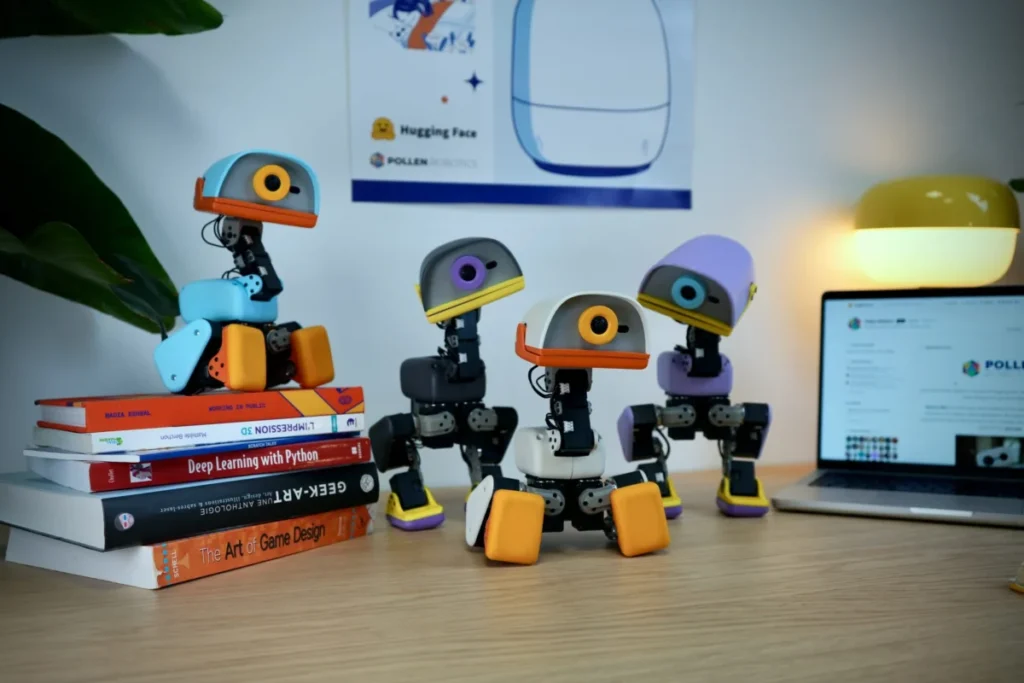
A new chapter in accessible robotics is unfolding with the official launch of Microduck, an innovative open-source, trainable bipedal robot developed through a collaboration between Hugging Face and Pollen Robotics. Priced at an accessible $400, Microduck is poised to democratize the field of reinforcement learning and robotics experimentation, building upon a lineage that traces back to advanced research platforms. This charmingly designed miniature bot, capable of pre-order now with deliveries slated for Christmas 2026, aims to put sophisticated robotic learning tools into the hands of a broader community, from students and educators to hobbyists and researchers.
The Evolution of Miniature Bipedal Robotics
The journey to Microduck reflects a broader trend within robotics: the scaling down of complex technologies to make them more manageable, affordable, and approachable for learning and development. The narrative begins with Disney Research, a powerhouse known for pushing the boundaries of animatronics and autonomous systems. In an exciting reveal, Disney showcased its BDX droid, a highly advanced bipedal robot that captured the imagination of the robotics community. The BDX droid was a testament to sophisticated engineering, demonstrating impressive gait and balance capabilities in a compact form factor, though its proprietary nature and presumed high cost limited its direct accessibility to the general public or even smaller research institutions.
Recognizing the immense potential and the community’s desire for similar platforms, the open-source movement swiftly embraced the concept. This led to the creation of the Open Duck Mini, a community-driven initiative inspired by the BDX droid’s design principles but reimagined with accessibility and DIY construction at its core. This project highlighted the power of collaborative development, as enthusiasts and engineers pooled their knowledge to replicate and innovate on the bipedal design using readily available components and 3D printing technologies. The Open Duck Mini served as a crucial bridge, proving that advanced robotic locomotion could be achieved without exorbitant budgets, fostering a vibrant ecosystem of makers.
Building on the successes and lessons learned from the Open Duck Mini, prominent AI and robotics companies, Hugging Face and Pollen Robotics, stepped in to refine and professionalize the concept. Hugging Face, a leader in natural language processing and open-source AI models, brought its expertise in democratizing AI tools, while Pollen Robotics contributed its hardware and robotics development prowess. This partnership culminated in Microduck, which represents a significant leap forward. It combines the community-inspired design with industrial-grade reliability, an integrated development environment, and robust support, making it a ready-to-use platform for serious experimentation and learning. This chronology underscores a remarkable progression from high-end corporate research to grassroots innovation, finally reaching a commercially viable and educationally impactful product designed for the masses.
Microduck’s Design Philosophy and Technical Specifications

At the heart of Microduck’s appeal lies its deliberate design, which balances advanced robotic capabilities with an undeniable "macro charm." The robot’s physical characteristics, such as its "pigeon-toed walk" and "bowlegged skating," are not merely aesthetic choices but are intrinsic to its function as a learning platform for reinforcement learning. In this paradigm, agents learn optimal behaviors through trial and error, often exhibiting awkward or inefficient movements initially. Microduck’s endearing clumsiness makes these inevitable failures less frustrating and more engaging, fostering a patient and persistent approach to learning. This design philosophy acknowledges that an approachable and even humorous aesthetic can significantly lower the psychological barrier to entry for complex technical subjects.
Each Microduck is designed with individuality, possessing its own "voice" – a unique identifier that adds to its personality and allows for easier differentiation in multi-robot experiments. This feature could also pave the way for more personalized human-robot interactions in the future. The robot’s compact size and lightweight construction make it ideal for indoor environments, minimizing potential damage during learning phases and ensuring safety for users. While specific dimensions were not detailed, the "micro" prefix and the visual cues suggest a highly portable and desk-friendly device.
Technically, Microduck is engineered as a robust platform for reinforcement learning (RL). RL is a branch of machine learning where an agent learns to make decisions by performing actions in an environment to maximize a cumulative reward. Microduck’s open-source Software Development Kit (SDK) is a cornerstone of its utility, providing users with the tools and flexibility to program the robot, design custom environments, and implement various RL algorithms. The SDK is readily available on GitHub (github.com/pollen-robotics/microduck), fostering transparency and encouraging community contributions. This open-source approach not only ensures continuous improvement and innovation but also allows users to delve deep into the robot’s inner workings, modifying its firmware, control algorithms, and even hardware interfaces.
While the initial release of Microduck does not feature onboard language processing capabilities, the developers have openly stated that this is a "technically feasible" future development. The expectation is that the vibrant open-source community will quickly integrate such functionalities. "Even if we’re not the ones doing it, I expect the community to build it in a matter of weeks after the first users get their robots," a representative noted, highlighting the profound trust in the collective intelligence and rapid prototyping capabilities of the maker and developer communities. This anticipated feature could transform Microduck from a purely motor-skill learning platform into one capable of understanding and responding to natural language commands, significantly expanding its educational and research potential. The modular design implicit in its open-source nature means that adding sensors, cameras, or processing units for advanced AI tasks like vision or voice recognition is likely within the scope of enthusiastic users.
Implications for Education and Research
The introduction of Microduck at a $400 price point marks a significant milestone in the democratization of advanced robotics and artificial intelligence education. Historically, access to sophisticated robotic platforms capable of reinforcement learning was largely confined to well-funded university labs or corporate research departments, often involving investments of thousands or even tens of thousands of dollars. Microduck drastically lowers this barrier to entry, making cutting-edge technology accessible to high school students, undergraduate programs, independent researchers, and hobbyists.
In educational settings, Microduck can revolutionize STEM (Science, Technology, Engineering, and Mathematics) learning. Students can move beyond theoretical concepts and engage in hands-on experimentation with real-world robotic systems. They can design reward functions, observe the learning process in real-time, and debug algorithms directly on a physical robot. This experiential learning approach is proven to be far more effective in solidifying understanding and inspiring future generations of engineers and AI specialists. For example, a student could program Microduck to navigate a simple maze, learning about pathfinding algorithms, or teach it to balance on two legs, delving into control theory and sensor fusion.

For university-level courses, Microduck offers an invaluable tool for teaching machine learning, control systems, and robotics. Its open-source nature allows for deep dives into modifying the underlying code, enabling students to understand the intricacies of robotic locomotion, sensor integration, and data processing. Furthermore, its affordability means that entire classrooms or research groups can be equipped with multiple units, facilitating collaborative projects and studies in areas like swarm robotics, where multiple agents interact to achieve a common goal. The ability to simulate real-world physics and dynamics on a physical robot, rather than solely relying on simulations, provides a more comprehensive and challenging learning experience.
In the realm of research, Microduck opens new avenues for experimentation, particularly for those with limited budgets. Researchers can leverage the platform to test novel reinforcement learning algorithms, explore human-robot interaction dynamics with "charming" robots, or investigate robust control strategies in dynamic environments. The standardized, open platform ensures reproducibility of results and fosters a collaborative research ecosystem, allowing researchers worldwide to share and build upon each other’s work. The potential for the community to integrate new sensors, actuators, or processing modules means Microduck can evolve beyond its initial scope, becoming a versatile testbed for a wide array of robotic research questions.
Market Positioning and Future Outlook
Microduck enters a growing market for educational and hobbyist robotics, but its combination of open-source software, reinforcement learning focus, and appealing design at a $400 price point gives it a distinct competitive edge. While there are other low-cost robotic kits available, many are focused on basic programming or remote control. Microduck’s emphasis on trainable intelligence through reinforcement learning places it in a more advanced category, often dominated by significantly more expensive platforms. The backing of Hugging Face and Pollen Robotics also lends it credibility and promises ongoing support and community engagement, which is crucial for the longevity of open-source projects.
The delivery timeline of "before Christmas 2026" for pre-orders suggests a careful and deliberate manufacturing and quality control process. This timeframe allows for refinement of the production line, further testing, and potentially, the integration of initial community feedback from early prototypes or developer kits. For customers, it provides ample time to prepare their learning environments and anticipate the arrival of their new robotic companion.
The developers’ playful suggestion that one day a Microduck might "clean your room, provided your messes are made up of socks and other lightweight debris that fits in the duck’s bill" highlights the current limitations while also hinting at future aspirations. While Microduck is not designed for heavy-duty domestic tasks, its capabilities are continuously improving. The performance of these and similar training models is on an upward trajectory, driven by advancements in AI algorithms, more powerful embedded processors, and the collective ingenuity of the open-source community. As computational power becomes cheaper and algorithms more efficient, the range of tasks even small robots can perform will expand dramatically.
The trajectory of Microduck from a Disney concept to a community-driven project and now a commercially available, open-source platform underscores a powerful trend: the democratization of advanced technology. By making sophisticated tools like reinforcement learning robots accessible and affordable, Hugging Face and Pollen Robotics are not just selling a product; they are cultivating a new generation of innovators. The open SDK and the vibrant online community promise a future where Microduck’s capabilities will grow far beyond its initial design, driven by the collective creativity and problem-solving skills of its users. The call to action is clear: with the list of affordable walking robots getting longer, the excuses not to engage with this exciting field are rapidly diminishing. Those interested can learn more and pre-order at pollen-robotics.com/microduck, or for the truly adventurous, the option to build one from scratch remains a testament to its open-source spirit.