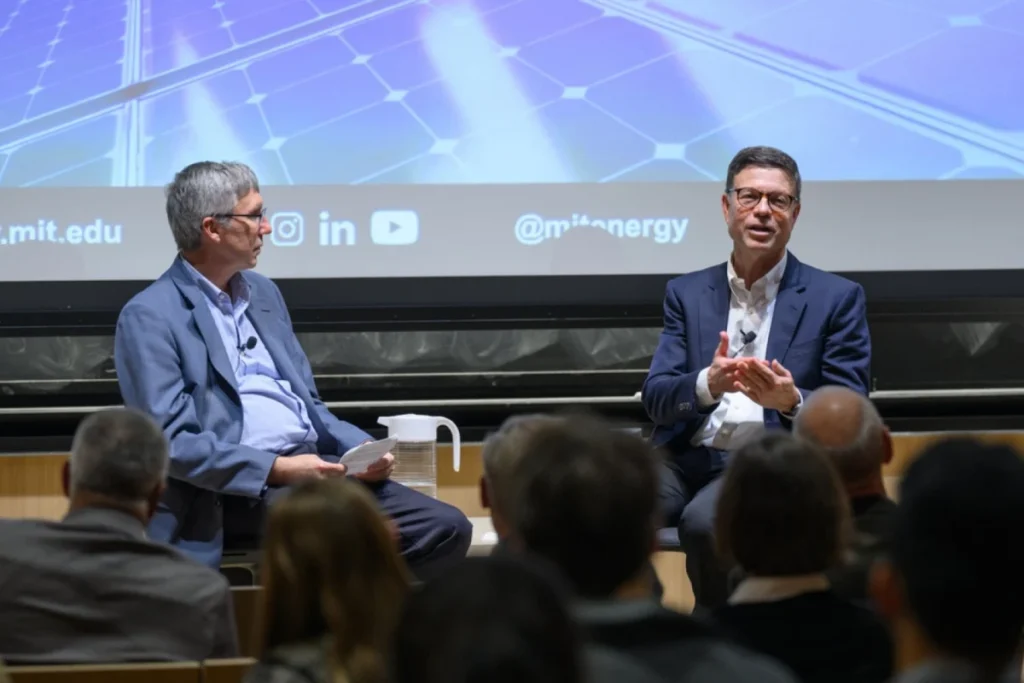
General Motors (GM) is at the vanguard of a seismic shift in both personal mobility and the broader energy landscape, driven by relentless innovation in battery technology. Kurt Kelty, Vice President of Battery, Propulsion, and Sustainability at GM, articulated this transformative vision during the prestigious MIT Energy Initiative (MITEI) Fall Colloquium. His address, a cornerstone of the ongoing MITEI Presents: Advancing the Energy Transition speaker series, delved into GM’s ambitious strategy for translating cutting-edge battery science from laboratory concepts to widespread commercial viability, thereby bolstering American leadership in battery innovation. The MITEI series itself serves as a critical platform, bringing together leading minds to dissect and advance the complex pathways toward a sustainable energy future.
At the heart of Kelty’s team’s multifaceted mission at GM lie three paramount objectives. The first, and perhaps most critical for widespread adoption, is enhancing affordability. "How do you drive down the cost?" Kelty posed to the assembled audience, highlighting the substantial impact of battery expenditures. "It’s the batteries. The batteries make up about 30 percent of the cost of the vehicle." This economic barrier is a significant hurdle in accelerating the transition to electric vehicles (EVs), and GM’s focus on cost reduction is directly aimed at making EVs accessible to a larger consumer base.
The second pillar of their strategy involves a rigorous pursuit of improved battery performance. This encompasses not only faster charging times, a key concern for EV owners seeking convenience akin to refueling a gasoline vehicle, but also increased energy density. Higher energy density translates to longer driving ranges, alleviating range anxiety and making EVs a more practical choice for a wider variety of uses, from daily commutes to long-distance travel.
The third, and increasingly vital, objective is the localization of the battery supply chain. Kelty emphatically stated, "We’ve got to build up our resilience and our independence here in North America, so we’re not relying on materials coming from China." This strategic imperative is driven by geopolitical considerations, supply chain vulnerabilities exposed by global events, and a desire to foster domestic manufacturing capabilities and job creation. The global reliance on specific regions for critical raw materials and battery component manufacturing presents inherent risks, and GM’s commitment to North American production signals a proactive approach to mitigating these challenges.
Accelerating Innovation Through Virtualization and AI
To achieve these ambitious goals, GM is making substantial investments in virtualization technologies, a strategic move designed to dramatically compress research and development timelines. Kelty explained how the integration of artificial intelligence (AI) and advanced modeling techniques allows his team to conduct sophisticated simulations upfront, reducing development cycles from months to mere days. This accelerated pace of discovery and refinement is crucial for staying ahead in the rapidly evolving battery technology landscape.
"If you want to modify… the nickel content ever so slightly, we can very quickly model: ‘OK, how’s that going to affect the energy density? The safety? How’s that going to affect the charge capability?’" Kelty elaborated, illustrating the granular level of control and insight offered by these virtual tools. This ability to rapidly assess the impact of minor material adjustments allows for a more efficient and targeted approach to battery design. Furthermore, the modeling capabilities extend beyond individual cell performance, enabling analysis at the pack level and ultimately, the complete vehicle integration. This holistic approach ensures that battery advancements are optimized for real-world application and performance.
The Breakthrough of Lithium Manganese-Rich (LMR) Batteries
A significant announcement from Kelty was the identification of a solution that effectively addresses the trifecta of affordability, accessibility, and commercialization: lithium manganese-rich (LMR) batteries. Historically, the industry has pursued cost reduction by decreasing cobalt content and increasing nickel. While high-nickel batteries have been the dominant chemistry in the U.S. due to their impressive range, LMR technology represents a leap forward.
LMR batteries achieve further cost reductions by diminishing nickel content while incorporating greater amounts of manganese. Crucially, this shift does not necessitate a compromise on range, a critical factor for consumer acceptance. This innovative chemistry offers a compelling alternative, positioning GM to offer EVs with both competitive pricing and robust performance.
Kelty drew a direct comparison to lithium-iron-phosphate (LFP) batteries, which are prevalent in China and are lauded for their low cost, extended cycle life, and inherent safety. "LMR batteries," he stated, "the cost is comparable to LFP with a range that is closer to high-nickel. That’s what’s really a breakthrough." This dual advantage of cost parity with LFP and range comparable to high-nickel batteries presents a potent combination that could redefine the EV market.
Overcoming Commercialization Hurdles
While LMR battery chemistry itself is not a novel discovery, its widespread adoption has been hindered by significant commercialization challenges. "People knew about it, but they didn’t know how to commercialize it. They didn’t know how to make it work in an EV," Kelty explained. The complexity lies in optimizing manufacturing processes and ensuring the long-term stability and performance of these batteries within the demanding environment of an electric vehicle. GM’s success in overcoming these obstacles is a testament to their advanced research and engineering capabilities. As a result, GM is poised to be the first automotive manufacturer to bring LMR batteries to market in their EVs, with a projected rollout in 2028. This strategic timing positions GM to capture early market share and establish a technological advantage.
The Future of Energy: Vehicle-to-Grid and Beyond
Beyond the immediate advancements in EV battery technology, Kelty also expressed considerable optimism regarding the integration of vehicle-to-grid (V2G) technologies. V2G systems, utilizing bidirectional chargers, enable a two-way flow of energy between electric vehicles and the power grid. This capability allows EVs to not only charge from the grid but also to discharge stored energy back to it.
"Customers can charge their vehicles at night when the electricity prices are really low, and they can discharge it during the day when electricity rates are really high," Kelty described, illustrating the economic benefits for consumers and the grid stabilization potential. This smart energy management can help balance electricity demand, reduce reliance on peak-hour generation, and potentially create new revenue streams for EV owners. The widespread adoption of V2G could fundamentally alter the relationship between consumers, their vehicles, and the energy infrastructure.
GM’s commitment to battery innovation extends beyond the transportation sector. The company is actively exploring applications for its battery expertise in grid-scale energy storage solutions. "It’s a big market right now, but it’s growing very quickly because of the data center growth," Kelty observed. The insatiable demand for reliable power from data centers, coupled with the increasing integration of renewable energy sources into the grid, creates a significant market for advanced energy storage systems. GM’s involvement in this space could position them as a key player in the broader energy transition, offering solutions that enhance grid reliability and support the expansion of renewable energy.
A Resurgent American Battery Industry
Looking ahead to the future of battery manufacturing and EV production in the United States, Kelty conveyed a strong sense of optimism. "We’ve got the technology here to make it happen. We’ve always had the innovation here," he asserted. "Now, we’re getting more and more of the manufacturing. We’re getting that all together. We’ve got just tremendous opportunity here that I’m hopeful we’re going to be able to take advantage of and really build a massive battery industry here."
This sentiment reflects a broader national effort to re-establish U.S. leadership in critical manufacturing sectors, particularly those vital to the clean energy economy. The confluence of technological innovation, increasing manufacturing capacity, and supportive policy initiatives creates a fertile ground for a robust domestic battery industry. This could lead to significant economic benefits, including job creation, reduced reliance on foreign supply chains, and enhanced national security.
The MITEI Presents: Advancing the Energy Transition speaker series, of which Kelty’s address was a part, plays a crucial role in fostering this forward momentum. By providing a platform for energy experts and leaders to share their insights, the series highlights the scientific, technological, and policy solutions essential for transforming our global energy systems. These discussions are invaluable for shaping a sustainable and prosperous energy future.
For those interested in further engagement with these critical discussions, MITEI’s Events page offers comprehensive information on upcoming colloquia and other initiatives aimed at driving the energy transition forward. The momentum generated by these dialogues, combined with the tangible advancements being made by companies like General Motors, suggests a future where sustainable energy and mobility are not just aspirational goals, but achievable realities.