DM3D, a contract manufacturer and metal additive manufacturing (AM) solutions provider, has significantly advanced the production capabilities for the aerospace and space sectors through its innovative 3D printing technologies. Specializing in large-format parts and its proprietary direct energy deposition (DED) systems, the company has become a crucial partner for clients like NASA, enabling faster and more cost-effective manufacturing of complex components. This strategic pivot from traditional manufacturing to cutting-edge AM has positioned DM3D as a key player in the evolving landscape of high-performance part production.
The Genesis of a Metal AM Leader
Founded in 2013, DM3D initially operated out of its Auburn Hills, Michigan facility with a focus on tool and die building and refurbishment, primarily serving the automotive industry. However, the inherent challenges of the one-off nature of tool and die manufacturing, coupled with the trend of offshoring, prompted president Bhaskar Dutta to re-evaluate the company’s strategic direction. With over two decades of experience in additive manufacturing and a growing interest in the demanding requirements of the aerospace market, Dutta recognized a significant opportunity to leverage metal AM for high-value applications. This foresight led to a decisive shift in DM3D’s core business towards metal additive manufacturing.
Dutta’s background in direct energy deposition (DED) was instrumental in this transition. He identified a critical need for scalable metal AM production within the space and aerospace industries. To meet this demand, DM3D invested heavily in developing its own DED technology and its patented direct metal deposition (DMD) systems, specifically engineered for large-format additive manufacturing (LFAM). These advanced systems not only serve DM3D’s internal production needs but are also offered to other additive manufacturers, further disseminating advanced AM capabilities.
The company’s Auburn Hills facility now serves as a comprehensive hub for its operations. Beyond the printing process itself, DM3D manages all packaging and shipping in-house. A significant portion of the post-processing is also handled internally, utilizing a suite of CNC and EDM machines. For exceptionally large components that exceed the capacity of their in-house finishing capabilities, DM3D strategically partners with specialized external providers, ensuring a complete and high-quality end-to-end service.

Direct Metal Deposition: A Core Technological Advantage
At the heart of DM3D’s success lies its patented laser Direct Metal Deposition (DMD) technology. This process is adept at working with a wide array of metals, including stainless steel, Inconel, and various alloys of aluminum, titanium, and copper. The flexibility of the laser DMD system is particularly advantageous, as it is engineered to handle a diverse range of metallic materials, a crucial factor for industries with stringent material specifications.
The DMD process is fundamentally designed for the intricate production of complex geometries. It operates by utilizing a focused laser energy source to melt and deposit metal powder or wire in a precise, layer-by-layer fashion. This additive approach allows for the creation of parts that would be impossible or prohibitively expensive to manufacture using traditional subtractive methods. The cyclical nature of the DMD process involves:
- Powder/Wire Feeding: Precisely controlled amounts of metal powder or wire are fed into the build area.
- Laser Melting: A high-power laser beam melts the fed material and the underlying substrate or previous layer.
- Deposition: The molten metal fuses with the substrate, forming a new layer of solid material.
- Layering: The build platform or print head moves to create the next layer, repeating the melting and deposition process until the part is complete.
This controlled melting and deposition process ensures high material integrity and excellent mechanical properties in the final printed component, making it suitable for critical applications in aerospace and space.
Large-Format Additive Manufacturing for Niche Industries
Industries characterized by low-volume production of large components, such as space and aerospace, stand to gain immense benefits from additive manufacturing. AM significantly reduces both the production costs and lead times typically associated with these complex parts. DM3D’s initial strategic focus on these low-volume, high-complexity sectors proved to be a sound decision.
"There was a lead time reduction with the elimination of the tool and die making process," stated Bhaskar Dutta, president of DM3D. "For low-volume production and prototyping, additive manufacturing is very cost-effective." This direct cost and time saving is a major driver for adopting AM in these specialized fields.

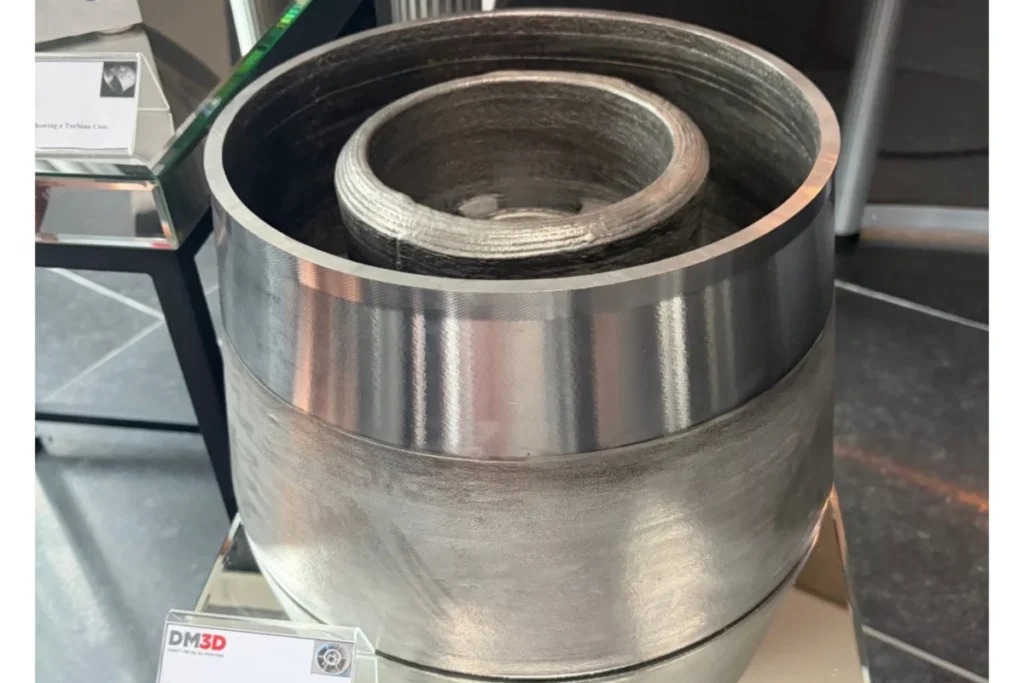
DM3D has demonstrated its capabilities by producing some of the largest additively manufactured metal components for rocket engines, serving clients like NASA and other prominent private space exploration companies. A notable achievement was the 3D printing of a candidate part for NASA’s RS-25 engine nozzle liner. This ambitious project involved creating a component that measured an impressive 111 inches in height with a 97-inch-diameter base. To accomplish this, DM3D developed a specialized multi-nozzle DMD system precisely tailored for this specific, large-scale application.
Case Study: The RS-25 Engine Nozzle Liner
The development of the RS-25 engine nozzle liner exemplifies DM3D’s advanced capabilities and collaborative approach. Following the initial design phase, DM3D and NASA engaged in rigorous simulation using ANSYS 3D simulation software. This crucial step allowed them to meticulously analyze and predict the part’s potential thermal stresses and distortions throughout the entire build process. By understanding and accounting for these variables, they could optimize the printing parameters to ensure the structural integrity and performance of the final component.
Once the simulations were complete, the nozzle liner was additively manufactured using DM3D’s DED technology. Upon completion, the printed liner underwent a comprehensive structured light geometric inspectional scan, verifying its dimensional accuracy and adherence to design specifications.
The impact of employing additive manufacturing for this critical component was substantial. DM3D reported a reduction of over 50% in lead time and a 25% decrease in cost compared to conventional manufacturing methods. A key factor in achieving these efficiencies was DM3D’s multi-nozzle DMD system. By employing two simultaneously operating process heads, the system effectively doubled the throughput. Furthermore, the system’s modular design allows for the addition of two more process heads if required, offering significant scalability for even larger or more complex projects.
Another example of DM3D’s contributions to space exploration is the 3D printing of a nozzle jacket from Inconel for NASA. This component, crucial for the extreme operating conditions of rocket engines, showcases DM3D’s ability to handle high-performance alloys and produce parts essential for mission success.

A One-Stop-Shop for Advanced AM Solutions
DM3D has strategically positioned itself as a comprehensive provider of additive manufacturing services and solutions, catering to a diverse range of industries. As a smaller, agile company, DM3D exercises careful selection of the applications it pursues, prioritizing resource conservation and focusing on projects where its specialized capabilities can deliver maximum impact.
Looking ahead, DM3D is actively expanding its technological portfolio and material expertise. The company is in the process of qualifying for wire-based additive manufacturing technologies, which can offer different advantages in terms of material deposition rates and cost-effectiveness for certain applications. Additionally, DM3D is working to qualify titanium parts for production. Titanium castings are becoming increasingly difficult for manufacturers to source due to supply chain constraints and complex manufacturing requirements, making AM-produced titanium parts a highly sought-after alternative. This expansion of capabilities will allow DM3D to serve an even broader spectrum of demanding applications and further solidify its role as a leader in large-format metal additive manufacturing. The company’s commitment to innovation and its strategic focus on high-impact applications position it well for continued growth and influence in the advanced manufacturing sector.