More than 70 aircraft are struck by lightning every day. If you happen to be flying when a strike occurs, chances are you won’t feel a thing, thanks to lightning protection measures that are embedded in key zones throughout the aircraft. For decades, the aviation industry has relied on a robust understanding of how lightning interacts with the conventional “tube-and-wing” aircraft design, a configuration that has proven remarkably resilient to these atmospheric electrical discharges. However, as the aerospace sector embarks on a new era of innovation, exploring radical new aircraft architectures aimed at enhancing fuel efficiency and reducing weight, existing lightning protection strategies face an unprecedented challenge. The very designs that promise aerodynamic advancements – such as blended-wing bodies and truss-braced wings – diverge significantly from the familiar tube-and-wing geometry, leaving a critical knowledge gap regarding their vulnerability to lightning strikes.
This emerging concern has spurred urgent research, with aerospace engineers at the Massachusetts Institute of Technology (MIT) developing a groundbreaking physics-based methodology designed to predict the complex pathways lightning takes across any aircraft configuration, regardless of its shape. This innovative tool not only forecasts how lightning currents will sweep across an aircraft’s surface but also generates detailed zoning maps. These maps identify specific sections of an aircraft that will require varying degrees of lightning protection, based on their predicted exposure to intense electrical discharge. This development is poised to redefine how aircraft are designed and certified for safety in the face of evolving aeronautical engineering.
The Evolving Landscape of Aviation and Lightning Threats
The aviation industry is perpetually driven by the pursuit of efficiency. For years, the dominant tube-and-wing design, characterized by a cylindrical fuselage and distinct wings, has been the standard. This configuration offers a predictable aerodynamic profile and, crucially, a well-understood response to external forces, including lightning. The current lightning protection systems, meticulously developed over decades, are tailored to this geometry. They typically involve strategically placed conductive materials, such as copper mesh or aluminum foil, embedded within the aircraft’s skin. These systems are designed to safely channel the immense electrical current of a lightning strike away from critical components and dissipate it into the air, often at wingtips or tail fins.
The effectiveness of these systems is measured by a zoning protocol, where different parts of the aircraft are classified into zones based on their historical susceptibility to lightning strikes and the intensity of current they are expected to endure. Zone 1, for instance, represents areas with the highest probability of direct lightning attachment and requires the most robust protection. This zoning has been refined through extensive flight testing, analysis of actual lightning strike incidents, and meticulous fine-tuning of protective measures.
However, the quest for greater aerodynamic efficiency and reduced operating costs is leading to a paradigm shift in aircraft design. Concepts like the blended-wing body, which merges the fuselage and wings into a single, unified lifting surface, and truss-braced wings, featuring slender wings supported by external bracing, offer significant potential for weight reduction and drag minimization. These novel configurations, while promising substantial fuel savings, present engineers with a new set of challenges. Their unconventional shapes can alter airflow patterns, potentially changing how lightning attaches and propagates across the airframe. The established zoning methodologies, heavily reliant on historical data from conventional aircraft, may not be directly applicable to these radically different designs.
MIT’s Physics-Based Innovation for Universal Protection
Recognizing this critical gap, MIT’s aerospace engineers, under the leadership of Associate Professor Carmen Guerra-Garcia, have pioneered a new approach that transcends the limitations of historical data and geometric specificity. Their work, published in the recent issue of IEEE Access, introduces a physics-based model capable of predicting lightning behavior on any aircraft design.
"People are starting to conceive aircraft that look very different from what we’re used to, and we can’t apply exactly what we know from historical data to these new configurations because they’re just too different," stated Professor Guerra-Garcia. "Physics-based methods are universal. They’re agnostic to the type of geometry or vehicle. This is the path forward to be able to do this lightning zoning and protect future aircraft."
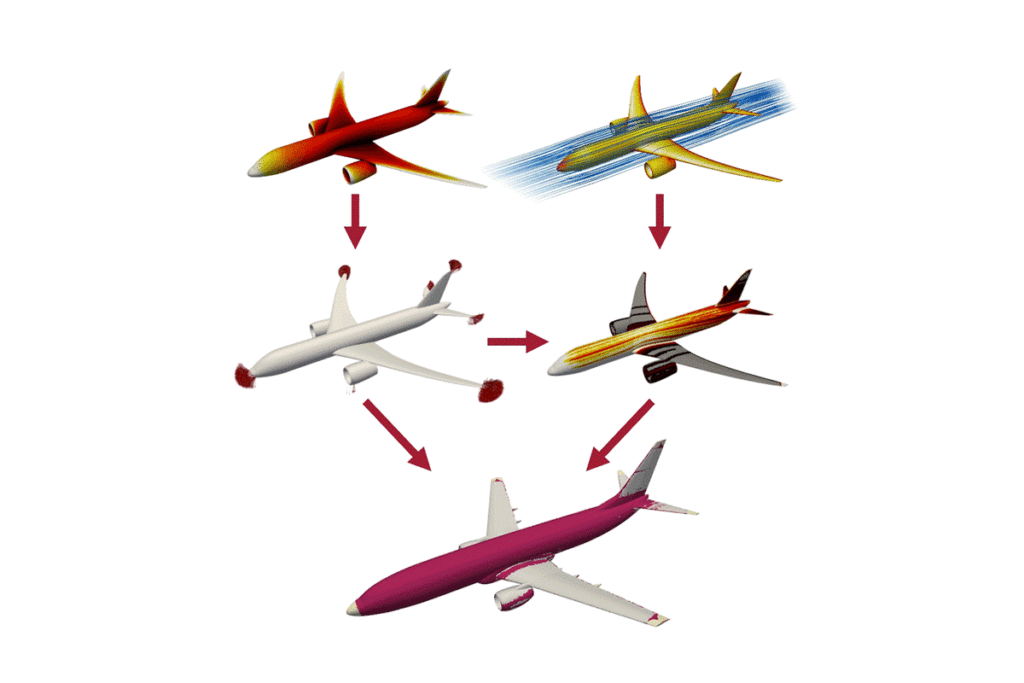
The core of this innovation lies in its ability to simulate the fundamental physics of lightning interaction with an aircraft. Unlike empirical approaches that rely on past observations, this method models the electrical and aerodynamic phenomena involved in a lightning strike. The process begins by simulating how air flows around a specific aircraft geometry at various speeds, altitudes, and pitch angles. This fluid dynamics simulation is crucial because the movement of air influences how lightning currents spread across the aircraft’s surface.
Building upon this aerodynamic foundation, the MIT team integrates a previously developed model that predicts the most probable points of initial lightning attachment. These are typically sharp edges or extremities of the aircraft, where electrical fields tend to concentrate. Once an initial attachment point is identified, the model simulates tens of thousands of potential lightning arc trajectories, representing the varied paths the electrical current might take. These simulations account for the dynamic interaction between the lightning arc and the airflow, predicting how the current’s intensity might change and where it might re-attach along the aircraft’s surface.
The outcome of these extensive simulations is a statistical representation of lightning propagation patterns for a given aircraft design. This probabilistic data is then translated into a zoning map, analogous to the industry-standard zones but generated through a predictive, physics-driven process. The maps highlight regions of varying vulnerability, indicating where the lightning arc is most likely to linger, thereby posing the greatest risk of damage.
Understanding the Lightning Strike: From Attachment to Sweep
A lightning strike is a complex and dynamic event. When a lightning bolt makes contact with an aircraft, it typically attaches to a protruding point, such as a wingtip or the nose. This initial attachment can last for a fraction of a second to over a second. During this critical period, the aircraft is not stationary; it continues to move through the atmosphere at high speed. This relative motion causes the lightning current to "sweep" or propagate along the aircraft’s surface.
The intensity and trajectory of this sweeping current are not constant. As the lightning travels, it can encounter varying electrical potentials on the aircraft’s surface and interact with the surrounding airflow. This can lead to changes in current density and even cause the arc to detach and re-attach at different locations. These re-attachments are particularly concerning because they can occur on more vulnerable sections of the aircraft, potentially causing structural damage, disrupting electronic systems, or igniting fuel vapors.
Previous research by Professor Guerra-Garcia’s group, led by graduate student Sam Austin, had already established a robust model for predicting these initial attachment points. The current work builds directly upon this foundation by focusing on the subsequent "sweep" phase, which is critical for understanding the overall impact of a strike. By accurately modeling this sweep, researchers can identify the areas most likely to experience prolonged exposure to high-intensity currents.
Optimizing Protection: The Weighty Equation of Safety
A critical aspect of lightning protection is managing the weight penalty associated with incorporating protective materials. As graduate student Nathanael Jenkins, the first author of the study, explained, "Protecting aircraft from lightning is heavy. Embedding copper mesh or foil throughout an aircraft is an added weight penalty. And if we had the greatest level of protection for every part of the plane’s surface, the plane would weigh far too much. So zoning is about trying to optimize the weight of the system while also having it be as safe as possible."
The traditional approach to zoning, while effective for established designs, has been an iterative process of trial and error, refined over many years of flight experience. This means that some areas might be over-protected, adding unnecessary weight, while others might not receive adequate protection. The new physics-based method offers a more precise and data-driven approach to this optimization. By accurately predicting the distribution of lightning threat across the aircraft, designers can tailor the level of protection to the specific requirements of each zone, thereby minimizing weight while maximizing safety.
Validation and Future Applications: Charting a New Course for Aircraft Certification
The MIT team rigorously validated their new methodology on a conventional tube-and-wing aircraft model. The zoning maps generated by their physics-based approach were found to be remarkably consistent with the zoning classifications that the aviation industry has established over decades of empirical observation and fine-tuning. This validation lends significant credibility to the model’s ability to accurately predict lightning behavior.
"We now have a physics-based tool that provides some metrics like the probability of lightning attachment and dwell time, which is how long an arc will linger at a specific point," Professor Guerra-Garcia elaborated. "We convert those physics metrics into zoning maps to show, if I’m in this red region, the lightning arc will stay for a long time, so that region needs to be heavily protected."
The implications of this research extend far beyond academic curiosity. The aerospace industry, represented by collaborators like Louisa Michael and Benjamin Westin from Boeing Research and Technology, sees immense potential in this physics-based approach.
"With physics-based methods like the ones developed with professor Guerra-Garcia’s group we have the opportunity to shape industry standards and as an industry rely on the underlying physics to develop guidelines for aircraft certification through simulation," stated Louisa Michael. "Currently, we are engaging with industrial committees to propose these methods to be included in Aerospace Recommended Practices." This suggests a proactive effort to integrate these new predictive capabilities into the formal certification processes for future aircraft.
Benjamin Westin added, "Zoning unconventional aircraft is not an easy task. But these methods will allow us to confidently identify which threat levels each part of the aircraft needs to be protected against and certified for, and they give our design engineers a platform to do their best work to optimize aircraft design." This highlights how the tool empowers engineers to make informed design decisions early in the development cycle, rather than retrofitting safety measures later.
The MIT team is already applying their approach to emerging aircraft geometries, including blended-wing designs and truss-braced structures. The goal is to enable designers to seamlessly incorporate robust and efficient lightning protection systems from the outset of the design process, a stark contrast to the current practice of validating safety measures after initial designs are conceived.
Broader Impact: Beyond Aviation to Renewable Energy
The applications of this advanced lightning modeling are not confined to the aerospace sector. Professor Guerra-Garcia is actively exploring its adaptation to other critical infrastructure vulnerable to lightning strikes, such as wind turbines.
"About 60 percent of blade losses are due to lightning and will become worse as we move offshore because wind turbines will be even bigger and more susceptible to upward lightning," she noted. "They have many of the same challenges of a flowing gas environment. It’s more complex, and we will apply this same sort of methodology to this space."
As wind turbines grow in size and are deployed in increasingly remote offshore locations, their exposure to lightning strikes intensifies. The complex aerodynamic interactions and the sheer scale of these structures present similar challenges to those encountered in aircraft design. By leveraging the physics-based lightning modeling developed for aviation, researchers aim to enhance the resilience of wind energy infrastructure, reducing costly damage and downtime. This cross-disciplinary application underscores the fundamental nature and broad applicability of the underlying scientific principles.
A Look Ahead: Ensuring Future Flight and Energy Security
The research was partially funded by The Boeing Company, a testament to the industry’s recognition of the importance of this work. As Nathanael Jenkins poignantly remarked, "Lightning is incredible and terrifying at the same time, and I have full confidence in flying on planes at the moment. I want to have that same confidence in 20 years’ time. So, we need a new way to zone aircraft." This sentiment captures the driving force behind this research: to ensure that the future of aviation, with its exciting and potentially radical new designs, remains as safe as the skies are today, even in the face of increasingly powerful and unpredictable atmospheric phenomena. The development of this physics-based lightning zoning methodology marks a significant stride towards that goal, offering a universal solution for safeguarding the next generation of aircraft and other vital technologies.