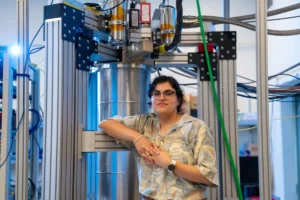
The fundamental laws of physics often appear to be in direct conflict with the observable reality of the cosmos. For decades, cosmologists and theoretical physicists have grappled with a profound paradox: the Second Law of Thermodynamics dictates that the Universe must move toward a state of maximum disorder, yet we inhabit a reality defined by exquisite structure, from the intricate spirals of galaxies to the biological complexity of the human brain. A groundbreaking theoretical study led by Professor Ginestra Bianconi, a mathematician at Queen Mary University of London, provides a sophisticated new lens through which this tension might finally be resolved. Published in the prestigious journal Physical Review D, the research investigates the "Gravity from Entropy" (GfE) framework, suggesting that the very expansion of the Universe provides the mechanism for local order to emerge even as total universal entropy continues its inexorable rise.
The Second Law of Thermodynamics is perhaps the most untouchable principle in the natural sciences. Albert Einstein famously remarked that it was the only physical theory of universal content which he was convinced would never be overthrown. In its simplest form, the law states that the total entropy of an isolated system—in this case, the entire Universe—can never decrease over time; it can only remain constant or increase. Entropy is frequently misunderstood as a simple measure of "messiness" or "disorder." In a more rigorous physical context, it represents the number of microscopic configurations that correspond to a macroscopic state, or more broadly, the distribution of energy and information within a system.
The cosmological challenge arises when we look back at the history of the Universe. Standard Big Bang cosmology suggests the early Universe began in a state of remarkably low entropy—a hot, dense, and relatively uniform "soup" of particles. According to the Second Law, the Universe should have transitioned into an increasingly homogenous and disordered state. Instead, gravity acted upon small fluctuations in density, pulling matter together to form the first stars, which grouped into galaxies, which in turn formed clusters and superclusters. Within these structures, heavy elements were forged, leading to the creation of planets and, eventually, the highly ordered systems we recognize as life. Reconciling this "cosmic climb" toward complexity with the "thermodynamic slide" toward disorder has remained one of the most significant hurdles in modern physics.
Professor Bianconi’s work addresses this by utilizing the Gravity from Entropy (GfE) theory, a burgeoning approach to quantum gravity that seeks to bridge the gap between Einstein’s General Relativity and the principles of statistical mechanics. In this framework, gravity is not merely a fundamental force or the curvature of a four-dimensional manifold; rather, it is an "emergent" phenomenon. This perspective suggests that the macroscopic gravitational interactions we observe are the result of deeper, microscopic processes involving quantum information and entropy.
The roots of this idea stretch back to the mid-1970s, a pivotal era for theoretical physics. In 1972, Jacob Bekenstein proposed that black holes possess a well-defined entropy proportional to the area of their event horizon. Shortly thereafter, in 1974, Stephen Hawking demonstrated through quantum field theory that black holes are not perfectly black but emit thermal radiation, now known as Hawking Radiation. These twin discoveries established a definitive link between the geometry of spacetime (gravity) and the laws of heat and energy (thermodynamics). Bianconi’s research extends these principles from the extreme environment of black holes to the entirety of the expanding Universe.
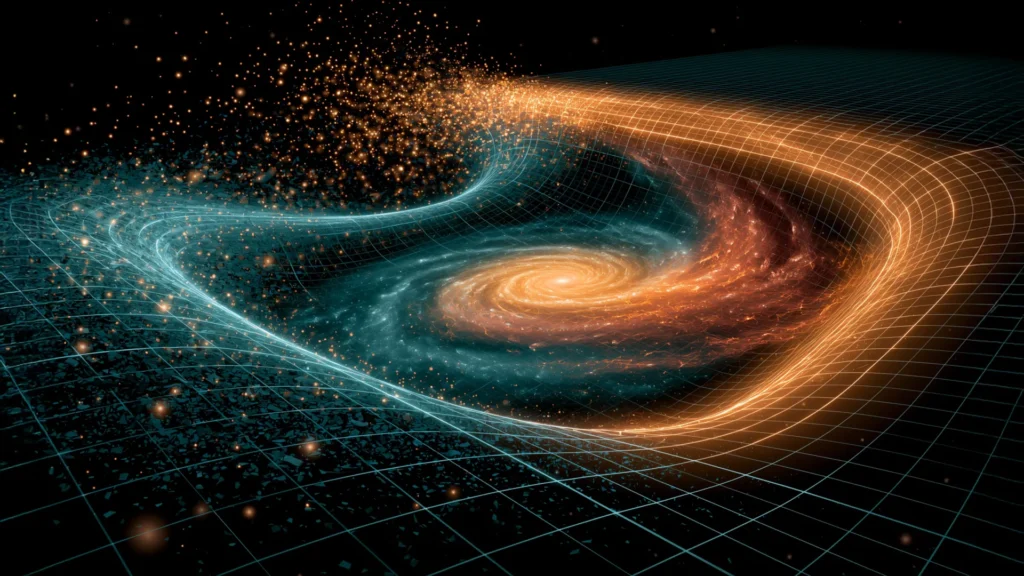
The central breakthrough of the new study lies in the distinction between "total entropy" and "entropy density." Bianconi’s mathematical analysis reveals that while the total entropy of the Universe is indeed increasing—consistent with the Second Law—the entropy per unit of volume is actually decreasing as the Universe expands. To visualize this, one might imagine a gas expanding into a vacuum. While the total disorder of the gas molecules increases as they occupy more space, the density of those molecules in any given cubic centimeter drops significantly. In the context of GfE, the expansion of the physical spacetime metric creates more "room" for entropy to be distributed.
This "dilution" of entropy density provides the theoretical space necessary for complexity to flourish. By reducing the local entropy per unit of volume (the Quantum Geometric Relative Entropy, or QGRE), the Universe allows for the formation of highly organized structures in localized regions without violating the global requirement that total entropy must rise. This effectively explains how the Universe can simultaneously become more "disordered" on a grand scale while becoming more "ordered" on a local scale.
Furthermore, the study provides a compelling new perspective on Dark Energy, the mysterious force driving the accelerated expansion of the Universe. In standard General Relativity, Dark Energy is often represented by the Cosmological Constant ($Lambda$), a static value that remains uniform throughout time and space. However, the GfE model suggests a more dynamic alternative. According to Bianconi’s equations, the "informational tension" between the actual spacetime geometry and the matter fields within it produces a dark energy contribution that evolves over time.
This dynamic dark energy is a critical feature because it offers a path toward empirical verification. Current and future space missions, such as the European Space Agency’s Euclid telescope and the Dark Energy Spectroscopic Instrument (DESI), are designed to measure the expansion history of the Universe with unprecedented precision. If the expansion rate shows variations that align with the predictions of the GfE Lagrangian, it would provide strong evidence that gravity and thermodynamics are indeed two sides of the same coin.
The mathematical backbone of Bianconi’s study utilizes Friedmann-Robertson-Walker (FRW) cosmological spacetimes. These models are the standard tool for describing a homogeneous, isotropic, expanding Universe. By applying GfE to these models, Bianconi demonstrated that the local geometric components of spacetime behave according to a version of the First Law of Thermodynamics. In this elegant formulation, the emergent dark energy acts as the system’s "internal energy," while the QGRE represents the local entropy. From this, variables such as effective temperature and pressure emerge naturally, suggesting that the vacuum of space itself has an inherent thermal character.
The implications of this research extend far beyond the realm of abstract mathematics. If the Universe’s evolution is fundamentally a thermodynamic process, it suggests that the emergence of life is not a freak accident or a violation of physical law, but a natural consequence of cosmic expansion. As the Universe expands and the local entropy density drops, the formation of complex, information-rich systems—like DNA and neural networks—becomes not just possible, but perhaps inevitable under the right conditions.
Professor Bianconi’s work represents a significant step in the quest for a "Theory of Everything." For nearly a century, physics has been divided between General Relativity, which describes the macro-world of gravity and stars, and Quantum Mechanics, which describes the micro-world of atoms and subatomic particles. These two frameworks are famously incompatible. Theories of "emergent gravity," like GfE, offer a potential bridge by suggesting that gravity is not a primary ingredient of the Universe but a secondary effect arising from quantum information and entropy.
While the Gravity from Entropy theory is still in its early stages, its ability to reconcile the Second Law of Thermodynamics with the observed complexity of the Universe provides a powerful new argument for its validity. It shifts the narrative of the Universe from one of inevitable decay and heat death to one of creative expansion, where the growth of space itself fuels the rise of complexity.
In her concluding remarks on the study, Professor Bianconi highlighted the broader potential of this framework. "This work reveals how the Gravity from Entropy theory can tackle the challenging question of reconciling the second principle of thermodynamics with the emergence of complexity in our Universe," she stated. "These results may open new avenues for investigating the long-standing problem of reconciling the foundations of cosmological irreversibility, the emergence of complex structures, and ultimately life, with fundamental gravitational dynamics."
As the scientific community digests these findings, the focus will likely shift toward the observational data needed to confirm the theory’s predictions regarding dynamic dark energy. If confirmed, the GfE framework would necessitate a fundamental rewriting of cosmology textbooks, placing information and thermodynamics at the very heart of how we understand the birth, evolution, and ultimate fate of the cosmos. The "Entropy Puzzle" that has haunted physics since the days of Boltzmann and Maxwell may finally have a solution, painted on the canvas of an ever-expanding Universe.