The shape of the universe, a concept rarely contemplated in daily life, is now at the forefront of cosmological research, with a new study suggesting it might be fundamentally asymmetric or "lopsided," meaning its properties are not uniform in every direction. This groundbreaking finding, published by a team of researchers, directly challenges the foundational assumptions of today’s "standard cosmological model," the prevailing framework that describes the dynamics, structure, and evolution of the entire cosmos. If validated, this asymmetry could necessitate a profound rethinking of our understanding of the universe, potentially ushering in a new era of theoretical physics.
The Bedrock of Cosmology: The Standard Model and its Assumptions
For decades, the standard cosmological model, often referred to as the Lambda-CDM model (Lambda for dark energy, CDM for cold dark matter), has served as the intellectual scaffolding for understanding the universe. This model rests squarely on a cornerstone principle: the universe is isotropic (looks the same in all directions) and homogeneous (looks the same in all locations) when averaged over sufficiently large scales. This dual assumption is collectively known as the Cosmological Principle, and it vastly simplifies the formidable equations of Albert Einstein’s theory of general relativity, leading to the Friedmann–Lemaître–Robertson–Walker (FLRW) metric. The FLRW description is the mathematical bedrock upon which Lambda-CDM is built, allowing cosmologists to model the universe as a simple, expanding fluid.
The success of the Lambda-CDM model has been remarkable, accurately predicting phenomena such as the existence and properties of the cosmic microwave background (CMB) radiation, the large-scale distribution of galaxies, and the abundance of light elements formed in the Big Bang. Its predictive power has cemented its status as the most widely accepted description of the universe. However, recent years have seen the emergence of several "tensions" or disagreements in astronomical data that pose significant challenges to this elegant, uniform vision of the cosmos, hinting that the universe might be more complex than previously imagined.
The Cosmic Microwave Background: A Relic of Apparent Symmetry
Central to the standard model’s success, and indeed to the Big Bang theory itself, is the cosmic microwave background (CMB). Discovered accidentally in 1964 by Arno Penzias and Robert Wilson, the CMB is the relic radiation left over from the Big Bang – the earliest light that could travel freely through space after the universe cooled sufficiently for atoms to form, approximately 380,000 years after its birth. Its detection provided powerful evidence for the Big Bang and has since been meticulously mapped by missions like COBE, WMAP, and Planck.
These observations have revealed the CMB to be remarkably uniform across the sky, varying by only about one part in a hundred thousand. This incredible uniformity has historically bolstered cosmologists’ confidence in modeling the universe using the "maximally symmetric" FLRW description. However, even within this near-perfect uniformity, subtle variations exist. The most significant of these is the CMB dipole anisotropy – a large-scale temperature difference where one side of the sky appears slightly hotter and the opposite side slightly cooler, by about one part in a thousand. This dipole is widely understood to be caused by the motion of our solar system and the Milky Way galaxy relative to the CMB itself, a phenomenon known as our "peculiar velocity." As such, this particular anisotropy is considered a local effect and does not, by itself, challenge the fundamental assumptions of the Lambda-CDM model regarding the universe’s overall structure.
Unveiling the Anomaly: The Ellis-Baldwin Test
The crucial question then arises: if our local motion causes a CMB dipole, should we observe a corresponding dipole in the distribution of matter across the sky? This is precisely the question posed by George Ellis and John Baldwin in 1984. They proposed a fundamental test: if the universe is truly isotropic on large scales as assumed by the FLRW model, then observers moving through this universe should see the same dipole in the distribution of distant astronomical sources – such as radio galaxies and quasars – as they do in the CMB. This is known as the Ellis-Baldwin test.
The rationale behind this test is critical. If our motion relative to the CMB is the sole cause of the observed CMB dipole, then as we look out into the universe, we should see distant sources appear statistically denser in the direction we are moving towards (due to relativistic beaming and Doppler shifts affecting observed flux, making sources brighter and thus more detectable) and sparser in the opposite direction. This "clustering dipole" in matter distribution should align perfectly, both in direction and magnitude, with the CMB dipole, once observational biases are accounted for. The sources chosen for this test must be extremely distant to ensure that any observed anisotropy reflects the large-scale structure of the universe rather than local clustering effects within our cosmic neighborhood.
For many years, the technological capabilities to perform such a precise test were lacking. It required vast, deep, and unbiased sky surveys of distant objects, something that has only recently become achievable with modern telescopes and satellite missions.
The Discordant Universe: Evidence Mounts
The new study, alongside previous research, reveals a startling outcome: the universe appears to fail the Ellis-Baldwin test. The variation observed in the distribution of distant matter does not match that in the CMB. Specifically, the magnitude of the dipole detected in large catalogues of radio galaxies and quasars is significantly larger than what would be predicted by our peculiar velocity alone, and in some cases, its direction also shows discrepancies. This finding is not an isolated incident; it has been corroborated by multiple independent analyses using different datasets and observational techniques.
For instance, studies employing terrestrial radio telescopes observing radio galaxies, as well as satellites observing at mid-infrared wavelengths, have yielded consistent results. The fact that the same anomaly is detected across different wavelengths and with different instruments, each with its own potential sources of error and systematic biases, lends significant credence to the robustness of the finding. This consistency suggests that the observed discord is not merely an instrumental artifact or a statistical fluke but rather a genuine feature of the cosmos.
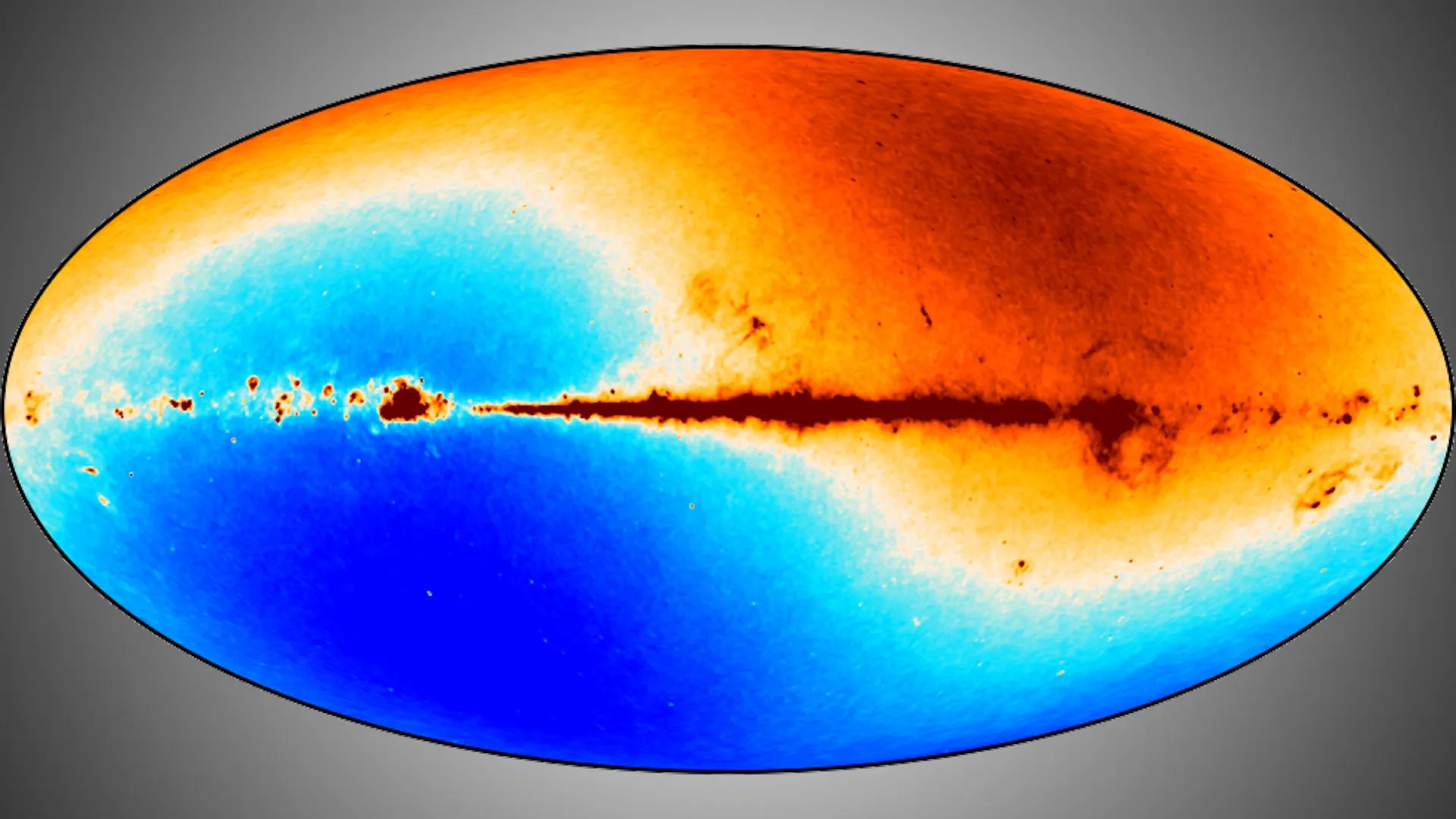
The cosmic dipole anomaly has thus established itself as a major challenge to the standard cosmological model. Unlike the CMB dipole, which is attributed to local motion, this discrepancy in the matter dipole suggests an intrinsic anisotropy in the universe itself, which directly contradicts the FLRW description and, by extension, the entire Lambda-CDM framework.
Beyond the Dipole: Other Cosmological Tensions
While the cosmic dipole anomaly is gaining prominence, it is not the only crack appearing in the facade of the standard model. Another significant discrepancy, the "Hubble tension," has received much more attention within the astronomical community. Named after Edwin Hubble, who in 1929 famously discovered that the universe is expanding, this tension refers to a persistent disagreement in the measured value of the Hubble constant (H₀), which quantifies the universe’s current expansion rate.
The Hubble tension emerged in the 2000s, primarily from different datasets. Measurements of H₀ derived from observations of the early universe – particularly from the CMB data collected by the Planck satellite – yield a value of approximately 67.4 km/s/Mpc (kilometers per second per megaparsec). In contrast, measurements from the nearby, more recent universe, using "cosmic distance ladders" built upon Type Ia supernovae calibrated with Cepheid variable stars (data from the Hubble Space Telescope and Gaia satellite), consistently point to a higher value, around 73-74 km/s/Mpc. This 8-10% difference is statistically significant and difficult to reconcile within the standard model without invoking new, unknown physics.
While the Hubble tension is a serious problem, the cosmic dipole anomaly presents an even more fundamental challenge. The Hubble tension might be resolved by introducing new particles or modifying existing components within the Lambda-CDM framework (e.g., new dark matter properties, early dark energy). However, the cosmic dipole anomaly directly questions the fundamental geometric assumptions of isotropy and homogeneity that underpin the FLRW metric itself. If the universe is indeed intrinsically lopsided, it means the very mathematical foundation upon which the Lambda-CDM model is built is flawed, requiring a much more radical theoretical overhaul than the Hubble tension.
Profound Implications: Re-evaluating Fundamental Physics
The implications of the cosmic dipole anomaly are truly profound. To abandon the FLRW description is not merely to tweak a parameter; it is to question the very structure of spacetime as we understand it on cosmological scales. The FLRW metric simplifies Einstein’s field equations enormously, making them solvable and allowing for the development of the standard model. Without these symmetries, the equations become vastly more complex, potentially requiring entirely new mathematical and computational approaches.
"Going back to square one" implies a fundamental re-evaluation of cosmological theory. It might mean exploring models where the universe is intrinsically anisotropic, perhaps expanding at different rates in different directions, or even models that are inhomogeneous on large scales without violating local observations. Such models are far more challenging to construct and test against observational data. The scientific community’s reluctance to fully embrace this anomaly might stem from the sheer difficulty of patching up such a fundamental problem; it’s not an easy fix. It necessitates not just new physics, but potentially a new paradigm for how we model the universe’s geometry and evolution.
The potential for a paradigm shift is immense, impacting not only cosmology but fundamental physics as a whole. Our understanding of gravity, dark energy, dark matter, and even the very early universe (inflation) is deeply intertwined with the assumption of an isotropic and homogeneous cosmos. A lopsided universe would force physicists to reconsider everything from the initial conditions of the Big Bang to the ultimate fate of the universe.
The Road Ahead: New Observatories and AI’s Role
Despite the challenges, the scientific journey is far from over. The coming years promise an "avalanche of data" from a new generation of sophisticated observatories, which will be instrumental in either confirming or refuting these anomalies with even greater precision.
- Euclid: The European Space Agency’s Euclid mission, launched in 2023, is designed to map the large-scale structure of the universe by observing billions of galaxies out to 10 billion light-years. Its primary goal is to probe the nature of dark energy and dark matter, but its precise measurements of galaxy distributions will be invaluable for further testing the cosmological principle and investigating any potential anisotropies.
- SPHEREx (Spectro-Photometer for the History of the Universe, Epoch of Reionization, and Ices Explorer): NASA’s SPHEREx mission, expected to launch in 2025, will conduct the first all-sky near-infrared spectral survey. It will create a 3D map of the universe, searching for the first light from the universe’s infancy, tracing the history of galaxy formation, and mapping water and organic molecules in star-forming regions. Its comprehensive sky coverage will offer unprecedented opportunities to search for large-scale anisotropies.
- Vera C. Rubin Observatory (Legacy Survey of Space and Time – LSST): Located in Chile, the Vera Rubin Observatory, with its massive 8.4-meter primary mirror, will conduct the deepest, widest-field optical survey of the night sky over ten years, starting in 2025. The LSST will map billions of galaxies, providing an unparalleled dataset for studying dark energy, dark matter, and cosmic structure, which will be critical for high-precision tests of cosmological models and the detection of subtle anisotropies.
- Square Kilometre Array (SKA): Currently under construction in Australia and South Africa, the SKA will be the world’s largest radio telescope, with an collecting area of one square kilometer. It will push the boundaries of radio astronomy, conducting the deepest surveys of neutral hydrogen across cosmic history, probing the epoch of reionization, and testing general relativity. The SKA’s sensitivity and vast survey capabilities will allow for incredibly precise measurements of large-scale structure and potential anisotropies in the radio universe.
These new observatories will provide an unprecedented wealth of data, allowing cosmologists to refine existing measurements, discover new phenomena, and rigorously test alternative cosmological models. Furthermore, the burgeoning field of artificial intelligence (AI), particularly machine learning, is expected to play a crucial role. Machine learning algorithms are exceptionally good at sifting through vast datasets, identifying subtle patterns, and detecting anomalies that might be missed by traditional analysis methods. They could help in constructing and testing new, more complex anisotropic or inhomogeneous cosmological models, simulating their predictions, and comparing them with observations.
The cosmic dipole anomaly, though largely overlooked until recently, stands as a formidable challenge to our most cherished understanding of the universe. It hints at a cosmos far more intricate and less symmetrical than we have presumed. The potential for a fundamental re-evaluation of cosmic principles, driven by new data and advanced analytical techniques, signifies an exhilarating era for cosmology and fundamental physics. The journey to comprehend the true nature of our universe may very well be just beginning, promising insights that could revolutionize our place within the cosmos.