The rapid advancement of generative artificial intelligence (genAI) has ushered in an era of unprecedented creative potential, allowing for the rapid generation of intricate and imaginative 3D designs. However, a persistent challenge has been translating these digital blueprints into tangible objects that can withstand the rigors of everyday use. Designs that appear visually stunning on a screen often prove to be structurally unsound or impractical when fabricated in the physical world. This disconnect stems from a fundamental limitation of many genAI models: a lack of inherent understanding of physics. While tools like Microsoft’s TRELLIS system can produce detailed 3D models from simple text prompts or images, the resulting designs, such as a chair, might lack stability or have disconnected components. The AI, not fully grasping the intended function of an object, can inadvertently create designs that, while aesthetically pleasing, would fail under practical application—a 3D-printed chair, for instance, might collapse under the weight of a person.
Addressing this critical gap, researchers at the Massachusetts Institute of Technology’s Computer Science and Artificial Intelligence Laboratory (CSAIL) have developed a groundbreaking system named "PhysiOpt." This innovative platform augments existing generative AI tools by integrating sophisticated physics simulations. The goal is to imbue AI-generated designs with the necessary structural integrity to ensure they function as intended when brought to life through 3D printing. PhysiOpt acts as a virtual reality check, rigorously testing the viability of 3D model structures. It achieves this by making subtle modifications to smaller geometric elements while meticulously preserving the overall aesthetic appeal and functional purpose of the original design.
The Genesis of PhysiOpt: A Need for Practical AI Design
The development of PhysiOpt arises from a growing demand for AI tools that can not only generate novel designs but also ensure their real-world applicability. Traditional design workflows often involve iterative cycles of creation, prototyping, testing, and refinement. For 3D printing and other fabrication methods, this process can be time-consuming and resource-intensive. GenAI promised to accelerate this by automating the initial design phase, but the lack of physical understanding created a bottleneck. Users were presented with visually appealing concepts that were often unusable, leading to frustration and limiting the practical adoption of AI in product design and personal customization.
The CSAIL team recognized this limitation and sought to create a system that could bridge the divide between AI-driven creativity and engineering practicality. Their research focused on leveraging the strengths of both generative models and physics-based simulations. By combining these two powerful technologies, they aimed to empower individuals to create unique, functional objects without requiring extensive expertise in engineering or computer-aided design (CAD).
How PhysiOpt Works: A Seamless Integration of AI and Physics
PhysiOpt’s user interface is designed for intuitive operation, allowing individuals to either describe their desired object and its intended use through text input or upload an existing image as a reference. The system then swiftly processes this information, typically delivering a realistic and manufacturable 3D object within approximately 30 seconds. A compelling demonstration of PhysiOpt’s capability involved a prompt to generate a "flamingo-shaped glass for drinking." The resulting design, a drinking glass featuring a handle and base cleverly sculpted to resemble a flamingo’s legs, was not only visually striking but also structurally sound, thanks to PhysiOpt’s subtle design refinements during the generation process.
"PhysiOpt combines GenAI and physically-based shape optimization, helping virtually anyone generate the designs they want for unique accessories and decorations," explains Xiao Sean Zhan, an MIT electrical engineering and computer science (EECS) PhD student and CSAIL researcher, and a co-lead author on the paper presenting the work. "It’s an automatic system that allows you to make the shape physically manufacturable, given some constraints. PhysiOpt can iterate on its creations as often as you’d like, without any extra training." This "training-free" aspect is a significant advantage, as it means the system can adapt to new design requests and constraints without requiring extensive and time-consuming retraining of the underlying AI models.
Enabling "Smart Designs" for Everyday Objects
The core innovation of PhysiOpt lies in its ability to facilitate "smart designs." In this paradigm, the AI generator not only crafts an item based on user specifications but also actively considers its functional requirements. Users can integrate their preferred 3D generative AI models with PhysiOpt. After articulating their design idea, they can specify critical parameters such as the expected load or weight the object should withstand. This allows for realistic simulation of real-world usage scenarios, such as determining if a coat hook will be robust enough to support the weight of a heavy coat. Furthermore, users can define the materials intended for fabrication (e.g., plastics, wood) and the object’s support conditions. For instance, a cup is designed to stand on a flat surface, whereas a bookend relies on leaning against a collection of books for stability.
Once these parameters are set, PhysiOpt initiates an iterative optimization process. At its heart, the system employs a sophisticated physics simulation technique known as "finite element analysis" (FEA). This comprehensive stress-testing method dissects the 3D model into a multitude of small elements, allowing for a detailed analysis of how forces are distributed throughout the structure. The output of the FEA is often visualized as a heatmap overlaid on the 3D model, clearly indicating areas of potential weakness or stress concentration. For example, if PhysiOpt were tasked with designing a birdhouse, the heatmap might reveal that the support beams beneath the main structure are colored bright red, signifying that these areas require reinforcement to prevent structural failure. This detailed analysis allows the system to pinpoint exactly where and how to adjust the design to ensure durability.
Beyond Basic Functionality: Embracing Complex Aesthetics
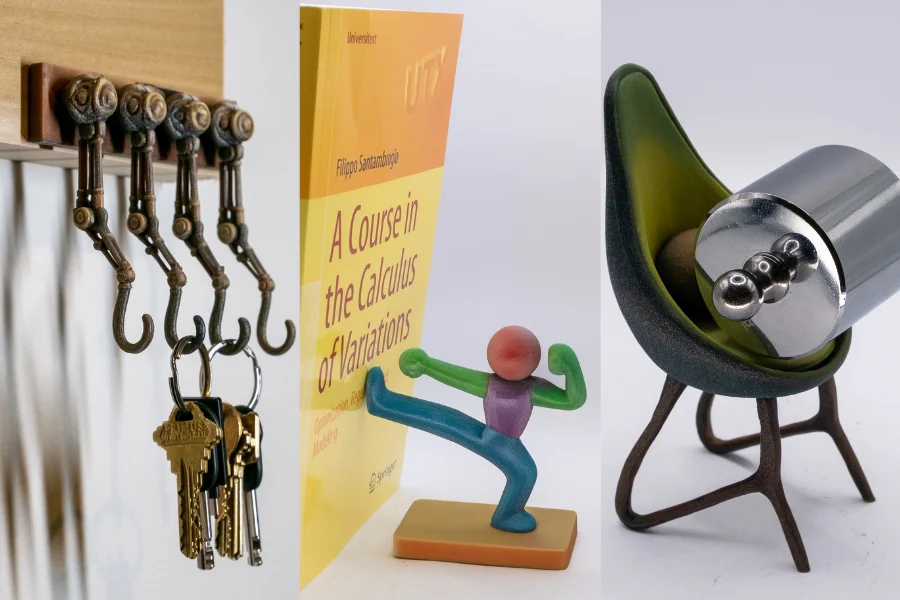
PhysiOpt’s capabilities extend beyond simple functional objects, enabling the creation of more complex and aesthetically daring pieces. The researchers demonstrated this versatility through the fabrication of a steampunk-inspired keyholder, characterized by intricate, robotic-like hooks, and a unique "giraffe table." The latter features a flat back designed for placing items, with the giraffe’s form ingeniously integrated into its structure. The question then arises: how does PhysiOpt understand and incorporate complex stylistic elements like "steampunk" or devise the unique structural solutions for furniture like the giraffe table?
The answer lies not in extensive, task-specific training by the researchers, but in the utilization of a pre-trained foundational model. These models have already been exposed to vast datasets encompassing thousands of diverse shapes and objects, imbuing them with a generalized understanding of form and structure. "Existing systems often need lots of additional training to have a semantic understanding of what you want to see," notes co-lead author Clément Jambon, also an MIT EECS PhD student and CSAIL researcher. "But we use a model with that feel for what you want to create already baked in, so PhysiOpt is training-free." This pre-existing knowledge, often referred to as "shape priors," allows PhysiOpt to leverage learned patterns of how shapes typically appear and function, enabling it to generate designs that align with user intent and stylistic requirements without requiring explicit instruction for every nuance. It’s akin to an artist who has studied numerous artistic styles and can then replicate a particular aesthetic with proficiency.
Efficiency and Realism: A Comparative Advantage
By relying on a pre-trained model, PhysiOpt benefits from its inherent understanding of shapes. This "visual know-how" contributes to more efficient 3D model generation compared to other comparable methods. In comparative tests conducted by CSAIL researchers, PhysiOpt was tasked with generating 3D designs for items such as chairs, alongside a method known as DiffIPC, which also involves simulation and shape optimization. The results indicated that PhysiOpt was nearly 10 times faster per iteration while simultaneously producing more realistic and refined objects. This significant improvement in efficiency is crucial for making generative design processes more accessible and practical for a wider range of users and applications. The speed advantage allows for quicker design exploration and iteration, accelerating the path from concept to physical product.
The Future of Design: Towards Autonomous and Intelligent Fabrication
PhysiOpt represents a significant step towards bridging the gap between abstract ideas and tangible, functional personal items. The concept of an idea for a coffee mug, for instance, can now more readily transition from a digital representation on a computer screen to a physical object on a desk. While PhysiOpt currently requires users to specify constraints like loads and boundaries, the researchers envision future iterations that could autonomously predict these parameters. This could be achieved by integrating vision-language models, which combine an understanding of human language with computer vision capabilities, allowing the AI to infer functional requirements from context and visual cues.
Furthermore, Zhan and Jambon are committed to refining PhysiOpt’s capabilities. They aim to eliminate artifacts—unwanted random fragments that can occasionally appear in 3D models—by making the system even more attuned to physical principles. The MIT scientists are also exploring ways to model more complex constraints relevant to various fabrication techniques. For example, for 3D printing, minimizing overhanging components is crucial for successful printing, and PhysiOpt could be trained to account for this proactively.
The research paper detailing PhysiOpt’s development was authored by Zhan, Jambon, Kenney Ng (MIT-IBM Watson AI Lab Principal Research Scientist), Evan Thompson (undergraduate researcher at CSAIL), and Mina Konaković Luković (Assistant Professor at CSAIL and principal investigator at the lab). The work received partial support from the MIT-IBM Watson AI Laboratory and Wistron Corp. It was presented in December at the Association for Computing Machinery’s SIGGRAPH Conference and Exhibition on Computer Graphics and Interactive Techniques in Asia, a premier venue for showcasing advancements in computer graphics and interactive technologies.
Broader Implications and the Democratization of Design
The development of PhysiOpt has far-reaching implications for various industries and individuals. For consumers, it opens up a world of personalized product design, allowing for the creation of unique decor, accessories, and functional household items tailored to specific needs and aesthetic preferences. Small businesses and independent designers can leverage PhysiOpt to rapidly prototype and produce custom goods, potentially reducing manufacturing costs and lead times. In educational settings, it offers an accessible tool for students to learn about design principles, physics, and AI, fostering innovation and creativity.
The move towards more autonomous design systems also suggests a future where sophisticated engineering and design capabilities are democratized. Individuals without specialized training in engineering or CAD software could soon be empowered to design and create complex, functional objects. This democratization of design has the potential to spur innovation across a wide range of fields, from consumer electronics to assistive technologies. As AI systems become more adept at understanding and applying physical principles, the boundary between imagination and tangible reality will continue to blur, ushering in a new era of accessible and intelligent creation. The ongoing research into making AI systems more physics-aware and capable of inferring complex constraints promises to further revolutionize how we design and manufacture the objects that shape our daily lives.