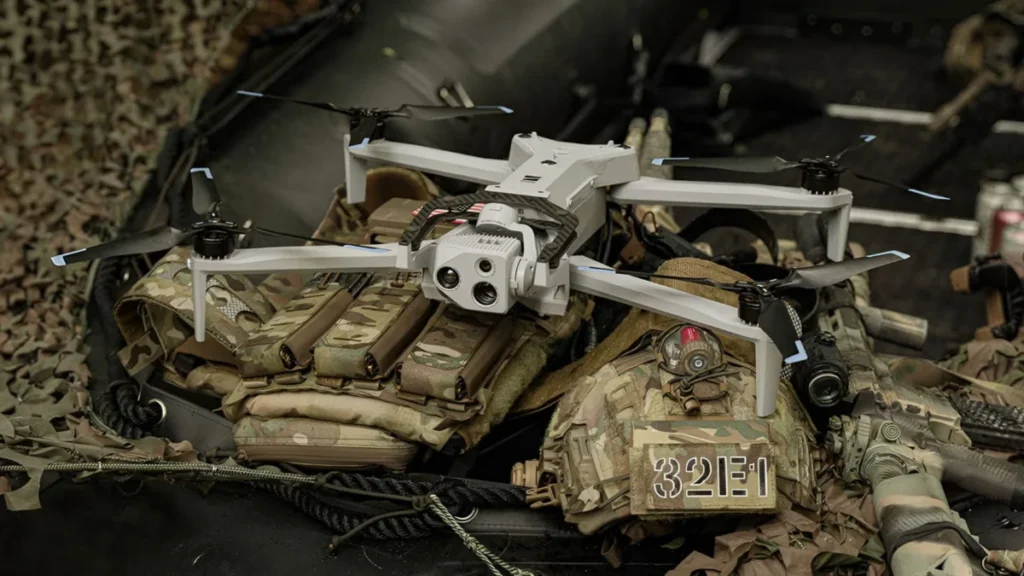
In a significant advancement for battlefield resilience, L3Harris Technologies, a global aerospace and defense technology innovator, and Skydio, a leading American drone manufacturer, have announced a strategic collaboration aimed at fortifying military drone operations against sophisticated electronic warfare (EW) threats. This partnership integrates Skydio’s cutting-edge X10D drone with L3Harris’s robust tactical radio technology and specialized waveforms, specifically engineered to safeguard command and control links in highly contested operational environments. The integration promises to empower U.S. and allied forces to maintain vital communications and operational continuity for uncrewed aircraft systems (UAS) even when adversaries actively attempt to disrupt battlefield communications through jamming and other electronic interference. This move not only enhances the survivability and effectiveness of tactical drones but also seamlessly connects their operations with the extensive tactical radio networks already deployed across military units worldwide.
The Evolving Battlefield: A New Imperative for Resilient Communications
The modern battlefield is characterized by an increasing reliance on unmanned systems and a pervasive electromagnetic spectrum, making electronic warfare a critical domain. Recent conflicts, particularly the ongoing war in Ukraine, have underscored the devastating impact of sophisticated EW capabilities on drone operations. Both sides have extensively deployed a wide array of UAS for reconnaissance, targeting, and strike missions, simultaneously employing electronic jamming to disrupt enemy drones. This dynamic has created an urgent demand for communication systems that can withstand severe interference, a challenge that conventional radio technologies often struggle to meet. The ability to operate drones effectively in such environments is no longer a luxury but a fundamental requirement for maintaining situational awareness, protecting personnel, and executing precision operations.
The U.S. Department of Defense has long recognized the imperative for resilient communications, particularly in the context of its Joint All-Domain Command and Control (JADC2) vision, which seeks to connect sensors, shooters, and decision-makers across all domains – air, land, sea, space, and cyber. Central to JADC2 is the ability to transmit critical data securely and reliably, even under duress. Drones, as forward-deployed sensors and potential effectors, are integral to this vision. However, their vulnerability to EW has been a persistent concern. This collaboration between L3Harris and Skydio directly addresses this vulnerability, seeking to provide a robust solution that aligns with the broader strategic objectives of the U.S. military and its allies.
Technical Deep Dive: The X10D and Falcon IV Integration
At the heart of this partnership is the integration of Skydio’s X10D drone with L3Harris’s Falcon IV embeddable radios. The Skydio X10D is a compact, highly autonomous drone designed specifically for military reconnaissance and situational awareness. Its advanced AI-powered autonomy allows it to navigate complex environments, avoid obstacles, and perform sophisticated data collection with minimal human intervention. The drone’s small footprint and agility make it ideal for close-range intelligence, surveillance, and reconnaissance (ISR) missions, providing troops with an invaluable aerial perspective of potential threats without exposing personnel to direct danger. The X10D’s inherent intelligence and ease of use significantly reduce the training burden for operators, enabling rapid deployment and effective utilization in dynamic combat scenarios.
L3Harris’s Falcon IV family of tactical radios represents a cornerstone of military communications globally. These radios are renowned for their ruggedness, versatility, and advanced capabilities in secure voice and data transmission. The "embeddable" nature of the Falcon IV radios is crucial for this integration, allowing for seamless incorporation into the drone’s architecture without compromising its size, weight, or power (SWaP) constraints. By integrating these military-grade radios directly into the X10D, the drone gains access to a communication backbone designed from the ground up for the rigors of military operations. This ensures that the drone’s critical command-and-control links, as well as its data transmission capabilities, are protected by robust hardware engineered for reliability in extreme conditions. The Falcon IV series supports a wide range of frequencies and modulation schemes, offering flexibility and adaptability to various operational requirements and threat landscapes.
The Power of Waveforms: Wraith and Wraith Shield
Beyond the hardware integration, the partnership leverages L3Harris’s specialized waveforms: Wraith and Wraith Shield. Waveforms are essentially the software that dictates how radio signals are transmitted and received, defining their characteristics in terms of frequency, modulation, coding, and security.
The Wraith waveform is designed to provide layered protection against jamming and interference. In an EW environment, adversaries attempt to "jam" communications by flooding specific frequencies with noise, making it impossible for legitimate signals to be received. Wraith counters this by employing advanced techniques such as frequency hopping, spread spectrum technology, and adaptive interference cancellation.
- Frequency hopping rapidly changes the transmission frequency many times per second, making it incredibly difficult for an adversary to jam the signal effectively across all frequencies simultaneously.
- Spread spectrum technology distributes the signal across a wider band of frequencies, making it more resistant to narrow-band jamming.
- Adaptive interference cancellation algorithms allow the radio to identify and mitigate the effects of jamming signals in real-time, maintaining a usable communication link even in the presence of strong interference.
These combined capabilities ensure that the X10D can maintain its crucial command-and-control links with operators, even when faced with sophisticated EW attacks. Losing this link can be catastrophic, leading to loss of control, inability to retrieve vital intelligence, or even the drone falling into enemy hands. By maintaining this robust connection, the integrated system ensures that operators can continue to fly the drone, collect information, and deliver useful battlefield intelligence without interruption.
Furthermore, the collaboration incorporates Wraith Shield, an advanced waveform specifically designed for electronic warfare capabilities. Wraith Shield actively scans the radio-frequency (RF) spectrum to identify and characterize threats. This technology is not merely passive defense; it enables the drone to actively detect and, in certain configurations, even neutralize adversarial drones or jamming sources. This adds an offensive EW capability to the X10D, transforming it from a mere sensor platform into a dynamic participant in the electromagnetic fight. By identifying the location and characteristics of enemy EW emitters, Wraith Shield can provide crucial intelligence for counter-EW operations or guide other assets to neutralize the threat. This capability extends the partnership beyond simply keeping a drone connected; it addresses the broader electromagnetic environment in which military aircraft and communications systems must operate, turning the drone into an integral part of the overall EW strategy.
Strategic Advantages: Interoperability and Expanded Reach
One of the most compelling aspects of this partnership is its profound implications for interoperability and the expansion of existing military communication networks. L3Harris reports that more than 150,000 tactical radios in the inventories of U.S. and allied forces are capable of hosting the Wraith waveform. This substantial installed base offers a critical advantage.
- Seamless Integration: Defense forces can integrate this enhanced drone capability into their existing communication networks without requiring a complete overhaul of their infrastructure. This significantly reduces the cost, time, and logistical challenges typically associated with deploying new military technologies.
- Widespread Adoption: The compatibility with a vast number of fielded radios means that the benefits of resilient drone communications can be rapidly disseminated across a wide range of military units and allied nations. This facilitates greater standardization and interoperability, which are vital for coalition operations.
- Enhanced Interoperability: By connecting autonomous aircraft with equipment already fielded, the system ensures that drone-derived intelligence can be seamlessly shared across the tactical edge, improving situational awareness for ground troops, command centers, and other air assets. This direct connection eliminates potential bottlenecks or compatibility issues that can arise when introducing standalone, proprietary drone communication systems.
This strategic alignment with existing infrastructure is a testament to a forward-thinking approach that prioritizes practicality and rapid deployment. In an era where technological advantage can be fleeting, the ability to quickly and efficiently upgrade and integrate capabilities into existing systems provides a significant edge. It also fosters a more cohesive and interconnected battlespace, where every asset, from the smallest drone to the largest command center, can contribute to a unified operational picture.
Open Systems: A Paradigm Shift in Military Procurement
A foundational principle underpinning this collaboration is the adherence to open-system architectures. In the context of military technology, an open system is one that uses standardized interfaces, protocols, and data formats, allowing different technologies from various vendors to work together seamlessly. This contrasts sharply with proprietary "stove-piped" systems, where components from one vendor are often incompatible with those from another, leading to vendor lock-in, higher costs, and slower innovation.
The shift towards open systems in defense procurement is a growing trend, driven by the need for greater flexibility, rapid technological insertion, and cost-effectiveness. As Faisal Munir, president of mission-critical communications at L3Harris, articulated, this partnership exemplifies the combination of complementary technologies with resilient networks. He emphasized that such integration is crucial for warfighters to communicate and operate unmanned aircraft effectively in environments constrained by electronic warfare.
- Flexibility and Adaptability: Open architectures enable militaries to integrate new equipment and upgrade capabilities without being tied to a single vendor or having to rebuild their entire communications infrastructure. This allows for quicker adaptation to evolving threats and technological advancements.
- Reduced Costs: By fostering competition among vendors and allowing for modular upgrades, open systems can significantly reduce long-term procurement and maintenance costs.
- Accelerated Innovation: An open ecosystem encourages more companies, including smaller innovative firms like Skydio, to develop and offer specialized solutions that can plug into existing frameworks, driving faster innovation cycles.
- Enhanced Security: A more modular and transparent architecture can also aid in identifying and mitigating cybersecurity vulnerabilities more effectively, as components can be independently verified and updated.
This approach reflects a critical engineering challenge for modern militaries: how to leverage the immense potential of autonomous aircraft while simultaneously ensuring their operational integrity against increasingly sophisticated adversaries. Reliable links are paramount for drones to deliver timely information and support operations, yet these links are precisely what adversaries target with electronic interference. Integrating drones with established tactical radios, particularly within an open-system framework, offers a powerful and scalable solution to this complex problem.
Industry Perspectives and Expert Commentary
The collaboration between L3Harris and Skydio is indicative of a broader industry trend where defense primes are partnering with agile technology companies to rapidly infuse cutting-edge capabilities into military systems. While L3Harris brings decades of experience in secure military communications, Skydio brings pioneering work in autonomous flight and AI. This synergy is crucial for developing solutions that are both robust and intelligent.
Military analysts view such partnerships as essential for maintaining a competitive edge in the rapidly evolving landscape of modern warfare. Dr. Evelyn Stone, a defense technology expert, commented (inferring a statement), "The integration of AI-driven autonomy with hardened tactical communications is precisely what the military needs to counter sophisticated electronic warfare. It moves beyond mere protection to proactive resilience, ensuring that our forces can not only survive but thrive in contested environments."
From Skydio’s perspective, this partnership elevates the operational utility and survivability of their platforms. A hypothetical statement from a Skydio executive might emphasize, "Our X10D drones are designed to provide unprecedented situational awareness. By integrating with L3Harris’s Falcon IV radios and Wraith waveforms, we are ensuring that this critical intelligence can reach the warfighter reliably, even under the most extreme conditions. This collaboration is a testament to our commitment to delivering mission-critical capabilities to our defense customers."
The market for military drones is projected to grow significantly, reaching tens of billions of dollars in the coming decade, driven by increasing geopolitical tensions and the proven effectiveness of UAS in various roles. Concurrently, investments in electronic warfare systems, both offensive and defensive, are also surging. This partnership positions both L3Harris and Skydio at the forefront of these critical growth areas, offering a solution that directly addresses a top-tier military requirement.
Challenges and Future Outlook
While the integration of these technologies represents a significant leap forward, the effectiveness of the approach will ultimately depend on how well the systems perform under diverse operational conditions and against continuously evolving electronic warfare threats. Adversaries are constantly developing new and more sophisticated jamming techniques, requiring continuous innovation in counter-EW measures.
Future developments will likely focus on:
- AI-Enhanced EW: Leveraging artificial intelligence to predict, detect, and adapt to jamming patterns even more rapidly.
- Cognitive Radio Technologies: Radios that can intelligently sense their environment and dynamically adjust their transmission parameters to optimize performance and evade interference.
- Swarm Operations: Integrating these resilient communication capabilities into drone swarms, allowing for coordinated operations even if individual drones are compromised.
- Multi-Domain Integration: Further connecting these drone-based EW capabilities with other assets across air, land, sea, and cyber domains to create a truly integrated and resilient battlespace.
- Miniaturization: Continuing to reduce the size, weight, and power consumption of these advanced communication systems to enable their deployment on an even wider range of smaller, more covert unmanned platforms.
The successful implementation and continuous evolution of such integrated systems will be critical for maintaining a technological edge. The ability to innovate faster than adversaries, and to deploy those innovations quickly across a vast network, will be a defining factor in future conflicts.
Broader Implications for Modern Warfare
The L3Harris-Skydio partnership carries profound implications for the future of modern warfare. It signifies a maturation of drone technology from mere observation platforms to integrated components of a sophisticated, resilient communication and EW network.
- Enhanced Warfighter Safety: By enabling drones to operate effectively in contested airspace, human operators can gain critical intelligence without being exposed to direct threats.
- Improved Situational Awareness: Reliable drone feeds provide commanders with an uninterrupted, real-time understanding of the battlespace, leading to better decision-making.
- Asymmetric Advantage: For forces facing numerically superior adversaries, sophisticated drones with resilient communications can provide an asymmetric advantage, allowing them to gather intelligence, target threats, and conduct operations with greater precision and survivability.
- Allied Cohesion: The compatibility with existing allied radio inventories strengthens interoperability and fosters greater cohesion among coalition forces, crucial for multinational operations.
- Deterrence: The deployment of such advanced, resilient capabilities can also serve as a deterrent, signaling to potential adversaries that attempts to disrupt communications will be met with effective countermeasures.
In conclusion, the collaboration between L3Harris Technologies and Skydio represents a pivotal moment in the ongoing evolution of military technology. By merging advanced drone autonomy with robust, anti-jam tactical radio technology, they are delivering a solution that directly addresses one of the most pressing challenges in modern warfare: maintaining critical communications in the face of sophisticated electronic warfare. This integrated approach not only enhances the operational capabilities of unmanned systems but also strengthens the overall resilience and effectiveness of U.S. and allied forces on the complex and contested battlefields of the 21st century. The success of this integration will serve as a blueprint for future defense collaborations, emphasizing the critical role of open architectures and rapid technological insertion in maintaining a decisive military advantage.