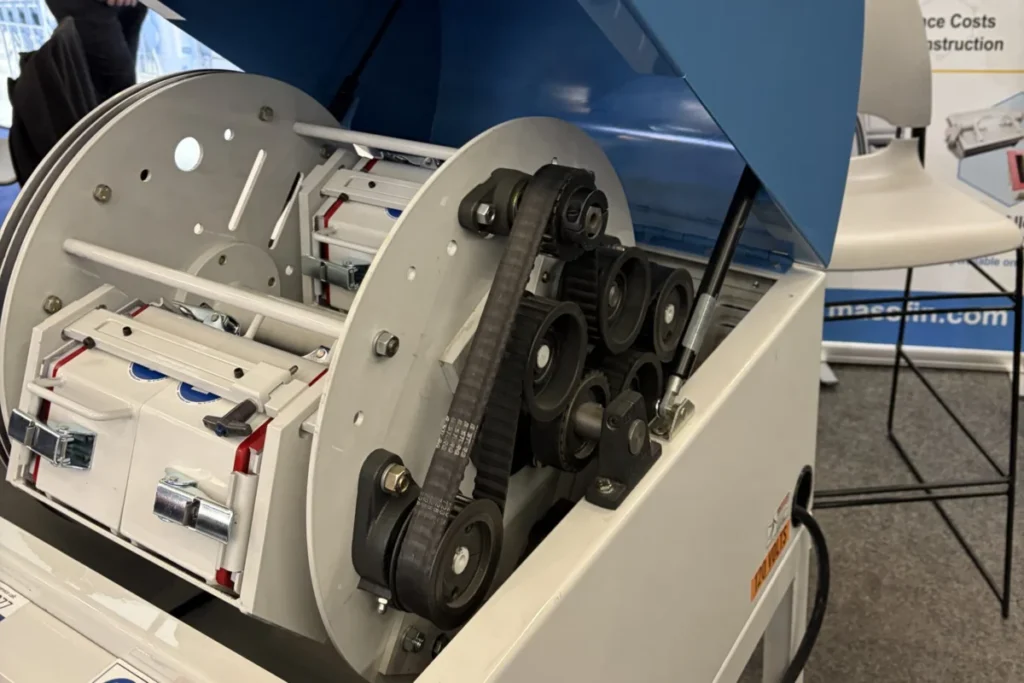
The increasing demand for compact and efficient finishing equipment for additively manufactured (AM) components has prompted Mass Finishing Inc. (MFI), a specialist in industrial parts polishing and deburring machines, to introduce its new HZ-6 centrifugal barrel tumbler finishing machine. This innovative system, designed with a 6-liter capacity and a remarkably small 3×2 foot footprint, is engineered to provide rapid, high-quality surface finishes for a variety of AM parts. Its integrated wheel system enhances maneuverability, allowing it to be easily relocated within a workshop or stored away when not in use, addressing the space constraints often faced in modern manufacturing environments.
The HZ-6 is a sophisticated two-barrel system featuring two distinct cradle positions, enabling the simultaneous finishing of multiple small, micro-precision 3D printed parts. This dual-barrel configuration offers significant flexibility. It includes one standard full-size latched-end barrel, measuring 8.375 inches in length, and two half-size latched-end barrels, each 3.625 inches in length. The inclusion of half-size barrels is particularly advantageous for iterative testing processes that require only small amounts of media, thereby reducing material costs and waste. These smaller barrels are adept at processing delicate, micro-precision parts, while the full-size barrel can accommodate components up to 8 inches long and with an outside diameter of 4.5 inches. MFI highlights that the HZ-6 operates with significantly reduced noise levels compared to many vibratory tumbling systems. It leverages centrifugal force to efficiently remove excess material and burrs, polish surfaces, and achieve a superior finish on parts.
The Criticality of Surface Finishing in Additive Manufacturing
The successful integration of 3D printed metal parts into critical applications hinges on overcoming the inherent challenge of surface roughness. Additive manufacturing processes, such as Laser Powder Bed Fusion (LPBF), while enabling the creation of intricate and large metal components, often leave behind a surface characterized by layered imperfections from the melted powder. Achieving a smooth, uniform surface finish is not merely an aesthetic consideration; it is paramount for the optimal performance and reliability of components across demanding sectors like aerospace, energy, and the medical industry.
In the medical field, for instance, 3D printed implants and devices, such as bone scaffolds and vascular stents, require a consistent and high-quality surface finish. This uniformity is crucial for biocompatibility, particularly in promoting osseointegration – the process by which bone tissue grows into and bonds with an implanted medical device. Any surface irregularities could impede this vital biological process, potentially leading to implant failure or patient complications. Similarly, in aerospace, smooth surfaces reduce aerodynamic drag and improve fatigue life, while in the energy sector, they can enhance efficiency and prevent premature wear in critical components.
The Advantages of Centrifugal Barrel Finishing
Centrifugal barrel finishing, often referred to as centrifugal barrel tumbling, represents a significant advancement over more traditional AM post-processing methods like vibratory finishing. This high-energy technique operates on a principle akin to a "Ferris wheel." The machine’s barrels rotate at a 1:1 ratio with the turret, generating substantial centrifugal force. This force creates a powerful sliding action of the media, water, compound, and components within the barrels. The process involves loading one or all of the machine’s chambers to an estimated 50-80% capacity.
The intense pressure and friction generated by this centrifugal action are highly effective in rapidly removing excess material, eliminating burrs, and polishing component surfaces. A key benefit of this method is its ability to produce isotropic finishes, meaning the parts are polished uniformly and evenly in all directions. This level of consistency is difficult to achieve with many other post-processing techniques.
MFI emphasizes that this high-energy process translates directly into substantial time savings. While vibratory finishing might require 10 to 20 hours to achieve a desired smooth surface on a metal AM component, the HZ-6 system can accomplish similar results in as little as one hour, and crucially, it can process multiple parts simultaneously. The HZ-6 is also versatile in its media compatibility, accommodating a wide range of abrasive media, including heavy ceramic, porcelain, and plastic media in various shapes and sizes. This allows for tailored finishing solutions for both harder and softer metal materials commonly used in additive manufacturing.
The HZ-6 system is specifically designed to handle 3D printed components fabricated from a range of materials, including titanium, copper, nitinol, and carbon steel. These materials are frequently employed in high-performance applications where surface integrity is critical.

A Timeline of Surface Finishing Evolution in AM
The journey to achieving high-quality surface finishes on 3D printed parts has been an evolving one. Initially, the focus was on simply removing excess material and support structures. As the capabilities of AM grew, so did the understanding of the critical role of post-processing.
- Early AM (Late 20th Century – Early 2000s): Focus on basic support removal and coarse deburring, often using manual methods or simple tumbling. Surface finish was a secondary concern.
- Growth of Metal AM (2000s – 2010s): With the advent of more sophisticated metal AM technologies like SLM and EBM, the challenges of surface roughness became more apparent. Vibratory finishing and media blasting became standard first steps for many parts.
- Increased Application Demands (2010s – Present): As AM parts moved into more critical and regulated industries (aerospace, medical), the demand for superior surface finishes, including internal channel smoothing and biocompatibility, intensified. This led to the exploration and refinement of more advanced techniques like Abrasive Flow Machining, chemical polishing, and laser polishing.
- Recent Developments (Late 2010s – Present): The rise of compact, automated, and high-throughput finishing solutions like MFI’s HZ-6 reflects the industry’s need for efficient and scalable post-processing that can keep pace with the growing output of 3D printers.
Exploring Diverse Surface Finishing Methodologies for AM Parts
Parts emerging from 3D printers frequently present a series of surface imperfections that necessitate further treatment. These can include visible layer lines, residual unfused powder, marks left by support structures, and internal roughness that can compromise performance and even lead to premature failure. It is important to recognize that there is no singular "AM finishing" process; the optimal sequence of treatments is dictated by a complex interplay of factors, including the material composition, the intricacy of the part’s geometry (particularly internal features), the target surface roughness, and the specific end-use requirements of the component. Below is an overview of prevalent post-processing and finishing techniques employed in additive manufacturing today:
Media Blasting (Bead, Sand, or Soda)
This technique serves as a foundational step for numerous metal and polymer AM parts. By directing pressurized media against the part’s surface, it effectively strips away loose powder, smooths minor surface defects, and imparts a uniform matte finish. Its speed and cost-effectiveness make it an attractive initial treatment.
Tumbling and Vibratory Finishing
In these processes, parts are placed in a bowl or barrel alongside abrasive media. Through prolonged agitation, typically spanning hours or even days, this method is well-suited for batch processing of small to medium-sized parts and is particularly effective for breaking sharp edges.
Chemical and Electrochemical Polishing
These methods involve immersing parts in specialized chemical solutions that selectively dissolve the elevated peaks of the surface, while leaving the valleys relatively intact. This approach is advantageous for treating both external and internal surfaces, making it ideal for complex geometries such as lattice structures, conformal cooling channels, and intricate medical implants.
Abrasive Flow Machining (AFM)
AFM utilizes a viscous, putty-like abrasive material that is pumped back and forth through the internal passages of a part under significant pressure. This method is widely adopted for smoothing critical internal features in components like AM fuel nozzles, manifolds, and hydraulic blocks, where conventional machining is challenging or impossible.
CNC Machining
While additive manufacturing excels at creating complex geometries, CNC machining remains indispensable for achieving precise tolerances and superior surface finishes on critical mating surfaces, bearing journals, sealing faces, and other high-precision features. The increasing prevalence of hybrid manufacturing machines, which integrate additive processes like Directed Energy Deposition (DED) or LPBF with traditional milling in a single setup, further underscores the complementary nature of these technologies.
Manual Grinding, Sanding, and Polishing
For large structural components, prototypes, and the meticulous removal of support witness marks, manual finishing techniques remain crucial. Despite the advancements in automated processes, hand finishing continues to be a significant cost driver in many low-volume metal AM workflows, requiring skilled labor and considerable time.
Laser Polishing
This advanced technique employs a defocused laser beam to remelt a thin surface layer of the material. Surface tension then acts to smooth out microscopic irregularities. Laser polishing offers the advantage of being consumable-free and eliminates the need for cleaning media from internal features. Its precise controllability makes it a suitable option for small, high-value parts, particularly in the dental and aerospace sectors.

Coatings and Plating
Following mechanical preparation, AM parts can be enhanced with various coatings and platings, including anodizing, Physical Vapor Deposition (PVD), electroless nickel, and powder coating. These surface treatments can mask minor surface defects, impart enhanced wear or corrosion resistance, and provide a uniform cosmetic appearance, thereby extending the functional lifespan and aesthetic appeal of the components.
Vapor Smoothing
This automated process involves submerging 3D printed parts in a solvent within an airtight vessel. The vessel is then heated, generating a vapor that uniformly smooths and polishes the part’s surface over several hours. Automated systems are popular for their efficiency and consistency, although the process can also be performed using sealed containers.
Broader Implications and Market Impact
The introduction of MFI’s HZ-6 centrifugal barrel tumbler finishing machine signifies a strategic response to the evolving landscape of additive manufacturing. As AM technologies mature and their adoption expands across diverse industries, the demand for efficient, scalable, and high-quality post-processing solutions will only intensify. The HZ-6, with its compact design, rapid processing times, and ability to handle multiple parts simultaneously, is well-positioned to address these critical needs.
The company’s focus on compact finishing options directly caters to the trend towards smaller, more agile manufacturing setups and the increasing decentralization of production. By offering a solution that is both effective and space-saving, MFI is enabling manufacturers, particularly those in specialized sectors like medical device production or aerospace component manufacturing, to integrate advanced finishing capabilities into their existing workflows without requiring substantial infrastructure investments.
The emphasis on faster turnaround times is also crucial. In industries where rapid prototyping and quick production cycles are essential, reducing post-processing time from potentially days to hours can be a significant competitive advantage. This acceleration not only speeds up the delivery of finished parts but also allows for more iterations during the design and development phases, fostering innovation.
Furthermore, MFI’s commitment to developing machines that offer quieter operation compared to traditional vibratory systems addresses a common concern in manufacturing environments, contributing to improved workplace conditions. The versatility in media compatibility suggests a deep understanding of the varied material properties and surface finish requirements inherent in additive manufacturing, allowing for a more customized and effective finishing process for each application.
As the additive manufacturing market continues its robust growth, projected by various industry reports to reach hundreds of billions of dollars in the coming decade, the post-processing segment will remain a vital and expanding area. Companies like Mass Finishing Inc., by innovating in areas like compact and efficient finishing machinery, are not only meeting current market demands but are also paving the way for broader adoption and the realization of AM’s full potential across a wider spectrum of industries. The success of the HZ-6 could signal a new wave of specialized post-processing equipment tailored to the unique challenges and opportunities presented by 3D printed components.