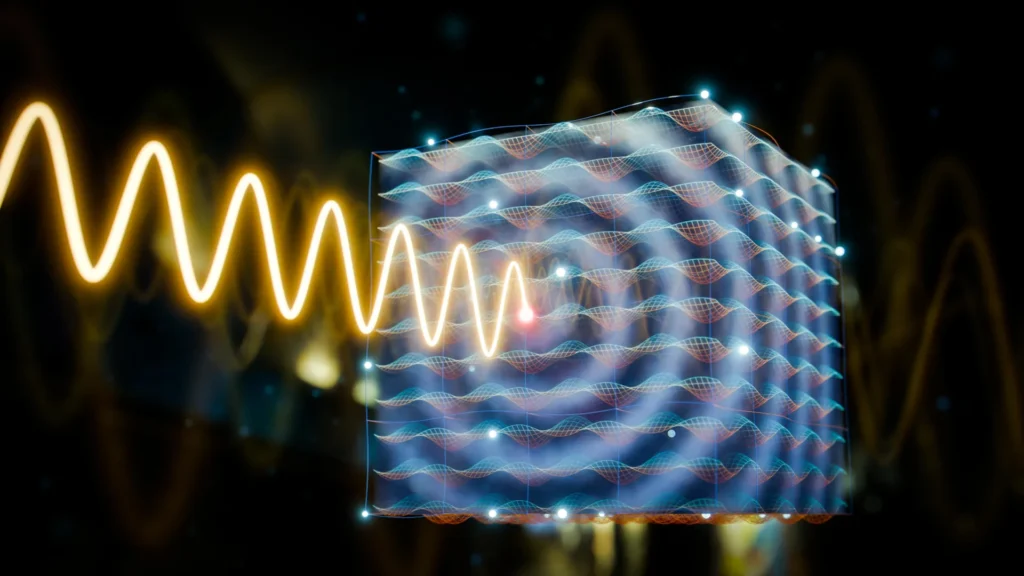
In a landmark achievement for the fields of optics and condensed matter physics, an international consortium of researchers has successfully engineered and experimentally validated the first all-optical photonic time crystal (PTC). This development, reported in the prestigious journal Nature, represents a fundamental shift in how scientists manipulate light, moving beyond static spatial structures to materials that evolve dynamically on timescales faster than a trillionth of a second. The breakthrough was the result of a collaborative effort involving the Laboratory of Irradiated Solids (LSI) at École Polytechnique, the Collège de France, and the Helmholtz-Zentrum Dresden-Rossendorf (HZDR) in Germany. By utilizing the unique capabilities of the TELBE superradiant terahertz source, the team has opened a new frontier in the "terahertz gap," a region of the electromagnetic spectrum that has long remained technologically underdeveloped but holds immense potential for the future of telecommunications, computing, and sensing.
The Evolution from Spatial to Temporal Photonics
To understand the significance of a photonic time crystal, one must first look at the history of conventional photonic crystals. Emerging in the late 1980s, photonic crystals are nanostructured materials designed with a periodic variation in their refractive index. Much like the periodic arrangement of atoms in a semiconductor crystal affects the motion of electrons, the periodic "lattice" of a photonic crystal affects the propagation of photons. By carefully engineering these spatial patterns, scientists can create "photonic bandgaps" that prevent certain wavelengths of light from passing through, allowing for the creation of highly efficient optical fibers, ultra-precise lasers, and advanced chemical sensors.
However, conventional photonic crystals are spatially fixed. Once fabricated, their optical properties are generally static. The concept of a Photonic Time Crystal (PTC) takes this principle and extends it into the fourth dimension: time. In a PTC, the refractive index or other optical properties of the material are not modulated across space, but rather modulated uniformly across the entire volume of the material at extremely high frequencies. While theoretical physicists have discussed the possibility of such materials for years, the technical challenge of changing a material’s properties rapidly enough to keep pace with the oscillations of light has remained a significant barrier—until now.
Bridging the Terahertz Gap
The research team, led by Yannis Laplace, an assistant professor at École Polytechnique, focused their efforts on the terahertz (THz) frequency range. This region sits between the frequencies used for electronic devices (like microwave ovens and radio) and those used for photonic devices (like infrared cameras and fiber optics). Terahertz radiation is notoriously difficult to generate and manipulate, leading scientists to refer to this part of the spectrum as the "terahertz gap."
"The THz range represents the frontier between electronic and photonic technologies," explains Laplace. Despite its underutilization, the terahertz range is of critical interest because it operates at frequencies roughly 1,000 times faster than those found in current high-end electronic components. Achieving control over light at these speeds could facilitate a transition from electronic data processing to all-optical processing, which would be significantly faster and more energy-efficient. The creation of a PTC in this range is seen as a vital step toward closing this technological gap and integrating the speed of photonics with the control of electronics.
Experimental Architecture: Building the Metamaterial
The realization of the PTC required the construction of a sophisticated "plasmonic metamaterial." Metamaterials are artificial structures engineered to have properties not found in naturally occurring materials. In this instance, the researchers worked with the Physics of Interfaces (PICM) laboratory at Polytechnique and Thales’ Laboratoire Albert Fert to design a device capable of trapping and modulating light with extreme precision.
The device consists of a semiconductor substrate made from a specific mixture of indium and antimony. Atop this semiconductor layer, the team deposited micrometer-scale gold structures in a "crenelated" or notched pattern. These gold structures act as tiny resonators or cavities. When terahertz light enters the device, it becomes confined between the gold patterns and the semiconductor surface.
The key to the "time crystal" behavior lies in the interaction between the light and the electrons at the semiconductor’s surface. When the semiconductor is excited by an external source, it generates "surface plasmons"—collective oscillations of electrons that couple strongly with the trapped photons. By modulating the state of the semiconductor, the researchers found they could change the reflectivity and resonance of the entire system on a picosecond (one-trillionth of a second) timescale. This rapid, periodic modulation of optical properties is the defining characteristic of a photonic time crystal.
The Role of the TELBE Facility and Superradiant Pulses
The experimental validation of the PTC would have been impossible without the infrastructure at the Helmholtz-Zentrum Dresden-Rossendorf (HZDR). The researchers utilized the TELBE facility, a unique superradiant terahertz source powered by the ELBE linear accelerator. TELBE is capable of producing intense, phase-stable pulses of terahertz radiation that can be precisely tuned to specific frequencies.
During the experiment, the researchers subjected their metamaterial to these high-field pulses. The intensity of the TELBE source allowed for a "strong-field" interaction, where the material’s properties were not just slightly altered, but fundamentally transformed. The team achieved a level of modulation where the material’s reflectivity changed so drastically and so quickly that it was equivalent to an object instantaneously changing its color.
Jan-Christoph Deinert, the coordinator of the TELBE facility, emphasized the importance of this specific infrastructure. "TELBE’s unique ability to generate high-field, phase-stable terahertz pulses was critical," Deinert stated. "Without this infrastructure, achieving the coherent, ultrafast modulation needed for the PTC regime would have been impossible." The phase stability of the pulses ensured that the researchers could observe the timing of the light’s behavior with sub-picosecond accuracy, confirming that the temporal patterns were indeed periodic and sustained.
Theoretical Modeling and the Reduction of Dissipation
To interpret the complex data generated during the experiments, the team turned to Marco Schiró, a Research Scientist at the Collège de France. Schiró and his colleagues developed a theoretical framework that accurately modeled the behavior of photons within the time-varying metamaterial. This model was essential for confirming that the observed effects were truly a result of the photonic time crystal state and not merely a transient artifact of the laser pulse.
One of the most significant findings of the theoretical analysis was the impact on photon dissipation. In most optical systems, a portion of light is "lost" or dissipated as it passes through a material, often turning into heat. Schiró’s calculations revealed that by modulating the material over time, the team was able to cut photon dissipation in half. This occurs because the temporal modulation can actually "pump" energy into the system, compensating for the natural losses that occur in the metal and semiconductor layers.
"The theory not only reproduces the experiment but also provides the basis for guiding future discoveries in this system," Schiró noted. The reduction in dissipation is a crucial milestone for the development of practical devices, as it suggests that PTCs could be used to amplify light rather than just filter or guide it.
Chronology of the Discovery
The path to this discovery involved several years of incremental progress across different European institutions:
- Phase 1 (Initial Research): Early experiments at École Polytechnique explored how external stimuli like temperature and magnetic fields could influence the light-trapping capabilities of photonic crystals. While successful, these changes were too slow to create a temporal lattice.
- Phase 2 (Design and Fabrication): Collaborative efforts between Thales and PICM led to the design of the indium-antimony and gold metamaterial, specifically optimized for the terahertz range.
- Phase 3 (Experimental Execution): The team moved to the HZDR facility in Dresden to utilize the TELBE source. These experiments provided the first evidence of picosecond-scale optical modulation.
- Phase 4 (Analysis and Peer Review): The data were analyzed alongside Marco Schiró’s theoretical models throughout 2023, culminating in the peer-reviewed publication in Nature in 2024.
Future Implications: From Ultrafast Computing to New Lasers
The successful creation of an all-optical photonic time crystal has profound implications for the future of technology. The ability to manipulate light on picosecond timescales is a prerequisite for the next generation of optical computers. Unlike current computers that rely on the movement of electrons through silicon, optical computers would use photons, allowing for vastly higher processing speeds and lower power consumption.
In the realm of telecommunications, the PTC could be a "game-changer" for 6G and 7G networks. These future networks will likely operate in the terahertz range to accommodate the massive data demands of an increasingly connected world. A PTC-based component could act as an ultrafast switch or modulator, directing data traffic at speeds that current hardware cannot match.
Furthermore, the discovery points toward the creation of entirely new types of lasers. Because the temporal modulation can amplify light by reducing dissipation, researchers believe they can develop highly adaptable terahertz lasers. Such devices would be invaluable for medical imaging—where terahertz waves can "see" through materials and tissues without the ionizing radiation risks of X-rays—and for advanced chemical spectroscopy.
Tingwen Guo, a PhD student at École Polytechnique and the lead author of the study, expressed optimism about the trajectory of the research. "By extending photonic crystals from space to time, we open a new dimension for light control," Guo said. The team’s next goal is to further reduce dissipation and increase the number of photons trapped within the crystal, moving closer to a self-sustaining "lasing" state.
As the scientific community continues to explore the properties of photonic time crystals, this experiment stands as a foundational moment. It proves that time itself can be a medium for engineering the behavior of light, transforming a theoretical curiosity into a tangible tool for the technological revolution of the 21st century.